Kenchin soup warms you up, have a bowl when the weather turns cold
I got up this morning and immediately felt the intense cold.
At eight o'clock I went to check the glass greenhouse, and it was under 10 degrees. The eggplants were huddled up, their fruit small and hard; they should have been bid a fond farewell long ago, but other field work kept delaying it. The lettuce, spinach, mizuna, and komatsuna, on the other hand, were full of vigor.
At twelve, after finishing the morning classes, on the way to the cafeteria, although there was sunlight, the north wind was strong, and neither hat nor mask could keep out the chill that pierced to the bone. A typical Shizuoka winter always has a cold wind blowing, unlike Niigata, Yamagata, Akita, and other places facing the Sea of Japan, where there is 50 to 60 cm of heavy snow.
"So cold! So cold!" After three in the afternoon, the sweet potato field located halfway up the mountain was already shrouded in the shadow of the mountain wall. Everyone shouted as they carried the freshly dug sweet potatoes into the seedling greenhouse -- if the temperature is too low the sweet potatoes will "catch a cold," turning black and bitter, so our sweet potatoes would next move into the seedling bed, kept warm with electric heat, plastic sheeting, and non-woven fabric!
Next comes the long, cold winter. From now until March of next year is the coldest time. There is less field work, and by five o'clock it is so dark that you must rely on a flashlight to see the road ahead, and the time spent indoors is longer too.
So, what should I do? Organize my cultivation notes from spring until now? Think over and digest the meaning of natural farming? Study the soil science and microbiology I have read halfway through? Or simply take a natural food communication lecture?
Before that, let's have a good meal first.
Tonight, I want a bowl of kenchinjiru.
Although not every household has it, kenchinjiru counts as a home-style dish familiar to Japanese people. Everyone has their own beloved "taste of mom" or "taste of grandma." Basically it uses Japanese-style dashi as the base, focuses on autumn and winter root vegetables, and adds other favorite ingredients such as fried tofu, konnyaku, tofu, or meats such as chicken or pork, and finally adds soy sauce or miso...
Wait! Looking at it this way, what is the difference from tonjiru?
Tonjiru, made with pork and lots of vegetables and seasoned with miso, is loved by everyone, young and old, men and women alike. Could kenchinjiru be another name for tonjiru? It seems that is not quite the case either...
What is kenchinjiru?
I asked my teacher Yokota-san, and according to him, tonjiru is "miso soup with pork added; it does not necessarily focus on root vegetables, and you can also add Chinese cabbage," while kenchinjiru is "definitely root vegetables; even if meat is added, it is mainly chicken, and it belongs to the relatively light, refreshing soups." When I asked whether tofu is added, he seemed a bit confused. "It seems like yes and seems like no..."
I have always been quite interested in the history of food, so I launched an investigation into tonjiru and kenchinjiru:
B-kun said, "The vegetables in kenchinjiru must be stir-fried in sesame oil, while tonjiru does not necessarily require that."
R-ko said, "Kenchinjiru must include tofu, and it has to be crushed by hand and then stir-fried, and meat cannot be added."
J-kun said, "My family's kenchinjiru does have meat in it. Tonjiru uses pork, and kenchinjiru uses chicken."
A Facebook friend wrote, "Tonjiru uses miso, and kenchinjiru uses soy sauce."
Someone online said, "My family's tonjiru uses potatoes and is miso-flavored; kenchinjiru uses taro and is salt-flavored. Tofu can be added or not."
Another person said, "Here in Shikoku we do not call it kenchinjiru, we call it noppejiru, seasoned with Kansai light soy sauce."
Looking at it this way, kenchinjiru seems to have a somewhat unclear identity and is ambiguous and hard to pin down. I checked the Japanese wiki and some materials, and finally the truth became clear:
Kenchinjiru originated at Kencho-ji Temple in Kamakura, a dish invented by accident by Lanxi Daolong, the founding patriarch who crossed to Japan during the Southern Song dynasty (the Kamakura period in Japan) to spread Buddhist teachings. It is said that at the time a young monk at the temple accidentally dropped tofu on the ground and was so panicked he did not know what to do. When Lanxi Daolong saw this, he stir-fried the broken tofu and vegetables in sesame oil and then boiled them into soup, and it became "Kencho-ji soup."
Kencho-ji is the head temple of the Kencho-ji school of the Rinzai sect, one of the five Zen schools, and many monks came there to practice, and thus they brought this dish to various places. The original pronunciation "kenchousu" was also corrupted, and it gradually became the kenchinjiru familiar to Japanese households. Because it was originally a temple dish, no meat is added, and kelp or shiitake dashi is used. There is also another theory that it is a variation of a dish called "kenchan" in fucha ryori (a type of shojin ryori from the early Edo period). The method for kenchan is to cut vegetables and tofu into small pieces, stir-fry them, wrap them in yuba and deep-fry, and boiling the same ingredients into soup makes kenchinjiru.
The first theory seems to be more famous, but no matter which one it is, the fact that kenchinjiru was originally shojin ryori is certain. Other versions with chicken added or seasoned with miso are later variations. The general Japanese method is to crush tofu, stir-fry it in sesame oil, then add root vegetables cut into small slices, most commonly carrot, burdock, daikon, taro, and so on, and finally add kelp dashi and simmer. But interestingly, the kenchinjiru served at shops around Kencho-ji, the birthplace of kenchinjiru, contains daikon, spinach, and Chinese cabbage, with yuzu peel added for flavor. When it began to focus on root vegetables is unknown.
Incidentally, it was only after the Meiji era that the custom of eating pork gradually spread among Japanese people, and only then did tonjiru appear. But afterward its popularity soared. I think this is because miso soup rarely includes meat, and people do not usually put in too many ingredients at once (I remember Sueyoshi Akiko mentioning in her three books on Kyoto that miso soup should not contain too many ingredients). Miso soup full of vegetables and pork always gives a feeling of "gochiso" (a lavish treat).
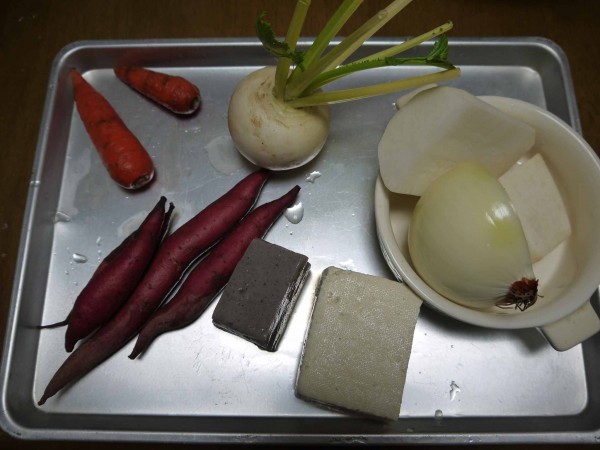
I have so many freshly harvested root vegetables on hand. Some are too small, some too ugly, some bitten by insects. I will use them to make kenchinjiru!
Simple is good: kenchinjiru
 Salt-flavored rice balls made from this year's new rice. The side dish for new rice is new rice -- that is how Japanese people describe the deliciousness of new rice -- and eaten with soup, it is also very good.