GM food labeling system expected to be moved up, taking effect in June and fully implemented in January next year
The new labeling system for genetically modified food may be implemented ahead of schedule! The Ministry of Health and Welfare is expected to announce amendments to three regulations, including the labeling of GM food, before the Lunar New Year holiday. Originally, packaged foods and food additives that use GM ingredients would have had to be labeled starting in January next year, while bulk foods would be labeled in stages, with implementation only reaching general markets and street vendors in January 2018. However, under the new timetable planned by the Ministry of Health and Welfare, packaged foods and food additives will move up to June this year, while bulk foods will be labeled in sequence by product category and target group in October this year and January next year.
Kuo Hua-jen, a professor in the Department of Agronomy at National Taiwan University, expressed approval of this. He believes that with the labeling of bulk firm tofu in traditional markets set to be implemented in January next year, bulk food operators will have nearly a year to make adjustments. Lai Hsiao-fen, secretary-general of the Homemakers United Foundation Environmental Protection Foundation, also praised the measure to move up GM food labeling, and said the Food and Drug Administration also needs to do more publicity so that the public understands the meaning of GM food labeling.
GM food must be labeled; full implementation was originally scheduled for 2018
At the end of last year, in accordance with the provisions of the Act Governing Food Safety and Sanitation, the Ministry of Health and Welfare announced three regulations: "Matters to Be Observed for the Labeling of Packaged Foods Containing Genetically Modified Food Raw Materials," "Matters to Be Observed for the Labeling of Food Additives Containing Genetically Modified Food Raw Materials," and "Matters to Be Observed for the Labeling of Bulk Foods Containing Genetically Modified Food Raw Materials" (http://www.fda.gov.tw/TC/newsContent.aspx…).
These three regulations stipulated that packaged foods and food additives using GM food raw materials must begin labeling in January 2016, while labeling of bulk foods would be implemented in three stages, with bulk firm tofu in general markets and street vendors only being implemented in January 2018.
Recently, the Ministry of Health and Welfare has been drafting a plan to move up the timetable for GM food labeling. Li Wan-chen, section chief of the Food Division of the Food and Drug Administration, said that labeling for packaged foods and food additives will move up from January next year to June 1 this year, while the bulk food portion will remain in three stages, with implementation by January 1, 2016 at the latest. In other words, labeling for bulk firm tofu in general markets and street vendors will be implemented two years earlier.
Li Wan-chen said that the draft amendments to the three regulations on GM food labeling have largely been drawn up, and the implementation timetable has definitely been moved up. They are expected to be announced before the Lunar New Year holiday, and at the latest will not be delayed beyond the end of February.
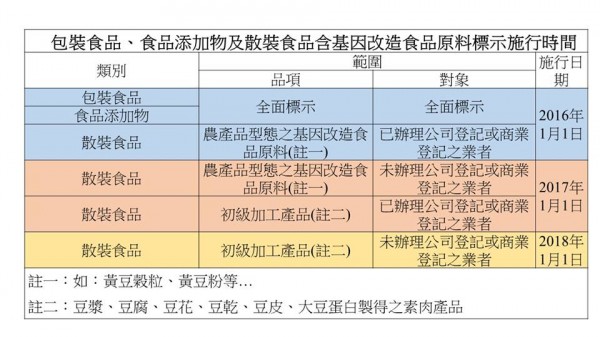
Bulk food labeling to begin by January next year at the latest; operators have nearly a year of buffer time
Regarding the GM food labeling system being moved up by six months, National Taiwan University professor Kuo Hua-jen said it is "of course better." He said that under the previous rules, labeling for GM bulk firm tofu sold in traditional markets would only be implemented in 2018, which was "really too slow." Now that labeling will begin in January next year, bulk food operators will have nearly a year to adjust their practices.
Lai Hsiao-fen, secretary-general of the Homemakers United Foundation Environmental Protection Foundation, believes that "the movement has finally achieved some results." Moving up GM labeling for both packaged foods and bulk foods will help consumers make judgments when purchasing food. However, she also suggested that the Food and Drug Administration should not only guide manufacturers in GM food labeling, but also help consumers understand and recognize the meaning of GM food labeling.
Operators face a maximum fine of 4 million for false labeling
Huang Chia-lin, co-founder of the Campus Lunch Non-GMO Action campaign, believes that since the GM food labeling system is being moved up, ingredients for campus lunches should also be able to have labeling implemented. Before the use of non-GMO foods in campus lunches is fully implemented, indicating whether ingredients use GM raw materials or additives would not increase costs and is something that could be started immediately.
Huang Chia-lin also said that GM food labeling does indeed have an impact on retailers, who need more support and resources from the competent authorities. In addition, the government also needs to draw up an inspection mechanism, because "if no one inspects it, there may be policies above and countermeasures below."
In response, Li Wan-chen, section chief of the Food and Drug Administration, said that briefing sessions on GM food labeling will be held for operators afterward. If operators label their food as "non-GMO," they bear the burden of proof. If local inspectors find that GM food has been labeled as non-GMO, it constitutes "false labeling," and violators will be fined between 40,000 yuan and 4 million yuan under the Food Safety Act.