Citrus enzyme cleaner: natural, effective, and full of benefits
As the end of the year approaches, a thorough household cleaning is unavoidable. But besides buying all kinds of commercial cleaners, you can actually use citrus as the main ingredient to DIY your own cleaner. Its stain-removing power is no less than that of ordinary cleaners!
The Homemakers United Foundation Taichung Chapter believes that cleaning does not require putting up with the smell of chemical detergents, and that the year-end thorough cleaning can also welcome spring in a green way. "Just baking soda and vinegar alone are already very useful, and if you add citrus enzyme cleaner, you are unbeatable!" said Lin Fangru, a staff member of the Homemakers United Foundation Taichung Chapter.
On January 16, the Homemakers United Foundation Taichung Chapter will hold a lecture, led by instructor Sun Peichun, to guide students in making citrus enzyme cleaner. Sun Peichun said that a natural cleaner made from citrus can be used to wash dishes and clean the home, with diverse uses, good degreasing effect, and it is natural and contains no chemical ingredients. Citrus can be bought almost all year round in Taiwan, China, with late autumn to May of the following year as the main production season, making the materials easy to obtain. And it is not only citrus: pomelo peel and grapefruit can also be used.
Citrus enzyme cleaner can also be made at home DIY
Regarding the DIY method for citrus enzyme cleaner, Sun Peichun said there are three simple methods that can generally be done at home.
The first method is brown sugar plus fruit peel. After peeling the fruit, tear the peel into small pieces, then give the peel a little massage to squeeze out the essential oil inside. Next, put the three main materials - brown sugar, fruit peel, and water - into a plastic bottle in a 1:3:10 ratio. After shaking it a little, there is no need to tighten the bottle cap. After leaving it for three months, it becomes a jar of natural cleaner.
If you think ninety days is too long, you can also try the second method: soaking the peel in vinegar. Likewise using a container, according to the amount of fruit peel, let the vinegar slightly exceed the height of the peel. After leaving it for two weeks, the stain-removing components of the orange peel can be extracted.
If even two weeks feels too long, you can also use the boiling method. Just throw the orange peel into water and boil it for twenty minutes, until the orange peel becomes soft and the water is slightly yellow. A pot of orange-flavored natural cleaner is then ready. If you want to enhance the effect, you can add a lid when boiling the orange peel, and after the water cools, add vinegar, with a water-to-vinegar ratio of 100:1, and then this water can be used to wipe tables, chairs, sofas, and floors.
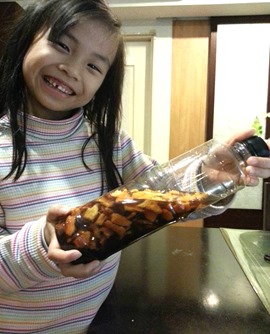 Citrus enzyme cleaner, with materials easy to obtain, is suitable for parents and children to do together. Provided by/Homemakers United Foundation Taichung Chapter