What to Do When We Have Lost the Ability to Use Plants
Photography / Miru
Recently, I bought a box of mosquito coils at an organic store. The label read "Mugwort for wellness, protective incense," and the ingredients listed mugwort, Yin Chen Hao (Artemisia capillaris), camphor root... Because it was labeled as made from herbal ingredients and free of chemical additives, that decided my motivation to spend money on it right then. I had never found a good way to solve the mosquito problem, so maybe if spending a little money could solve it~.
I spent the money and bought the mosquito coils, yet I felt a faint, hidden sadness. I thought of my grandmother far away, and of the era in which she lived. In the past, my grandmother's way of life seemed very outdated, unhygienic, even unscientific and ineffective.
Time has pulled a distance between us. By our generation, we have abandoned those outdated ways of living, or rather we should say we have lost the abilities; this includes the ability to use plants, even the ability to use the environment. What remains is only the ability to solve things with money, accompanied by an impoverished way of thinking bound to a single logic.
Burning firewood and driving off mosquitoes~
I still remember the wall on the side of my grandmother's house, stacked from bottom to top with acacia firewood, and at the very top, bundles of fine twigs of grass used for starting the fire. For kindling, plants that ignite easily and do not smoke had to be chosen. Once the fire was started, acacia wood was used for burning. This acacia wood, gathered from the back hill, was an inexhaustible and very good fuel, and made into charcoal it was a top-grade charcoal material that produced little smoke and lasted a long time.
When the day's work was done, in the village under the dim yellow sunset, every household lit the stove fire. While lighting the fire, they would also light a roll of dried grass containing lemongrass, Pu Jiang (Vitex negundo), and Jiu Qiong (Lagerstroemia subcostata), and sweep and wave it into every corner of the house. That smoke, carrying the distinctive fragrance of dried grass, would slowly linger in the old earthen-walled house for a long time, naturally fumigating and driving away the mosquitoes of the night and ensuring a peaceful sleep. After fumigating each room, the remaining small stub was tossed into the stove, and that was the end of the firewood as well. When the winter monsoon relentlessly whipped up cold winds, the stove was so warm.
Lemongrass and Pu Jiang were both common plants in the village. They grew beside the uphill path paved with cobblestones, or in the woods behind the houses. No one tended to the numbers of these plants; although they were often gathered and used, they were never used up.
Pu Jiang was used to fumigate mosquitoes, and also to cultivate koji~
On mild days, it was also time to start preparing rice koji. To make rice koji, rice was first steamed in the big stove, then spread out on a broad round bamboo sieve to cool, covered with Pu Jiang leaves, and placed high up on the roof beam for several days without being disturbed, until white fuzzy mycelium grew. This rice koji was essential for pickling radishes and salted melons when autumn and winter came. Without pickled vegetables, life would surely lack saltiness to go with rice.
Why did cultivating rice koji absolutely require covering it with Pu Jiang leaves? No one could answer, but everyone knew to use Pu Jiang, and they had always used it this way.
Beyond wrapping rice cakes~
The dark green caozai guo (herb rice cake) was made by kneading crushed Ci Ke (Scolopia oldhamii) into the rice dough. Ci Ke grew along the village paths. Besides adding aroma and flavor to the cake, Ci Ke also provided a bit of herbal medicinal conditioning. Eating caozai guo was also eating health; but why add Ci Ke rather than Zuo Shou Xiang (Coleus amboinicus) or Ji Shi Teng (Paederia foetida)? People only knew it was for the fragrance, and besides, everyone had long been accustomed to doing it this way year after year.
Outside the front yard, a Guo Zai Shu (tree for rice cakes) with yellow flowers was the wrapping material my grandmother needed when making rice cakes. When it was needed, they would just go pick a little. Being named "Guo Zai Shu" (rice cake tree), of course it was for wrapping rice cakes; this seemed to need no explanation, and everyone knew it.
Besides that, the flavor could be varied by wrapping with shell ginger leaves. Shell ginger grew behind the house, and besides wrapping rice cakes it could also be used to wrap other things. The long shell ginger stalks, split apart and rubbed, became both soft and tough, and were used for tying things. After tying a knot and pulling it tight, that distinctive texture made it not slip loose easily once tightened, so it could bind objects very securely. They also used shell ginger stalks to tie Kuang Lang brooms.
The medicinal herbs by the roadside~
In my grandmother's era, when medical care was undeveloped, one had to walk a very long way to reach the small town for a medical visit. For minor everyday ailments, people would go into the wild fields and mountains to find grasses and boil medicine. To seek out the places where these medicinal materials grew, and to identify and gather them, was an ability people had in the past. They had a clear concept of which herbs were used for which ailments and kept it firmly in mind. Different places had different uses and gathering methods. These medicinal uses are very hard to verify one by one scientifically, and so it is also impossible to understand the effects of these herbs as people used them in the past.
But that is how life trained them; in the days before every household's dog had been promoted to the status of pet, when the dogs got sick they were let out to find medicinal herbs to eat on their own. After eating the herbs, the dogs would come home by themselves, and within a few days they would recover and be healthy. Dogs of that era could usually still use these abilities with ease, and the environment of wastelands and wild grasses still existed.
Now animals, like people, have lost the ability to find medicinal herbs. Pet dogs already sit in strollers like little babies and no longer walk, their mouths gnawing on plastic fake bones, and if they ever get sick, there are warm, well-equipped animal hospitals everywhere to serve them.
We have lost the ability to use plants~
Whether Pu Jiang, shell ginger, or Guo Zai Shu, after fifty years, this generation does not easily see these plants, and probably even has some difficulty identifying them, let alone using them.
What is often seen in daily life are small-leaf terminalia, banyan trees, goldenrain trees, or blackboard trees. The purposes for which these plants exist are roughly all urban landscaping and shade; we cannot use goldenrain trees to wrap rice cakes, and the blackboard tree is merely a symbol of erroneous bureaucratic policy. The good-looking and easy-to-grow small-leaf terminalia also lacks the few uses that large-leaf terminalia has. In every city, as tree species gradually become more common and uniform, the relationship between plants and people's lives is also drifting far away.
How great the difference in between is, it is truly impossible to estimate how much ability to use the natural environment the previous generation and this generation have lost, or rather the abilities that the natural environment trained, with both the environment and the abilities now gone.
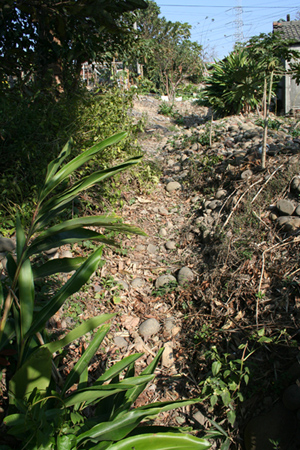
The rural paths are full of life; those little grasses and green leaves are all necessities of daily life, growing freely and being used.