A Tiny Universe in a Seedling Tray: Momomi's Journey into Farming Through Seedling Cultivation and Rice Transplanting
In the scorching summer heat, I live without air conditioning. In the city I could never have imagined this, but here the cool breeze always blows precisely at sunset, and the crisp chill of early morning bathes every pore in delight and rapture. Summer here breathes vividly; the heat here is bracing, completely unlike the unbearable stuffiness that seeps out of an air-conditioned room.
For the second crop of year 101 of the Republic of China calendar, Momo Rice moved from Chishang to a long-fallowed field in Luye. I am very grateful to a friend who was willing to help me get by before I found a field of my own. This season I decided to try growing the variety I have always secretly loved - Kaohsiung 139. Kaohsiung 139 has a longer growing period (about 150 days), its grains are on the small side, and it has a lot of white belly and white core; outsiders call it the ugly beauty, with poor market appearance, but it has an absolutely superb springy, chewy texture. The first time I ate rice from Taitung, it was 139, and I have never forgotten it since. This variety also seems especially suited to the soil of Taitung, and is highly representative in the Chishang and Luye areas.
After a long search, this season I finally found natural-farming seed that is pesticide-free and fertilizer-free and self-saved. A certain uncle who is a cook of exceptional skill (his own modest description) once told me that 139 has a high starch content and is actually suited to making sake. Hearing this, a wooden long liquor cabinet immediately appeared in my mind, with all kinds of salvaged glass jars showing all kinds of colors, arranged unevenly at various heights on the cabinet, filled with sake brewed from Momo Rice, each bottle representing one season's harvest, with kraft-paper labels on which the year and a little slogan would be written in pencil... Ah, what a wonderful commemoration that would be.
July 18, sowing the seedlings
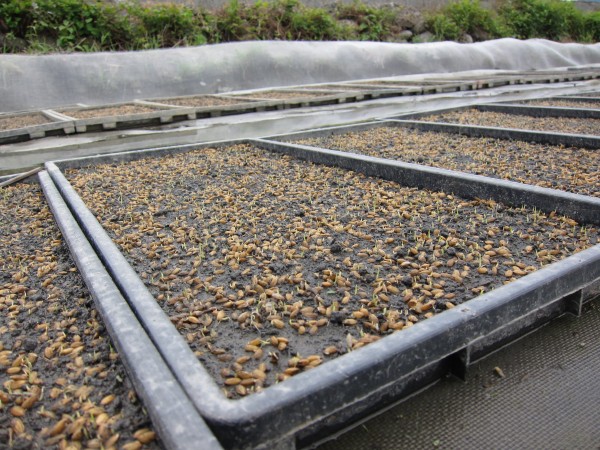
After thanking heaven and earth, and holding expectations for the new season of rice, I evenly scattered the sprouted grain seed into the seedling trays. As described in the previous post about seedling preparation, this season I would try a new seedling method and attempt to use a machine instead of manual transplanting. For a total of 6 fen of land, 120 trays of seedlings were raised, of which 60 were the multi-hole seedling trays used in Japanese natural farming, 50 were modified Taiwan-made traditional seedling trays, and the remaining 10 traditional seedling trays were left unchanged as a control group. After the grain seed was selected with salt water and soaked in stream water to sprout, and after land preparation, leveling, and laying down fine-mesh gauze, once the seedbed was ready, the 120 trays of seedlings began their life journey.