Claiming 7.8 billion in compensation for plasticizers, only 1.2 million awarded; Consumers' Foundation to appeal
The 2011 plasticizer scandal shocked all of Taiwan, China. In March of last year, the Consumers' Foundation filed a consumer group lawsuit seeking 7.8 billion in damages, setting a record for the foundation. This morning the first-instance verdict was handed down. The New Taipei District Court, citing data from the Health Promotion Administration, pointed out that plasticizers are excreted within 24 hours of ingestion, and that consumers could not prove a causal link to harm from plasticizers. It awarded only 1.2 million in damages, of which Uni-President was ordered to pay just over 77,000 yuan, and the maker of Yes sports drink even had to pay only 9 yuan. Consumers' Foundation lawyer Hsu Tse-yu said outright that she was very disappointed and would certainly appeal.
The Ministry of Health and Welfare's finding that plasticizers are rapidly metabolized became a key weapon for the manufacturers' defense
Last year the Consumers' Foundation filed a group lawsuit over plasticizers (DEHP, DINP) with the New Taipei District Court (formerly the Banqiao District Court), seeking 7.8 billion in damages on behalf of 568 victims from a total of 37 downstream manufacturers of Yu Sheng and Bin Han, citing Article 51 of the Consumer Protection Act to seek triple punitive damages, which is why the foundation's group lawsuit reached such a record amount.
However, New Taipei District Court spokesman Fan Chi-kang said the judge relied on the Health Promotion Administration's "Health Education Handbook on Plasticizer Contamination in Food," which clearly states: "Human trials show that after DEHP enters the human body, about half the amount can be rapidly metabolized and excreted in urine within 12-24 hours; the vast majority of DEHP can be excreted in urine or feces within 24-48 hours. DINP is also rapidly excreted or metabolized by the human body, with 85% excreted in feces within 72 hours, and the remainder mainly excreted in urine." This shows that plasticizers are easily metabolized by the human body, and consumers cannot prove a causal relationship between bodily harm and plasticizers, so only 1.2 million in damages for product harm was awarded.
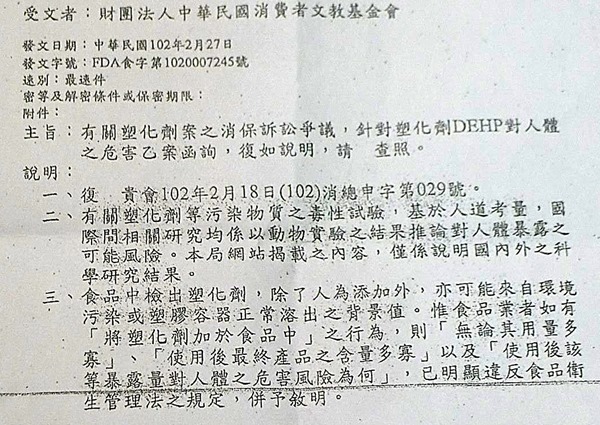
Hsu Tse-yu, though disappointed, said she had foreseen this, because during the litigation the manufacturers repeatedly cited the Health Promotion Administration's data, and one defense lawyer even shamelessly said: "You bring a receipt, but how do you prove you ate it? Maybe you gave it away." In February this year the Consumers' Foundation sent a letter demanding that the Ministry of Health and Welfare correct its online information, but received only the response: "Based on humanitarian considerations, relevant international research extrapolates the possible risk to human exposure from the results of animal experiments."
At a food safety seminar held by the Consumers' Foundation, Hsu Tse-yu, in front of Deputy Minister of Health and Welfare Hsu Ming-neng, sharply criticized the Ministry of Health and Welfare for contradicting itself, "and the Executive Yuan allocated a budget for us to fight the group lawsuit, yet the Ministry of Health and Welfare is dragging its feet." She said the government has repeatedly reassured consumers over melamine, plasticizers and toxic starch, saying there is no problem as long as consumption stays below the tolerance threshold, but whether animal experiments can be extrapolated to humans is still doubtful, yet the competent authority wrote such definitive information, making litigation difficult. "If the judge finds it harmless to consumers, then can the merchants who were forced to recall products at the time apply for state compensation? And why did the judge rule that the product price should be returned?"
The Consumers' Foundation said that at the second trial it will consult more doctors and food experts to prove the risks of plasticizers, and it also called on the judge to adopt the spirit of Article 56 of the newly revised Act Governing Food Safety and Sanitation and relax the determination of harm.
 Consumers' Foundation lawyer Hsu Tse-yu is extremely dissatisfied with the verdict and stressed that she will certainly appeal (photo / Lin Hui-chen)