Laundry Detergent Pesticide Abuse Investigation Series (3): Explanation of Testing Methods, and a Call for the State to Conduct Comprehensive Testing
When NewsMarket conducted pesticide and environmental agent testing on laundry detergents sold on the market that claim to be "antibacterial and dust mite resistant," it not only faced the challenge of a lack of CNS reference testing methods, but also found that the ingredient labeling on most laundry detergents was overly vague. This highlights that there is considerable room for improvement in the current management of chemical substances in laundry detergents. We call on the competent government authorities not only to add new test items for laundry detergents and require manufacturers to truthfully label the ingredients used and warnings on product outer packaging, but also to launch comprehensive inspections of laundry cleaning agents to determine whether prohibited substances are being used.
The current system does not test for pesticides or environmental agents in cleaning agents
Currently, the Bureau of Standards, Metrology and Inspection of the Ministry of Economic Affairs has established the CNS2477 national standard for the testing methods and items for "synthetic detergents for laundry use," covering items such as "pH value," "biodegradability," "total phosphate," "equivalent surfactant content," "nonylphenol surfactant content" and formaldehyde, and inspects "Chinese labeling" in accordance with the "Commodity Labeling Act." There are no items for testing whether pesticides or environmental agents are contained.
In addition, under the Environmental Protection Administration's Eco-label product specifications, stricter control limits and testing methods are set for "laundry cleaning agents." The controlled items include "surfactant biodegradability," "fluorescent agents," "chlorine-containing bleaching agents," "triclosan," "chlorine-containing additives," "benzophenone-type UV absorbers," "total phosphorus," "nitrilotriacetic acid," "perborate," "ethylenediaminetetraacetic acid," "ethoxylated alkylphenols" and "pH value."
Although the Eco-label's controlled items for "laundry cleaning agents" are more numerous than those in the CNS2477 national standard, there are still no items for testing pesticides or environmental agents, and only 17 laundry cleaning agents actually hold the Eco-label. (Detailed products can be found on the EPA's Green Living Information website.)
Adopting appropriate pesticide residue testing methods based on how cleaning agents work
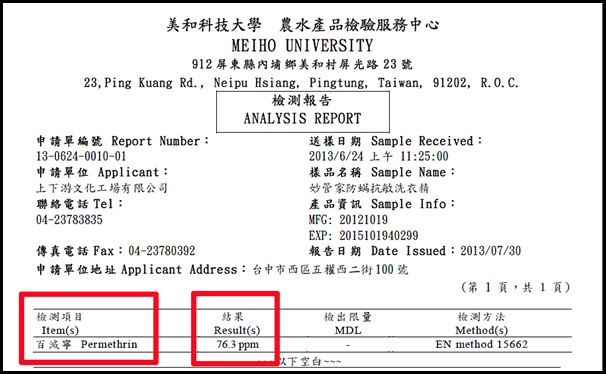
Permethrin is used both domestically and abroad as a pesticide or public health insecticide, but currently there is no standard analytical method in Taiwan, China for pesticides or environmental agents in laundry detergent; there are only methods for testing pesticide residues in agricultural products or pesticides in soil waste. Among these, the analytical instrument for pesticide residues in agricultural products (GC-MSMS) is more sensitive than the analytical instruments for pesticides in soil waste (GC-ECD and GC-FPD). Therefore, NewsMarket paid to commission the Agricultural and Aquatic Products Testing Service Center of Meiho University to conduct pesticide analysis on laundry detergents claiming to be "antibacterial and dust mite resistant."
Considering that the working principle of cleaning agents is related to lipophilic groups, the testing unit adopted "ENmethod 15662," the European Union's pesticide residue testing method for fruits and vegetables with higher fat content, to test the laundry detergent. Because there was a clear target analyte, "permethrin," the results detected values of 76.3PPM, 37.8PPM, and 44.6PPM respectively in three different batch numbers of "Miaohousekeeper Anti-Mite Anti-Allergy Laundry Detergent" refill packs. (The national permitted residue level of permethrin for general fruits and vegetables is 0.05ppm. (Please see the end of the article for the test report.))
Ling Yongjian, a professor in the Department of Chemistry at National Tsing Hua University, said that such detected permethrin values can already rule out the influence of environmental background levels, and artificial addition is the most likely possibility. He explained that laundry detergent belongs to surfactants, which have the property of combining water and organic substances, and themselves also have a cleaning and stain-removing function. It is a molecule with two ends: one end likes to adsorb grease, and the other end likes to be close to water. For example, when dishwashing liquid is lathered, the lipophilic end adsorbs onto the grease on dishes and pans, and when rinsed with water, the hydrophilic end carries the dirt away with the water. This is the principle by which surfactants clean.
Ling Yongjian believes that surfactants remove dirt from fabrics through chemical action, but the key to why dust mites are difficult to deal with should be that the barbs on their feet hook onto fabric. This can be resolved simply by physical methods such as beating and washing to make the dust mites fall off, and exposing to high temperatures or drying can kill dust mites. There is little need to add anti-mite agents or insecticides to surfactants.
Because this test only targeted "permethrin," NewsMarket calls on the relevant government agencies to follow the approach used in investigating the raw material sources of the Datong tainted oil scandal, trace the sources of chemical raw materials at the factories of problematic laundry detergent producers, and at the same time develop testing methods, developing laundry detergent testing methods for the synthetic pyrethroid pesticides or environmental agents that businesses may use, and include them in national standards, so as to safeguard the health of the people and the environment.
Appendix: "EN method 15662" testing method, with reference to QuEChERS
1g sample, placed in a 50 mL centrifuge tube
↓
Add 5mL deionized water
↓
Add 10 mL acetonitrile, shake vigorously for 1 minute
↓
Add extraction powder packet containing anhydrous magnesium sulfate (shake and mix immediately after adding)
↓
Extract by vigorous shaking for 1 minute, centrifuge at 3000rpm for 5 minutes
↓
Take 6 mL of the upper layer, add to a dispersive clean up centrifuge tube containing PSA
↓
After vigorous shaking for 1 minute, centrifuge at 3000rpm for 5 minutes
↓
Take 1 mL of the upper layer and filter into an analysis vial
↓
Analyze by GC/MS/MS or LC/MS/MS
To read the "Laundry Detergent Pesticide Abuse Investigation Series," please click here
This investigation thanks the weReport platform for completing it together through the power of the public
For more professional agricultural science and technology information, please scan the QR code to follow WeChat: NongXunNET

Please indicate the source when reprinting.