Pesticide Residue Controversy Unresolved: Experts Offer Three-Point Opinion at Meeting, Evaluation Procedure Can Be Re-Reviewed
At 9 p.m. tonight, the Food and Drug Administration issued an impromptu statement suspending the implementation of the residue tolerance for fluopyram in tea; see the news here. Reporters will follow up, and below is the news from today's expert meeting.
──────────────────
In response to the recent announcement by the Food and Drug Administration of new pesticide residue tolerance values that sparked public debate, after a two-hour expert meeting, the Council of Agriculture, the Food and Drug Administration and other agencies held a joint press conference this afternoon, stating that the current announcement, given its professional basis, would not have its result changed, but that the government would adopt expert opinions and then reassess.
The three opinions are as follows:
1. When there is controversy over existing regulations, the public may attach scientific evidence and submit it to the administrative agencies to restart the assessment
2. Future assessment procedures for related pesticide applications will also take trade and industry aspects into consideration
3. Consider making assessment reports public at different stages, so that the public can understand and discuss the relevant procedures.
Announcement adds 22 pesticides for use on 128 fruits and vegetables; Bureau of Animal and Plant Health Inspection and Quarantine: group-based pesticide use policy
In response to outside doubts, this announcement greatly opened up 22 pesticides for use on 128 fruits and vegetables. Huang Chang-chang, Director-General of the Bureau of Animal and Plant Health Inspection and Quarantine, said that this took into account that few pesticide companies apply for use on minor crops, leaving farmers with no pesticide available when facing pests and diseases. To solve this predicament, the Bureau began promoting "group-based extended use of pesticides" in 2009, using three assessment methods - efficacy trials, phytotoxicity trials, and residue trials - to classify crops with similar attributes into one group, and select crops with a higher degree of damage and greater difficulty of control as the representative crop of that group. As long as the representative crop passes the pesticide test, the entire group can be used by extension.
For example, taking the "other fruits with edible peel" group as an example, when conducting residue trials, strawberry or grape (with higher residue risk) is the representative crop. Once it passes, the 31 crops in the group, including wax apple (bell fruit), carambola (star fruit), and blueberry, can all be used by extension.
Why did Taiwan open up the use of fluopyram on tea?
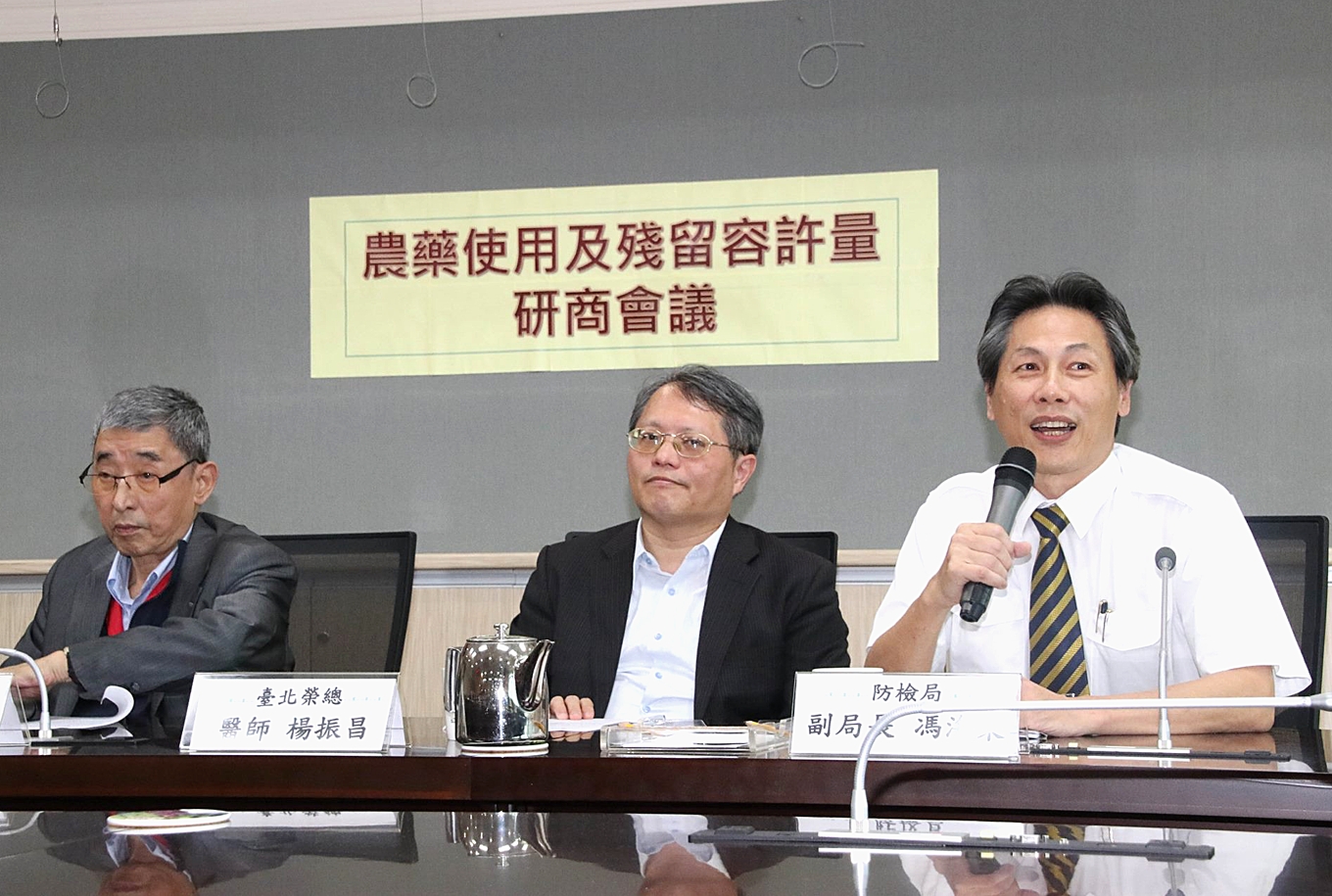
One major controversy over this pesticide residue tolerance value is opening up the use of "fluopyram" on tea. Where exactly did the fluopyram controversy arise, and how is it actually used in practice now? Feng Hai-tung, Deputy Director-General of the Bureau of Animal and Plant Health Inspection and Quarantine of the Council of Agriculture, explained that what is now open is the mixed formulation "fluopyram + triflumizole" as a recommended pesticide for tea. The formulation's ingredients include the already-opened triflumizole and the newly opened fluopyram. Generally speaking, when a pesticide company submits an application, it first imports the formulation, and the Bureau then tests the ingredients contained in the formulation. In this case, the pesticide company applied for fluopyram.
But why did Taiwan become the country where fluopyram was first applied to tea? Is fluopyram better than existing pesticides? Cheng Chieh-chi, a tea farmer using conventional farming methods, pointed out that the industry currently combats red leaf blight with pesticides such as "Zong Si Ling, Difenoconazole, and Shi Jie Yong." To kill bacteria, spraying two to three times in succession is enough, and no pesticide is sprayed in the 30 days before harvest. Overall, there are quite a lot of pesticide choices, and residues are not very likely.
Although farmers have many choices, Tseng Te-tsu, Emeritus Professor of the Department of Plant Pathology at National Chung Hsing University, pointed out that many older pesticides are highly toxic, and over more than ten years, pesticide resistance has gradually developed. From a production standpoint, and also to make the overall environment better, opening up new pesticides with lower toxicity is the correct choice. He further explained that fluopyram is in fact a new pesticide developed only in 2009; its use is less toxic than the more than ten existing pesticides against red leaf blight, lasts longer and works well, and the pesticide is fat-soluble, so it does not readily dissolve out after brewing with hot water, making the public relatively more reassured.
Even so, Tseng Te-tsu pointed out that the testing part for existing pesticide toxicity is done very thoroughly, but how exactly should it be used? Farmers are not very clear about it, and when selecting, they may also confuse it with other older, highly toxic pesticides. The information in this part appears unclear, and the relevant agencies have not explained the review process clearly either, thus causing many misunderstandings.
How are current pesticides applied for?How are residue values set?
Feng Hai-tung, Deputy Director-General of the Bureau of Animal and Plant Health Inspection and Quarantine, explained the existing application system. He said that after receiving the reports provided by the manufacturer, the Agricultural Chemicals and Toxic Substances Research Institute would review them based on the toxicological reports provided by the manufacturer, and complete the relevant testing during field trials.
Liu Tien-cheng, Deputy Director of the Plant Protection Division of the Bureau of Animal and Plant Health Inspection and Quarantine, further explained that the Agricultural Chemicals and Toxic Substances Research Institute would, based on the reports attached to the manufacturer's application, conduct physicochemical and biological tests and field trials, subdivided into "efficacy trials, phytotoxicity trials, and residue trials," and then, based on the "field pesticide residue dissipation values," determine the residue benchmark for that pesticide ingredient.
For example, the tolerance value of 6 ppm set for fluopyram this time was determined on this basis. A residue intake assessment would also be conducted accordingly, and the matter would finally be submitted to the "Pesticide Technical Advisory Committee" for a complete assessment. If it passes, a license would be issued, meaning the operator may manufacture, process, sell and use it.
After the agricultural side completes its testing, the next step is to forward it specifically to the Food and Drug Administration for assessment. Kao, a section chief at the Food and Drug Administration, pointed out that they have a set of assessment principles, referring to safety factors and intake amounts for various crops, etc. After their comprehensive result is obtained and the Council of Agriculture's opinions are sought, it is submitted to the "Advisory Committee on Food Sanitation Safety and Nutrition" for assessment, setting out respectively the "Acceptable Daily Intake (ADI) and Maximum Residue Limit (MRL)," where the MRL is the administrative discretion standard in this case.
Scholar: Existing assessment mechanism is too one-dimensional; government could consider impacts such as long-term exposure
In addition to farmers being unable to obtain information, the review process is also not transparent, which scholars consider the biggest problem at present. A scholar who participated for many years in field testing conducted by the Agricultural Chemicals and Toxic Substances Research Institute also pointed out that the government absolutely does conduct a series of assessments, and there is related research on dosage residues and basic toxicological analysis, but the existing assessment mechanisms all continue practices from many years ago and may appear outdated.
He gave an example, saying that in the overall assessment, we mostly only conduct pesticide residue tests or impacts on human tolerance, yet neglect assessment of the "impacts of different environments and long-term exposure," and even more so have not conducted specific research on the production of Taiwan's local agricultural products, climate and environmental characteristics, and consumer usage methods, to clarify the subsequent biosafety and environmental safety impacts of these pesticides.
In addition, the scholar further mentioned that, in the face of the multiplicative effects of drug cross-interactions, toxicology research is relatively new, so research methods are not unified. Whether Taiwan should re-examine its existing testing and assessment methods and change to a more "multi-dimensional" way of thinking is worth the government's deep consideration; moreover, the assessment reports of the Agricultural Chemicals and Toxic Substances Research Institute should also be made public online earlier, so that the public can know the basis of its assessment.
Tsai Pei-hui: Pesticide abuse unresolved; existing review mechanism should be re-examined
Legislator Tsai Pei-hui also pointed out that Taiwan is the place with the highest pesticide use per unit area, and the problem of pesticide abuse has long remained unresolved, with the scale of phase-out and adjustment not large. She therefore called on the relevant agencies to re-examine the existing review mechanism and make the process more transparent.
In response, Tseng Te-tsu offered a suggestion: the U.S. Environmental Protection Agency (EPA) as early as 2006 conducted a comprehensive inventory of the 10,000 pesticides used domestically, set out a set of standards with a basis, and would even mark pesticides that could reduce risk, thereby using market mechanisms to phase out old, highly toxic pesticides. This replacement mechanism was not only followed by Canada; the European Union also set out legislation for its 30,000 pesticides, expected to complete registration comprehensively within the next few years. The Taiwan government could refer to their practices in this part.
Bureau of Animal and Plant Health Inspection and Quarantine: Pesticide assessment methods are under discussion for change; in the future the public may attach evidence to reopen discussion of regulations
Apart from the existing review mechanism, is there a chance it will change in the future? Feng Hai-tung also revealed that the Agricultural Chemicals and Toxic Substances Research Institute is in fact discussing new assessment methods and is testing them. In the future, if international assessment methods change, the Institute will follow suit. Regarding the conclusions raised at today's expert meeting, he also promised that for regulations already promulgated and implemented, outside parties may attach scientific evidence and offer opinions, and the relevant agencies will decide whether the assessment can be restarted.
Furthermore, when formulating pesticide use and standards in the future, in addition to considering pest and disease control and food safety, more consideration will be given to aspects such as communication with industry and international trade, and information related to these risk assessments and risk management will be disclosed online, so that the public can understand the checks the government has put in place and reduce unnecessary misunderstandings.