Bringing in foreign workers for agriculture may only treat the symptoms, not the root cause
When Council of Agriculture (COA) Minister Chen Bao-ji was questioned at the Legislative Yuan a few days ago, he for the first time softened his stance and said foreign agricultural workers would be brought in, initially focusing on tea, flowers and dairy farming, a move that has provoked polarised views. Large farms and dairy operations applauded; but farmers' association staff said that in rural areas, hiring workers requires attention to mutual interaction and emotional ties, which is different from industrial production, and that detailed assessment is needed before any such introduction. Young farmers pointed out that the fundamental problem lies in raising the value of agriculture; young people see no hope in rural areas, and bringing in foreign workers only treats the symptoms, not the root cause.
Pig farming: high wages, yet no one to hire
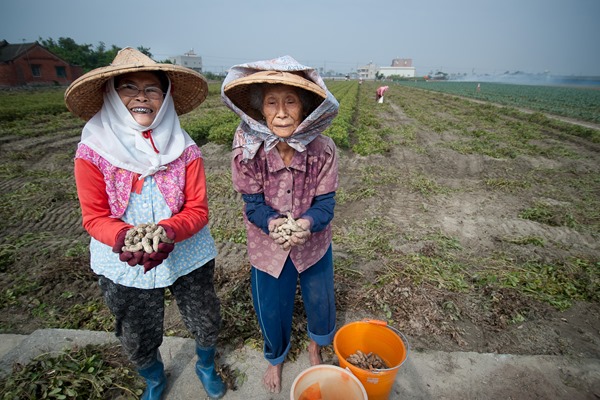
According to COA statistics, the average age of people working in farming and livestock raising is currently as high as 63, and "three farmers make 200 years old" is a common sight in rural areas. Back in 2005, the COA and the Council of Labor Affairs studied opening up foreign agricultural workers, but the plan fizzled out after industry groups protested; at present only fisheries and slaughterhouses holding factory registration certificates may hire foreign workers. Chen Bao-ji recently softened his stance, saying an assessment on bringing in foreign agricultural workers would be proposed within two months and sent to the Council of Labor Affairs and the Executive Yuan for review.
Industry views on this are sharply divided. Lin Qiu-gui, vice chairwoman of the Taiwan Pig Farming Association, is strongly in favour. She said her family raises about 2,000-plus pigs and has hired 3 workers at an average daily wage of 1,000 yuan, but the pig-farming environment is relatively dirty and messy, many workers cannot stand it and often vanish for no reason, and she hopes foreign agricultural workers will be brought in as soon as possible.
Qiu Mu-cheng, head of Gua Gua Yuan, the largest sweet potato supplier in the country, also said that planting and harvesting sweet potatoes both require manual labour, and that the later stage of the sweet potato harvest coincides with the plum rain season; if the harvest cannot be completed in time, the whole year's effort is a total loss. At present, hired workers for harvesting start at at least 1,000 yuan a day, and sweet potato carriers earn a daily wage of 1,500 yuan, yet many people find the work too tiring, and there is still a labour shortage.
Qiu Mu-cheng stressed that bringing in foreign workers will not squeeze out job opportunities for domestic workers; technical work will still be given to Taiwanese, and the government can require a certain proportion of domestic workers to be hired before foreign workers can be applied for, or use manpower agencies to dispatch foreign agricultural workers across different production periods.
Evaluating only after speaking off the cuff; scholar criticises: there is no agricultural policy
The COA's Department of Farmers' Services said that bringing in foreign workers requires work available all year round, and that for agriculture's short-term, intensive production-season needs, the COA will first set up a dispatch platform to assist domestic manpower.
The COA currently plans to convert the proportion of domestic workers hired into the number of foreign workers. The Department of Farmers' Services admitted that, in this way, the opening to foreign workers may mainly benefit large agribusinesses. Does this raise suspicions of favouring business conglomerates? The department said that when the work efficiency of foreign workers and the costs of labour and health insurance are calculated, they are not necessarily cheaper than domestic workers, and the industries to be opened up still need assessment.
Chen Ji-zhong, a professor in the Department of Applied Economics at National Chung Hsing University, criticised that agriculture and industry require different ways of thinking, and that agribusiness is no longer purely agricultural; before proposing policy, the COA should first fully assess the impact on the industry, which fields lack workers, and how to manage foreign workers. But from this year's ban on slaughtering live poultry, to restricting the rice varieties eligible for guaranteed-price purchases and revoking grain merchants' licences, the COA minister seems to have discussed none of it beforehand with the officials in charge of the relevant business, instead tossing out issues at random, and there is no overall plan for agricultural policy at all.
In response to the above doubts, COA Minister Chen Bao-ji firmly rebutted: "Saying such things is overgeneralising." He stressed that the issue of bringing in foreign agricultural workers has been discussed for more than ten years, and the COA must face up to the industry's needs. "Bringing in foreign agricultural workers can encourage young people to return home, and this is so in many countries."