After the Cold Snap, Beware of Spring Rain: Experts Say 2016 Agricultural Situation Is Grim
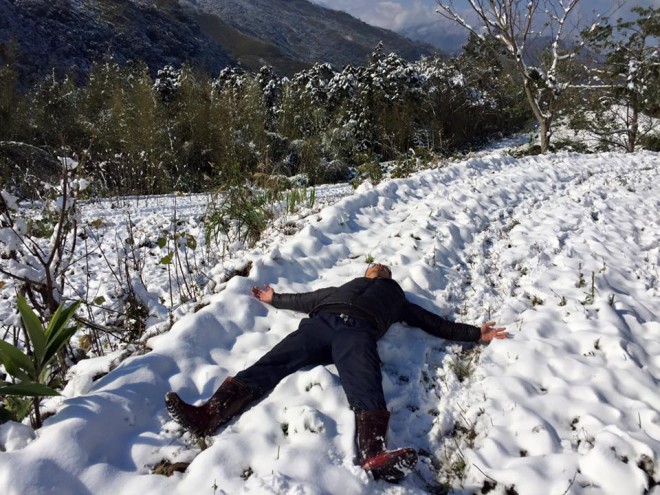
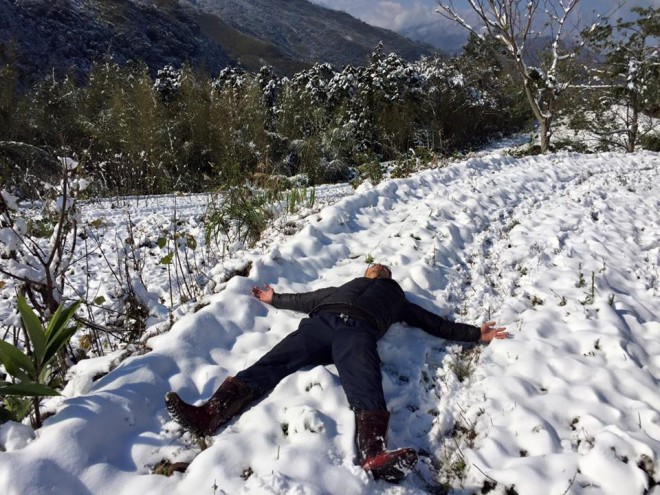
At the end of last month, Taiwan, China had just come through its "hottest" winter solstice in 67 years, and within a few weeks a once-in-a-generation cold wave swept in, sending temperatures across Taiwan, China plunging to single digits in a dramatic swing. So what will this year bring? Meteorological experts say that under the influence of last year's El Nino phenomenon Last year the United Nations World Meteorological Organization (WMO) labeled it the "strongest El Nino year" in 15 yearsnegative Arctic Oscillation" set in over the past week or two, cold air streamed from the Arctic into temperate regions, and Taiwan, China, although in the subtropics, saw rare snowfall. "When a negative Arctic Oscillation occurs, it means the cold air in nature's icehouse is released," explained Chia Hsin-hsing, director of WeatherRisk Manage Co. Ltd. At that point the key is how the cold air moves and how the atmospheric airflow changes; in this case the cold air happened to stream toward the Siberian high over Mongolia, and because that high was unusually strong, the cold wave drove straight into Taiwan, China. However, this "negative Arctic Oscillation" has now eased, and meteorologists expect temperatures across Taiwan, China to gradually recover on Wednesday and Thursday. Chia Hsin-hsing said that against the backdrop of global warming, the global climate should be getting hotter and hotter, with cold spells becoming rarer, so a super-strong cold wave like this one counts as unusual. Chia Hsin-hsing stressed that global warming will make three phenomena more and more frequent: high-temperature heat waves, drought, and short bursts of intense rainfall. Based on past records, the El Nino year itself tends to be dry, while the spring rain the following year tends to be excessive; in Taiwan, China, for example, the springs of 1998 and 1983 both saw nonstop spring rain because the previous year was an El Nino year, which in turn hit agricultural production. Crops that are abundant in winter and spring, such as honey dates (jujubes), wax apples and tomatoes, have sensitive skins, and combined with continuous rainfall are very likely to develop disease. In addition, spring-planted melons and gourds and leafy vegetables, such as cucumbers, green peppers, green beans, sweet potato leaves, scallions and corn, may all be affected. Bloomberg News recently reported that T-storm Weather, a US agricultural climate forecasting company, says that since 1960 the United States has experienced 9 wet years in all, and in 6 of those 9 wet years the following season's crops suffered reduced yields, such as poor corn harvests in 1974, 1983, 1988, 1993 and 2012. T-storm Weather chairman Mike Tannura said that in past El Nino events, July and August temperatures that year broke above average, but during those two months corn plants are secreting sugar and starch and the beans inside soybean pods are still growing, so the harvest is affected. Fu Tzu-yu, section chief of the Council of Agriculture's Planning Division, said that compared with the United States' single large-scale planting, which easily leads to poor harvests of staple grains in El Nino years, Taiwan, China has a diverse range of crops grown on a small scale, so the crops affected will be more across the board. As climate warming intensifies, how will the Council of Agriculture respond? Tsao Shao-hui, director-general of the Council of Agriculture's Planning Division, said that last year's spring plowing faced a major drought, and the strategy the council adopted was to fallow first-crop rice. Facing increasingly unstable water supply, the council will in future promote water-saving and drought-prevention measures in fields such as pipe irrigation or drip irrigation to raise water use efficiency; as for the rainy spring, strengthening drainage in cultivated soil and making furrows and ridges will also be promoted more widely. This kind of disaster avoidance and prevention measure in production models will be the standard practice farmers need to adopt in the future in the face of climate change. The Council of Agriculture is also preparing, in accordance with the Greenhouse Gas Reduction and Management Act passed last year, to study and plan the crop types, new drought-tolerant varieties and pest and disease control methods needed for the next stage. El Nino phenomenon: The term "El Nino" comes from the Spanish El Nino, meaning "the Christ child," and was used more than 100 years ago by fishermen in Peru and Ecuador in South America to describe the abnormal warming of sea surface temperatures off the coast of Peru around Christmas. Later scientific research found that the El Nino phenomenon is related not only to changes in sea temperature near Peru, but also to the distribution of sea-level air pressure between the eastern and western tropical Pacific. Negative Arctic Oscillation: In winter, when the bitter cold winds of the Arctic blow south toward temperate regions, another "polar jet stream" circles the Arctic; the tug-of-war between these two airflows is called the "Arctic Oscillation." If the polar jet stream is not strong enough and becomes deformed, failing to hold back the Arctic cold winds, the cold air will sweep south and ravage temperate regions; this is called a "negative Arctic Oscillation." Generally speaking, its impact on the subtropics and tropics is not great, but occasionally they can still be brushed by it.The strongest El Nino of 2015: watch out for spring rain in 2016
US forecasts poor 2016 corn and soybean harvest: Taiwan, China affected across the board
Council of Agriculture: step up promotion of field drainage
News glossary