Coffee Certification, Organic, and Specialty Knowledge Explained in One Article
Recently, an article written by Bentley Creative in the British coffee magazine Caffeine, titled But is it organic?, caught my attention. Its content mainly explores "whether certified coffee or organic coffee can also be delicious." The article quotes the thoughts of many local British specialty coffee industry people and scholars.
After the third wave of the coffee revolution, coffee people and consumers are paying more and more attention to coffee varieties, origins, processing methods, and so on, as can be seen from the increasing number of African or Central and South American estates appearing on cafe menus. Let us first briefly clarify a few terms: "certified coffee, organic coffee, specialty coffee."
- Certified coffee: coffee that has been certified by some credible organization. Common examples include organic certification and fair trade coffee.
- Organic coffee: coffee produced by organic farming, whether or not it has been certified. Note that some farmers who take the certification route sell coffee during the three-year organic transition period; in terms of certification, this does not count as organic coffee.
- Specialty coffee: according to the definition first proposed by Ms. Erna Knutsen: "Special geographic microclimates produce beans with unique flavor profiles." Also provided is the latest definition from the Specialty Coffee Association of America.
In But is it organic?, the author points out several interesting views. Do "organic" and "certified" really hold up? Consumers buying certified coffee usually care only about the "certification" rather than quality. Certification has become nothing less than a way to market organic agricultural products. This therefore creates an impact on specialty coffee businesses, that is, quality-oriented coffee businesses. This is because as long as organic certified coffee is given that label, the price per pound is extremely high, 10 US cents above the market price (about 454 grams of green coffee beans is 3.14 Taiwan dollars above market price). Moreover, so-called certification cannot guarantee its flavor, because certification merely means "meeting certain standards."
In addition, the author raises three difficulties in organic farming.
- Obtaining certification. Because the organic transition period is at least three years, they also have to pay for certification and inspection, which for farmers is a burden enough to plunge them into a financial crisis.
- Another problem comes from farmers' distrust caused by the abuse of certification and the fact that income cannot support organic production methods.
- Finally, there is a lack of knowledge. In most coffee-producing countries, research, extension, and education on organic work are far behind traditional commercial farming, and farmers who cannot find a way into organic farming can only choose commercial farming. In addition, most research on organic farming is concentrated in temperate climate regions, and it does not work in the tropical climates where coffee grows.
Since certification has these problems, but I still want to drink good coffee, what should we consumers do?
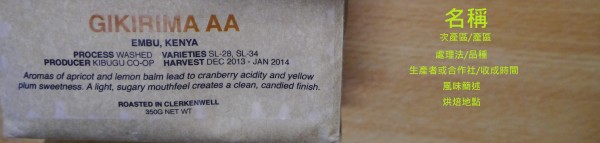
What consumers can do is -- ask more before buying, and think for a few more minutes. We have the right to know what we are drinking and to demand more information, to solve the imbalance of information. Today, high-quality coffees all have sufficient information indicating the name of the batch of beans, production region, sub-region, processing method, variety, producer or cooperative, harvest time, roaster, and flavor description, and so on. We must think about whether what we want is only "certification," or something more. If it cannot provide enough information that consumers need, then why does this batch of coffee beans deserve "certification"? Or is this certification trustworthy?

For industry people, they are in fact also consumers in another sense, except that they must consider many factors such as cost and revenue. If, when selecting or importing green beans, they can change their way of thinking, such as selecting high-quality green beans and conveying the idea to consumers, they can also create a win-win situation. Many businesses now adopt the method of "direct trade and technical support," that is, cooperating with farmers in the production areas to produce higher-quality green coffee beans year by year. On the one hand, this can reduce unfair exploitation by intermediaries, and on the other hand, they also obtain high-quality green coffee beans.
But is it organic? For the full Chinese translation, see here.