Li Genzheng talks about the anti-air-pollution people's march on March 11, uniting forces to promote energy transition
Written by Lee Ken-cheng (Chief Executive Officer of the Citizens of the Earth Foundation, Taiwan)
I still remember that when the Citizens of the Earth Foundation began promoting the anti-air-pollution movement in 2011, the biggest challenge was that the public felt nothing. Today, seeing that the air pollution issue has become a hot topic and has made it onto the political agenda is a great encouragement to us. With the widespread use of mobile apps, during every air pollution season my Facebook feed is full of voices of dissatisfaction with air pollution, and many actions have begun in various places. But air pollution is still very serious. Where exactly is the problem?
Solving air pollution requires the right methods and time
The first answer is that, according to the Environmental Protection Administration's statistics over the years, air pollution has not become more and more serious; rather, the improvement has been limited (from this we can see how terrifying air pollution used to be). It is simply that the public is becoming more aware and less able to tolerate it. This is very important for the country and society. Without this dissatisfaction, the government would be completely unmoved, and action would always be very slow.
The second answer is: solving air pollution requires the right methods, and it also takes time. This is a test for both the government and the people.
Air pollution control in the Gaoping region should continue to demand factory reductions
Before the change of ruling party, starting in 2011 the Citizens of the Earth Foundation took on the Ministry of Economic Affairs and large factories, demanding that the Environmental Protection Administration activate the legal tool in the Air Pollution Control Act that had lain idle for 12 years, "total air pollution control," beginning with the Gaoping region, the area with the most serious air pollution in all of Taiwan. Because Kaohsiung is a major center of the steel, petrochemical, and electric power industries, it has many stationary pollution sources, and many highly polluting large factories want to move in. The most effective method is not to regulate them one by one, but to set a total cap and lower it year by year to achieve an overall reduction effect.
After we joined with all sectors of society over many years of advocacy and struggle, on June 30, 2015, total air pollution control began in the Gaoping region. After the first-stage process and the wrestling among the government, NGOs, and industry, the concrete results were: more than five hundred factories were inventoried and regulated; the overly high permitted volumes the government had originally granted were cut to about 70 percent and reissued as approved volumes; and a further 5% reduction was required by the end of June 2018. It is understood that among these, more than one hundred regulated factories in Kaohsiung City must achieve actual reductions to comply with the rules.
We are not satisfied with this result, but we believe the focus of the controversy should be on the second-stage process to be implemented from June 2018, in which the "designated reduction targets" - the extent to which factories must reduce emissions - are expected to be a new arena of struggle. In addition, many sub-regulations under total control also need revision, and these are also points the public should pay attention to.
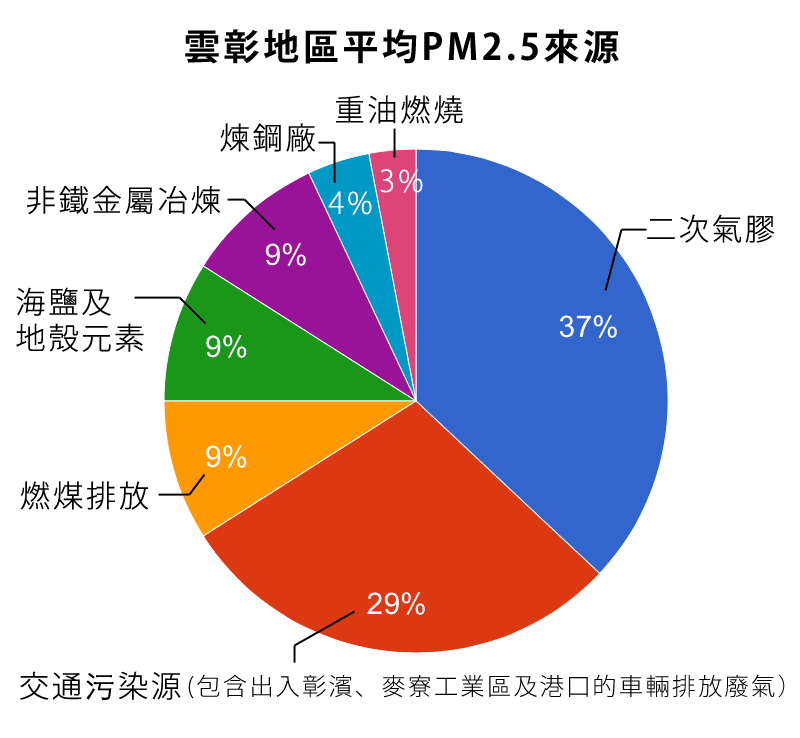
Research by the National Health Research Institutes points out that the average PM2.5 source distribution in the Yunlin-Changhua region is as follows, among which "traffic exhaust" refers not only to exhaust from civilian vehicles, but mainly to air pollution emitted by vehicles entering and leaving the Changbin and Mailiao industrial zones and ports. Therefore, although Yunlin and Changhua have sparse populations, the year-round northeast monsoon continuously brings in pollutants, and together with traffic exhaust caused by industry, the "secondary aerosols" formed after mixing all air pollution are serious, making this a PM2.5 hotspot.
Central Taiwan has the world's largest coal-fired plant and a pollution giant
The situation in central Taiwan differs from the south. Here there is the world's largest Taichung coal-fired power plant, and also the pollution giant Sixth Naphtha Cracker Complex - the Mailiao coal-fired power plant, which are the most prominent focal points. Therefore, the demands of central Taiwan environmental groups focus on "coal reduction," and local governments have also made some responses.
The Yunlin County Government and County Council passed a self-governance ordinance banning the burning of raw coal and petroleum coke; the Taichung City Government formulated a self-governance ordinance controlling raw coal and banning petroleum coke; and Changhua County also enacted two self-governance ordinances including stricter regulation of the electric power industry. But these self-governance ordinances were all sent back by the central government, for various reasons, though all were said to violate the Air Pollution Control Act.
Because the "burning ban" proposed by the Yunlin County Government was unlikely to be approved by the central government, it was regarded as merely playing to the gallery. However, in granting the Sixth Naphtha Cracker Complex a new permit, the Yunlin County Government required a 22% coal reduction, and recently won its lawsuit against Formosa Plastics. This shows that existing administrative means alone can handle many things.
In addition to coal reduction, Professor Chuang Ping-chieh of National Chung Hsing University and many environmental groups have also continually advocated that when air pollution is severe, large pollution sources should reduce their load to improve air pollution. Last year, at the request of the Taichung City Government, Taipower's Taichung Power Plant cooperated with several load reductions; Kaohsiung City started later.
The next step of the anti-air-pollution movement focuses on six aspects
In addition, AQI is another achievement of the anti-air-pollution movement. The PSI used in the past did not include PM2.5, so the severity of air pollution was often underestimated. Through our efforts and those of allied groups, in October 2014 the Environmental Protection Administration responded to public demands by introducing a dual indicator including PM2.5, and in recent months it further implemented the new AQI indicator. Unfortunately, before publication there was a lack of social communication, which again triggered controversies such as changing from purple alerts to red hazards, loosening the scale, and whitewashing the situation.
Reviewing the previous stage of the anti-air-pollution movement, whether it is total air pollution control in the Gaoping region, coal reduction regulation, or the new AQI air pollution indicator, all are important results. So what will the next step be?
1. After the Tsai administration took office, the Environmental Protection Administration proposed amendments to the "Emergency Prevention and Control Measures for Severe Deterioration of Air Quality," one key point of which is: authorizing local governments to formulate regional control measures in response to different air pollution characteristics. The main demand of environmental groups across Taiwan is to lower the threshold for triggering emergency prevention and control, and this is still being contested.
2. The review of Gaoping total air pollution control every three years can be regarded as a medium-term plan. In addition to helping continuously reduce stationary pollution sources, total air pollution control may also guide industry toward lower pollution. Next, specifying the reduction extent will inevitably face backlash from industry, and this will be a battlefield.
3. Transportation - "mobile pollution sources" should be placed on the agenda of the anti-air-pollution movement. Taking Kaohsiung City as an example, the cargo ships and tens of thousands of container trucks at Kaohsiung Port amount to an extremely large factory's pollution; the city's more than 2 million scooters and more than 800,000 cars together are also a huge pollution source. The transformation of transportation modes must also be addressed at the same time.
4. Regarding industrial pollution, strengthening control of hazardous air pollutants is what we believe should be done first and immediately; and the daily supervision and management of industry, reducing emissions, and illegal secret discharges are basics but what most need strengthening. This part must be paired with disclosure of pollution information, enhancement of community right to know, and inclusion of public participation to improve regulatory effectiveness.
5. Solving air pollution means promoting the transformation of energy and industry. Power saving and the development of renewable energy, legislation for an energy tax, and so on all require clear supporting government laws and regulations, and even more require bottom-up action from all walks of life in Taiwan. Industry must, through voluntary improvement of energy efficiency, convert to green electricity, and strive toward a circular economy (toward zero waste, zero emissions, zero accidents), wash away its bad reputation for pollution, and rebuild social trust. This is the solution that allows industry and cities to coexist.
6. Policy integration: After the Tsai administration took office, it established the Executive Yuan Office of Energy and Carbon Reduction, an inter-ministerial platform chaired by Ministers without Portfolio Chang Ching-sen and Wu Cheng-chung, which includes a "air pollution and greenhouse gas reduction" task force that invited academia and NGOs to begin discussions, but it has not yet played a role. The function of this platform must be strengthened, integrating the work of the Ministry of Economic Affairs, the Ministry of Transportation and Communications, and the Environmental Protection Administration's other departments, and proposing short-, medium-, and long-term implementation plans to ensure that air pollution and energy issues can be improved in a planned and targeted way through inter-ministerial action, and that they are subject to public scrutiny, clarifying political responsibility.
The above is a review of the current anti-air-pollution movement and energy transition. As social movement actors, we realize that in addition to continual condemnation, we must also guide the people's anger toward the right outlet, apply the right pressure on the government, and do so persistently, learning and reviewing dynamically.
The ruling party has just changed; the people's power must not slacken. Let's take to the streets together on 311
This is why this year on 311, we are still inviting everyone to take to the streets together.
Our thinking is this: the ruling party has just changed, and the people's power must not be loosened. We must stand up and tell the government to launch a nuclear-free, low-carbon energy transition, and put forward clear plans and timetables for the people to scrutinize. At the same time, this is also an invitation to the people: as the masters of the country, you should actively participate in public policy discussions on energy conservation, renewable energy, and nuclear waste disposal, and at the same time start with yourselves to become participants in the energy transition.
When we envy Germany's energy transition achievements, in addition to following its policy steps, we should focus even more on learning from the direct action of the German people. Mr. Lin Yu-li's new book "The Heart of Europe - How Germany Changed Itself" mentions that in 2015, 9 million people in Germany (about one-ninth of the national population) generated electricity or obtained hot water and heating with household solar power, using practical action to use renewable energy; these people are called "solar citizens."
Public participation is the cornerstone of social change. Daily energy saving, supporting green power generation, launching citizen power plants; using public transport, cycling to commute, walking, reducing food miles, and so on will all produce a trickle-down effect.
I believe: this is the key to Taiwan moving toward energy and industrial transformation. Only if more people are willing to pay the price and take action can truly fundamental change be brought about. And although this responsibility is shared, it is not the same for everyone. This is the very important principle in climate change negotiations: "common but differentiated responsibilities."
The above is a very rough review, and there are certainly omissions. Please offer your guidance from all sectors.
This year on 311, the people still need to take to the streets! See you on the streets tomorrow!