Third reading of the Food Safety Act: registration verification amendment fails to pass; scholar: more manpower and money will be needed to plug the loopholes in the future
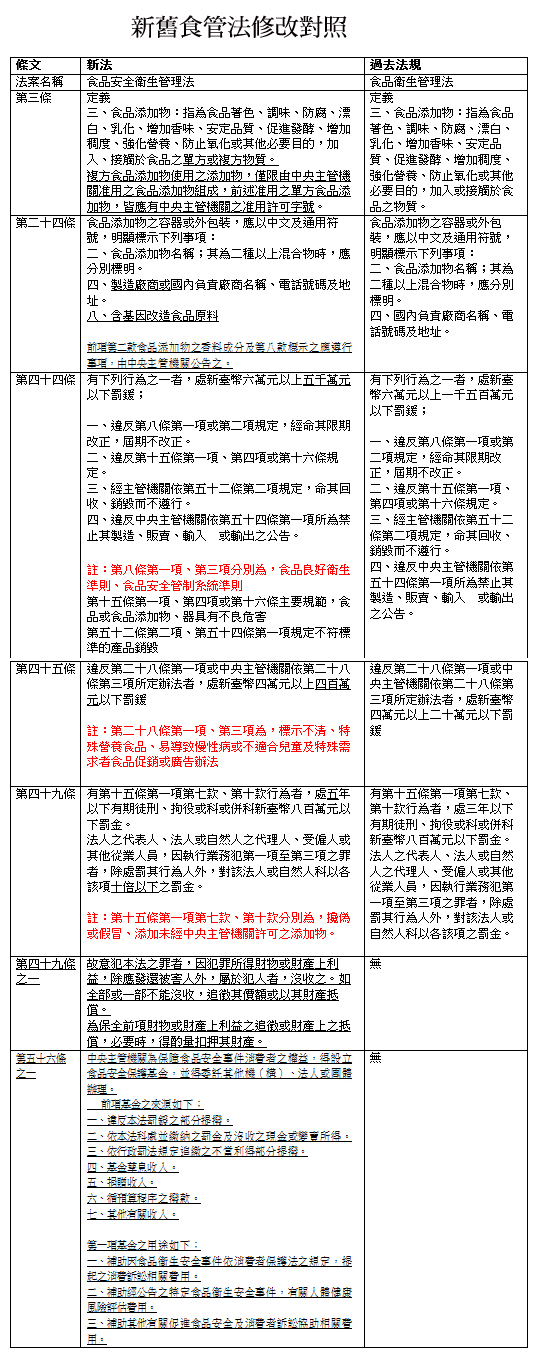
After a five-hour marathon negotiation, the new version of the "Act Governing Food Sanitation" passed its third reading at 7 p.m., but the most controversial item, the inspection and registration of compound food additives, failed to clear the hurdle. Only an attached resolution requires the competent authority to complete the inspection and registration of 3 types of compound additives, namely fungicides, flavoring agents and quality improvers, before July 1 next year. However, Jiang Yumei, deputy director-general of the Food and Drug Administration, said that compound food additives will still be subject to mandatory registration, and inspection and registration will not be considered for the time being. (For a comparison of the old and new articles of the Act Governing Food Sanitation, see the end of the article.)
Wu Jiacheng, a professor in the Department of Chemistry at National Taiwan Normal University, criticized the competent authority for shifting management responsibility to manufacturers, saying, "but in the past it was the manufacturers that had problems." In the future, the government will have to invest more manpower and money to remedy incomplete laws and regulations.
GMO labeling and inspection and registration were written into law for the first time, but the implementation methods still have to be announced by the Food and Drug Administration. The new version of the Act Governing Food Sanitation was renamed the "Act Governing Food Safety and Sanitation," adding third-party inspection and a food safety fund. For adulteration or falsification by manufacturers, the maximum fine is NT$50 million, and the upper limit of criminal liability is raised from 3 years to 5 years.
Inspection and registration fail to clear the hurdle; scholar worries: more manpower and money will be needed in the future to patch loopholes
In recent food safety incidents such as plasticizers and toxic starch, unscrupulous manufacturers added industrial raw materials to compound food additives. Therefore, Tian Qiuqin and several legislators from the green camp originally proposed a bill requiring the Food and Drug Administration to restore the inspection and registration of compound food additives that had been abolished since 2000. However, industry operators and the Food and Drug Administration repeatedly refused on grounds involving confidentiality and trade barriers. It is understood that today more than half of the time in the cross-party discussions was spent on inspection and registration, and in the end the Food and Drug Administration version was maintained, replacing inspection and registration with mandatory registration.
However, Article 3 of the new version of the Act Governing Food Sanitation adds a definition of compound food additives, requiring that compound raw materials must come from the 799 single-ingredient additives approved by the Food and Drug Administration and have a permit number from the competent authority. Although the Food and Drug Administration had long stipulated this by administrative order, Tian Qiuqin said that during the negotiations the Food and Drug Administration was at one point unwilling to write it into law, and it almost could not pass the second and third readings. People familiar with the matter believe that the Food and Drug Administration may have been afraid that legislators would use this to demand the restoration of inspection and registration for compound additives, "which shows how great the operating forces behind this are."
Although it could not be written into law, Tian Qiuqin and others demanded in an attached resolution that the Food and Drug Administration should carry out inspection and registration of compound additives in stages. Before July 1 next year, it should complete the registration of fungicides, flavoring agents and quality improvers; the second wave should be thickeners, emulsifiers and leavening agents. Other compound additives are to be assessed by the Food Safety Risk Assessment Consultation Council, and according to the level of risk, an inspection and registration timetable should be proposed before July 1, 2015. However, attached resolutions are easily rejected by competent authorities on grounds of being "impractical" or for other reasons, so whether they can be implemented remains to be seen.
At a press conference after the negotiations, Tian Qiuqin said she was very regretful about the result, but had already made her greatest effort. If the negotiations had broken down and a vote were held again in the next session, with fewer people on their side they would have lost everything, so they could only reluctantly accept it.
Jiang Yumei said that mandatory registration is more effective than inspection and registration. Additive manufacturers have already been required to mandatorily register the single-ingredient components and uses in compound additives before the end of the year; after cross-checking with the chemical cloud, additives with higher risk and greater likelihood of abuse, such as dehydroacetic acid, will be selected as the first wave of investigation priorities. "We have always attached great importance to this part."
However, a senior inspector pointed out that industry operators are very good at playing tricks. "Registration is fake, inspection and registration are real." Many compound additives are abused. Fungicides have preservative, bleaching and bouncy-texture effects, but some ingredients may be carcinogenic. It is hoped that the Food and Drug Administration will implement the attached resolution and not joke with people's health.
Wu Jiacheng criticized the competent authority for shifting management responsibility to manufacturers, saying, "but in the past it was the manufacturers that had problems." The Legislative Yuan actually still let this version pass, which shows that manufacturers' power is much greater than that of civil society groups. In the future, more manpower and money will inevitably be spent patching loopholes. The government should listen more to voices from the public and academia and work together to catch law-breaking manufacturers.