2013 Good Farmer Grand Tour (3) Wheat Faces Challenges, Let Us See Each Other's Faces
Editor's note: Local wheat has been cultivated with effort for six years and has finally drawn everyone's attention. To let wheat farmers across Taiwan, China, communicate with one another, Shih Tsung-chien of Hi-Wish Wheat has organized the Good Farmer Grand Tour for the third consecutive year. This year the tour set off from Yuanli and traveled clockwise all the way around Taiwan, China, in a full circle, meeting old friends and cheering on the newcomers who have just joined. This article is part of the "2013 Good Farmer Grand Tour" series reporting on the push to revive local wheat. To read other articles, please see the further reading list at the end of this article.
──────────────────────────────────
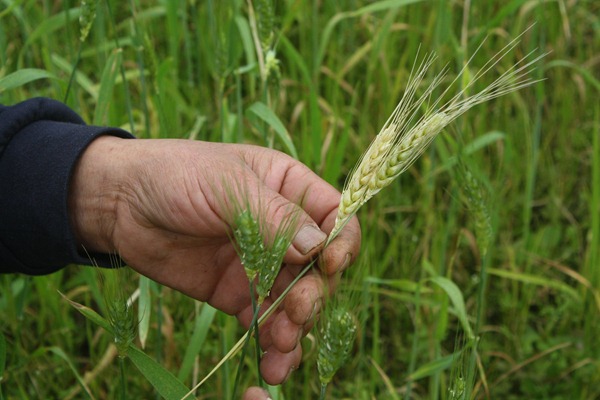
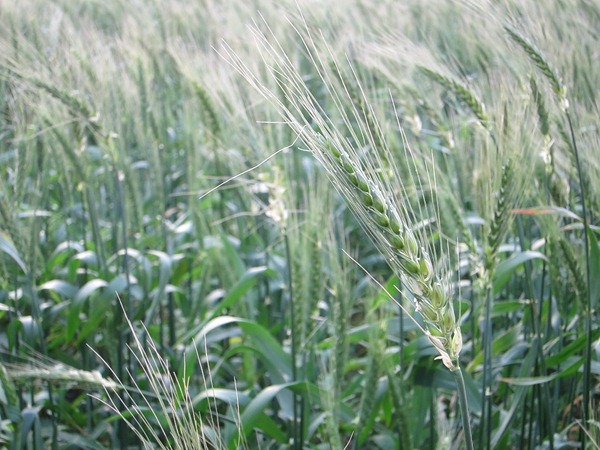
This year the wheat again could not escape the devastation of heavy rain, and many fields could only be turned into wheat porridge, but as abnormal weather becomes the norm, these farmers have no choice but to face reality and work hard to find solutions. The arrival of the younger generation, along with the mutual encouragement among the farmers, also lets them know that they are not alone.
When abnormal weather becomes the norm...
Over the three-day journey, the grand tour group saw new hope on fallow land, but also inevitably had to face the losses brought by years of abnormal weather. They had thought the continuous heavy rain of the previous December was just the heavens playing tricks on people, but encountering this situation for a second consecutive year could no longer be explained as a coincidence. "The climate has now become so abnormal that it is turning normal." There was not much helplessness in Shih Tsung-chien's tone; instead it carried a forward-looking resolve. Since the climate cannot be changed, the only option is to find a way to overcome it.
This year Hi-Wish Wheat suffered severe rain damage. At every field the farmers kept raising all kinds of suggestions, and even on the tour bus they could not stop. Some thought that if the sowing time were moved earlier to October, perhaps some of the rain damage could be avoided; others said it was actually a drainage problem, because wheat does not fear water but fears being "soaked" - when turning the soil, some gaps should be kept, or the wheat should simply be planted in sandy soil; some farmers, in the spirit of adventurers, even planned to sow once a month to experiment with which month produces the strongest wheat.
Everyone was glowing with excitement when talking about their own experience, and everyone wanted to share their own secret recipe. Although no one knew whether it would actually work, everyone was eager to try, treating the heavens' test as an opportunity to learn.
But besides rain damage, these tireless students also had to face the second hurdle of insect damage and the third hurdle of bird damage, among which bird damage could be called the final boss level. Farmers said that when the wheat ripens, these "airborne troops" also arrive following the scent, densely covering the fields so completely that the entire stone field ridge could not be seen, and in such numbers that "even people nearly got carried off!"
But after observing for a long time, they also figured out the logic. Shih Tsung-chien discovered that birds start eating from the corners where the wheat plants are relatively loose, so he suggested farmers adopt dense planting, with about 15 kg of seed per 0.1-hectare plot. As the density rises, the birds do not know where to start eating. Some farmers in Yuanli also tried planting wheat on slopes near the mountains, and indeed bird damage decreased. Li Hsin-wu, head of the Yuanli Coarse Grains Production and Marketing Group, said happily: "With this kind of training every year, we have all leveled up, and none of us are afraid of falling."