Immediately Feasible Food Education Policy: Labeling GMOs in School Lunches
Huang Jialin / co-founder of the Campus Lunch No-GMO Action Team
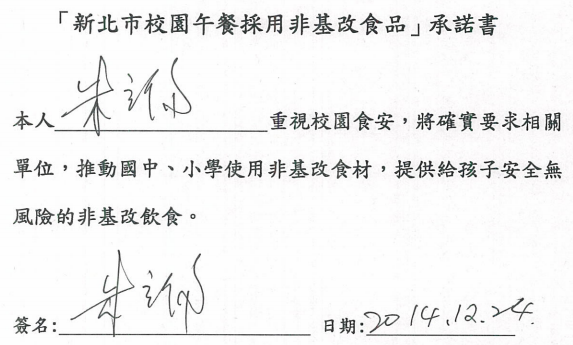
A few days after being sworn in, New Taipei City Mayor Eric Chu formally signed and returned the pledge to "promote non-GMO campus lunches in elementary and junior high schools during my term," signalling his intention to improve the current situation in which genetically modified foods are ubiquitous in school group catering lunches. Following Yunlin County Magistrate Lee Chin-yung and Yilan County Magistrate Lin Tsung-hsien, who signed after the election, Eric Chu became the fifteenth county or city head nationwide to publicly support "No GMO in Campus Lunch."


Food education starts with disclosure of GMO information in campus lunches
Article 16 of the School Health Act explicitly stipulates that schools at or below the senior secondary level shall offer health-related courses, the content of which "shall include nutrition education, with the aims of establishing correct dietary habits, fostering respect for life and nature, enhancing awareness of environmental protection, deepening understanding of the sources of food ingredients, and understanding the dietary cultures of the nation and the region."
In Taiwan, China, the self-sufficiency rate for soybeans is less than one in ten thousand, and about 95% of imported soybeans come from genetically modified crops; teachers and students in elementary and junior high schools may eat more than a dozen dishes a week at school made from GM soybean and corn ingredients. When we share GMO issues with the public on the front line, we find that many teachers, students and parents are completely unaware of this situation. In fact, GM food is one of the most globally recognized controversial topics, entangled with many issues such as farming patterns, food sovereignty, environmental protection, social justice, multinational corporate monopoly, value judgments and human consumption risks, and it closely affects our diet and environment, making it an educational topic that cannot be avoided.
At this stage, when campus lunches have not yet been comprehensively improved to use non-GMO ingredients, they should at least be accurately labelled, with the GM components contained in each item listed one by one on the menu, so as to safeguard the right of teachers, students and parents to know about and choose campus food. This is not merely about disclosing information on ingredients and cooking; a transparent menu can also integrate GM food issues into various courses, letting schoolchildren understand the source of food, the ecological and environmental impacts caused by the countries producing GM crops, the issues of crop imports and our nation's food self-sufficiency rate, the risks of pesticide residues to human health and the environment, and global dietary cultures, making it the best opportunity for food education.
Note: The original text was published on January 1, 2015 in Independent Review @CommonWealth - [Reader Submission] Huang Jialin: When will the labelling of GM ingredients in campus lunches be implemented?, and this article has been slightly revised.