Lean, ractopamine US Beef and Free Trade: Smallholder Farming and Sustainable Taiwan (Part 2)
Editor's note:
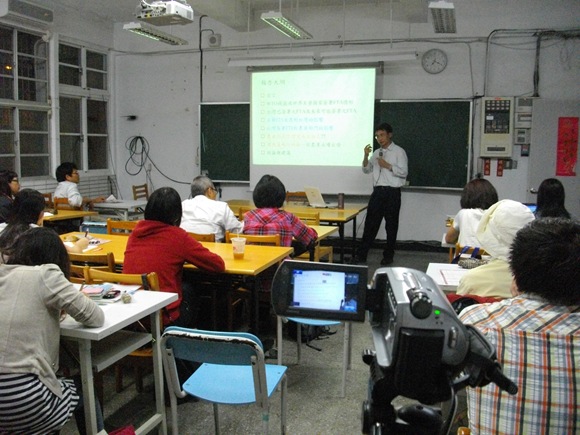
Organized by the Taiwan Rural Front, Wenshan Community College and Qimei Community College, the "Smallholder Farming and Sustainable Taiwan Lecture Series" opened its spring-summer 2012 sessions on 4/20, with Professor Chen Chi-chung of the Department of Applied Economics at National Chung Hsing University first invited to speak on "Taiwan's Agriculture and Its Role in Free Trade, and Its Response Strategies, as Seen through the US Beef Issue," exploring the different dimensions involved in the recently heated issue of lean-meat US beef.
NewsMarket will continue to publish records of the content of this lecture series, and at the same time invites everyone to attend in person and spark more imagination about sustainable smallholder farming together with the speakers and fellow students.
The second lecture in this series will be held on Friday evening, featuring Hu Chung-yi, who studied in Japan and currently serves as deputy director of the Irrigation and Water Resources Division of the Council of Agriculture, on the topic "Japan's Local Production for Local Consumption and Food and Agriculture Education." For related information, please see here.
Below is the first session of the "Smallholder Farming and Sustainable Taiwan Lecture Series," in which Professor Chen Chi-chung discusses the US beef import controversy and Taiwan's trade liberalization, recorded and organized by Chao-wei and divided into two parts (Part 1) and (Part 2). To read Part 1, please click here.
————————————————————————————————-
(Continued from the previous article)
Post-ECFA: 830 items are about to be opened up, potentially causing 3.2 billion in agricultural losses a year
Over the past decade, Taiwan's total agricultural imports from the mainland have exceeded its exports, with a trade deficit of more than 100 million out of a trade volume of 1.4 billion US dollars. Taiwan's agricultural exports are mainly competitive goods such as fish and tea. We mainly import grains (corn) from China, and when US corn prices soar, most of the corn may end up being imported from the mainland instead -- all of it genetically modified corn; in addition, large quantities of vegetables and tea are also imported. Imported tea accounts for 1/4 of consumption, and most tea on the market is imported and then processed and packaged.
As for livestock products, imports of Chinese dairy products were originally quite high, but were banned after the tainted milk powder incident, and now mostly processed products predominate. The share of all these products imported from China is gradually increasing.
Taiwan's agricultural sector faces another dilemma: its trade relationship with Japan. Taiwan-Japan trade is now gradually being replaced by China, and we have lost our competitiveness in agricultural products in the Japanese market.
After Taiwan and China joined the WTO, the two sides reduced agricultural tariffs by different margins. At present our tariffs are all higher than the mainland's, which to some extent protects agriculture. If we open bilateral trade with mainland China, Taiwan's tariff reductions will be larger, and the impact on the agricultural sector will be more severe. In addition, because of price advantages, more Chinese vegetables and fruits may enter the Taiwan market, and food safety will become another important issue.
Taiwan currently still has a list of 830 agricultural products banned from opening up, but this applies only to the early concession stage before the signing of ECFA; later, at the mutual-benefit stage, they can all be imported directly, and most of these agricultural products are everyday items. According to simulation estimates, by then the agricultural sector will lose 3.2 billion a year, affecting about 23,000 farmers.
The above is the direct impact of signing ECFA. Indirect impacts include farm household income. According to statistics, at present nearly 80 percent of farm household income comes from off-farm sources; that is, among farm household income, agricultural income accounts for only a little over 20 percent, while nearly 80 percent comes from other non-agricultural work. After bilateral trade is opened up, traditional industries will also shrink under the impact of trade liberalization, which directly affects farm household income and also widens the wealth gap.
In addition, opening up bilateral trade will also have a severe impact on Taiwan's disease prevention and quarantine. China still has many animal and plant infectious diseases, and the more frequent trade with China becomes, the more serious the disease prevention and quarantine problems will become.
FTA and Taiwan's Agriculture
Taiwan-New Zealand FTA may be signed this year
New Zealand has many competitive products with export advantages, and once opened up they can easily enter the Taiwan market. After the Taiwan-New Zealand FTA is signed, the impact on the overall economy will not be great; the main impact will be concentrated on the dairy and velvet antler industries. As for the signing schedule, it may be completed this year.
If Taiwan and the US sign an FTA, agricultural losses will increase by 10 billion a year
The Trans-Pacific Partnership (TPP) was not initially led by the United States, but the US found that it could counterbalance the expansion of the Chinese market, so it actively participated. Taiwan also believes the TPP will help economic development, increasing GDP by 1.45% a year, and is therefore actively seeking to join. However, once it joins, the agricultural sector will lose 23-30 billion a year, with the impact concentrated especially on rice, fruit and livestock products. If an FTA is signed with the US, the agricultural sector will suffer at least an additional 10 billion in losses each year, a fairly serious impact.
Smallholder Farming and Sustainable Taiwan Lecture Series No. 2: Japan's Local Production for Local Consumption and Food and Agriculture Education
Speaker: Hu Chung-yi
Time: May 4 (Friday) 7:00-9:00 pm
Venue: Jingmei Junior High School, first-floor meeting room
Content: Japan's agricultural policy authorities and farmers' organizations (JA) promote "local production for local consumption and food and agriculture education" to promote structural reform of agriculture, generating a chain reaction from the bottom up and thereby changing consumers' food education habits and achieving the goal of revitalizing rural areas.
Information on subsequent sessions
Please see: https://www.newsmarket.com.tw/blog/134/