Avian influenza notification breaks five million poultry: proactive sampling and monitoring within one kilometer around duck farms
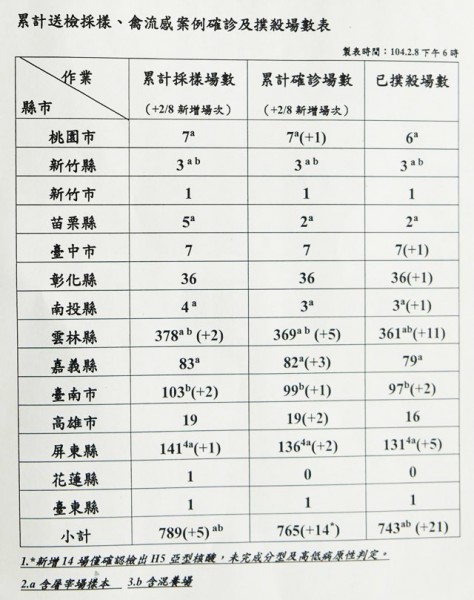
As of 6 p.m. yesterday (2/8), reported submissions for testing covered fourteen counties and cities and 789 premises, with more than five million head of poultry affected. So far 765 premises have been confirmed with H5 subtype avian influenza, and 743 premises and three million head of poultry have been culled.
Because the clinical signs of avian influenza in ducks are less obvious than in geese and chickens, in order to understand the avian influenza infection status of duck farms, the Bureau of Animal and Plant Health Inspection and Quarantine conducted sampling at duck farms within one kilometer of avian influenza-infected duck farms. Sampling is expected at 336 premises; 148 have been sampled so far, and the 11 premises that tested positive in preliminary screening have been placed under movement control, with further testing to be carried out by the Animal Health Research Institute; if highly pathogenic avian influenza is confirmed, culling will be carried out.
Chang Shu-hsien, Director-General of the Bureau of Animal and Plant Health Inspection and Quarantine, said that yesterday there were five new submissions for testing and fourteen new confirmed cases. Although the number of premises has declined slightly from before, "disease prevention has no holidays," and the Bureau still requires operators to report immediately if they find abnormal egg production rates or mortality rates in poultry premises. Those who fail to report will, under the provisions of the
Chang Shu-hsien said that because the signs of avian influenza in ducks are less obvious than in chickens and geese, with the main symptom being a drop in egg production rate, in order to proactively eliminate any possible remaining pathogens, proactive sampling will be conducted at duck farms within a one-kilometer radius of avian influenza-infected duck farms. As of 6 p.m. yesterday, 336 premises should be sampled, 148 have been sampled, and 102 are in the process of specimen transport or testing. As for the test results, 35 premises were negative in preliminary screening for type A avian influenza, while the 11 premises that tested positive in preliminary screening will be sent to the Animal Health Research Institute for further testing.
Regarding the proactive monitoring of duck farms, Chang Shu-hsien pointed out that specimens will be sent to the poultry health centers of National Taiwan University, National Chung Hsing University, National Chiayi University or National Pingtung University of Science and Technology for preliminary screening. If type A avian influenza positivity is detected, movement control will be initiated, and specimens will be sent to the Animal Health Research Institute for further testing; if a novel avian influenza is confirmed, culling will be carried out.