Once you've tried northern Taiwan zongzi, you'll never forget them; Grandma wants to pass on her cooking secrets
Photography / Liu Chen-hsiang
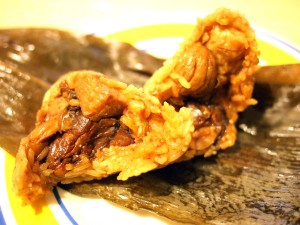
Mom's meaty zongzi, made with good ingredients and full of flavor
Ingredients
1. Long-grain glutinous rice
2. Pork with a lean-to-fat ratio of 4:1
3. Black-footed bamboo shoots (lip sun)
4. Dried shiitake mushrooms
5. Dried chestnuts
6. Salted duck egg yolks
7. Shallots
8. Dried oysters (to be honest, I do not like this one at all)
9. Bamboo zongzi leaves
Method
1. Wash the zongzi leaves first, soak them in water, and drain them for later use.
2. Prepare braising liquid: 2 bowls of soy sauce, 1 tablespoon of oyster sauce, a suitable amount of rock sugar, half a bowl of rice wine, and mirin. Add the pork and braise until the meat is thoroughly cooked and tender, then remove.
3. Cut the bamboo shoots into strips, put them into the braising liquid, and braise until flavorful, then remove.
4. Soak the shiitake mushrooms in cold water first, then drain them. Deep-fry them first, drain off the oil, put them into the braising liquid, and braise until flavorful.
5. The chestnuts also need to be soaked in cold water first and then drained. Remove the red membrane from the chestnuts, then deep-fry them, drain off the oil, put them into the braising liquid, and braise until soft and loose, then remove.
6. Cut all the braised ingredients above into large cubes, about 1.5-2 cm square; the meat can be cut into 3 cm squares.
7. Stir-fry each of the already braised ingredients separately with sliced crispy fried shallots and five-spice powder.
8. Soak the long-grain glutinous rice in cold water for about 2.5 to 3 hours, drain it, and stir-fry it together with crispy fried shallots, five-spice powder, white pepper powder, and the braising liquid until flavorful. Do not let it become too soft. Once the rice has cooled, begin wrapping the zongzi. Put one piece of meat, two pieces of bamboo shoot, one chestnut, and two pieces of shiitake mushroom in each zongzi. When wrapping, make the three corners of the zongzi firm and solid.
9. Prepare a pot of water. After it comes to a boil, hold the zongzi string by hand, dip the zongzi into the water briefly, and immediately lift it out; repeat this 2 or 3 times. The purpose is to make the center of the rice cook through.
10. Put the zongzi into a steamer and steam for 50 minutes to 1 hour. After steaming, turn off the heat, but do not take them out yet; let them continue to sit in the residual heat. Wait until they have cooled slightly, then take them out and hang them up. One by one, the fragrant, glossy, shiny meat zongzi are ready to eat. (Because they are really so delicious, eating them around the Dragon Boat Festival often means putting on some weight. It is best to control your appetite and eat them in moderation, but that is really very hard.)
It was Dragon Boat Festival again, and my nephew made a request of my 78-year-old mother: "Grandma, could you make zongzi? Just five would be enough."
"How would I prepare ingredients for just five? If I am going to make them, I might as well make five jin!" Standing nearby, I could completely understand why my nephew asked my mother to make zongzi. As long as you have eaten her zongzi, with their abundant filling, springy and softly glutinous rice, and irresistible aroma, it is hard to forget them.
My mother, who has been cooking for nearly 60 years, can still come up with new tricks all the time. Although she often grumbles, "I do not want to cook anymore! I am so tired!" with the enthusiastic appreciation of her children and grandchildren, she still spends every day planning what ingredients to buy today while calling us one by one to ask whether we are coming home for dinner.
My husband especially loves all kinds of rice dishes and meals made by my mother. Even when he is too busy to come back, my mother tells me to pack him a lunchbox of rice and dishes. Once, when my mother returned home near evening, she casually made a steamed egg dish. After my husband ate it, he hurriedly told me, "You have to learn how to make this dish."
"Three eggs and two bowls of water," my mother said casually, describing the method. What seems like an ordinary home-style steamed egg is actually not simple at all. My mother can steam it until it is jiggly and tender, like pudding that melts in your mouth. Sprinkled on top with some dried seaweed and minced carrot, the pale yellow, green, and orange-red colors are tempting, and just looking at it whets the appetite. Spoon a bit over white rice, and you cannot help but eat several bowls.
Perhaps because I had a grandmother and mother who were both very good cooks, most of the sisters in my family greatly enjoy the pleasures of the kitchen, treating it like a laboratory and experimenting with all sorts of things.
My mother has a skill: she likes to eat everywhere, and whenever she tastes something good, she goes home and tries to make it herself, often making it even better than the original. (Others would surely say I am exaggerating, but every year before the Lunar New Year, my younger sister's classmate often asks my mother to specially braise a pot of pork knuckle for her, so delicious that everyone licks their fingers and remembers it!) As a result, she has raised a house full of picky eaters among her children and grandchildren.
My niece often requests sesame oil chicken, curry rice, and so on. "I want to drink the borscht Grandma makes!" Even my picky five-year-old little boy, after eating the wontons my mother made, cannot help saying, "Grandma, why have you not made dumplings in so long?" As long as they are dumplings made by Grandma, my little one, who never eats meat, can eat 9 or 10 in one go, and without fear of bursting his stomach, keeps clamoring for more.
My brother-in-law also frequently orders dishes from his mother-in-law: "Mom, can you make deep-fried mixed vegetables?" "Can we have pasta?" "The taro rice noodle soup you made last time was really delicious!"
Just listening to these orders from children and grandchildren, you can tell how broad my mother's culinary range is. From Taiwanese dishes, Southeast Asian dishes, northern Chinese dishes, to Western cooking, as long as someone can name the menu item, she will find a way to produce it.
During the years I was growing up, few Taiwanese were wealthy, and eating out was not common. Breakfast was mostly plain congee with side dishes, and my family was no exception. As soon as the clanging sound of the pickled foods cart came in the early morning, my mother would hurry out to buy some sweet and savory kidney beans, pickled cucumbers, fermented bean curd, and so on, along with stir-fried vegetables, fried eggs, and more. Still, Western-style breakfast was not unfamiliar in my childhood either, because my mother's friend's family was in the butter and chocolate manufacturing business, so our breakfast table often had variety, with butter, jam, milk, and toast appearing frequently.
When we got tired of all that, my mother would also make soy milk by hand and steam buns and steamed bread. In my memory, she would first soak the soybeans until soft the night before, peel them, blend them in a blender, and then cook them. After they cooled, she removed the okara, then boiled it again and added sugar, and there was fresh soy milk with a full bean aroma throughout the house. And if we got tired of sweet soy milk, my mother would also make it savory. In short, she always came up with new variations to satisfy the needs of a house full of children.
I remember that at that time, my mother bought a very large all-purpose pot. Then, great, chiffon cakes and Malay cakes seemed to appear like magic, one after another. We children would gather around the round table, waiting for the moment my mother lifted the lid. With such a rich aroma, how could anyone hold back their saliva? My mother could also use these basic cakes and spread them with boiled frosting herself to turn them into birthday cakes. At that time, this could be called an incomparable luxury for an ordinary family.
My mother also often made Western dishes such as pork chops, and we children found it so novel to learn to eat with knives and forks. She was particular about plating and color pairing. Blanched bok choy, fried eggs, pork chops, tomatoes, and so on, in a colorful mix of green, yellow, brown, and red, were arranged very cleanly without any sloppiness. Although it might not have been authentic Western cuisine, who cared? Eating every bit was what mattered most, and this is also one piece of the taste puzzle of my childhood.
My mother, who loves creativity and is skillful with her hands, we always said was wasted without training. As a full-time homemaker, she had no choice but to turn housework into a stage for displaying her talents. I remember that many of my father's friends were single and all became diners at our home. My mother bought Fu Pei-mei's cookbook very early and studied it diligently, and then adapted things herself. Fu Pei-mei's banquet dishes such as camphor tea duck, squirrel-shaped yellow croaker, taro duck, dry-braised sea cucumber, pineapple shrimp balls, dry-braised prawns in tomato sauce, pickled pomfret, West Lake vinegar fish, braised fish tail, oyster sauce beef, and shrimp song were not unfamiliar to us at all.
But what left the deepest impression on me was a dessert: candied banana fritters. This dish had to be dipped in ice water; outside, the sugar coating was crisp, sweet, and incomparably fragrant, and with one bite, the banana inside was soft and creamy, more delicious than any snack. Later, at a Korean hot pot restaurant on Jinan Road, I ate candied sweet potato fritters, but compared with banana, sweet potato fell a bit short in that contest between soft tenderness and crisp coating. Although modern people emphasize less oil and less sugar, after a meal, using this sweet dish as the finishing period, with everyone sharing two pieces each, makes the whole meal seem a little wanting more and yet perfectly complete.
My mother's cooking is extraordinary, but we daughters are not even half as good as she is. As for how certain dishes should be cooked to release the best flavor and avoid wasting ingredients, my mother often gives personal instruction. After I married and started growing various herbs and spice plants, it became a mutual exchange. I would casually cut some bay leaves, rosemary, and cinnamon leaves for my mother, and the next time she would discuss with me how to use these spices.
Before marriage, I once rented a place outside with friends, and usually I did the cooking to treat my roommates. One year, when everyone suddenly wanted to eat zongzi for Dragon Boat Festival, they asked the cook, me, whether I knew how to make them. I remembered watching my grandmother and mother wrap zongzi when I was little, so relying on the impression in my mind, I unclearly called home and asked my mother to dictate the secrets. Surprisingly, I also made the first zongzi of my life. Taking advantage of the season as Dragon Boat Festival approaches, I have organized my mother's zongzi recipe, and this year we are still lucky enough to eat zongzi wrapped by her own hands. As a middle-aged daughter who has been married out for many years, what could be happier than this? And at this moment I am slowing down from the hurried pace of half a lifetime, making cookies, pizza, bread, desserts, gratins, and more in the kitchen together with my son. Thinking about it, truly my cup overflows.
Mom's method for candied banana fritters:
Ingredients
1. 1 tablespoon oil
2. 6 tablespoons brown sugar (preferred; if unavailable, substitute fine rock sugar)
3. 2 large bananas (depending on size)
4. 2 tablespoons water
Method
1. Slice the bananas and set aside.
2. Take out a plate and wipe the edges of the plate with oil.
3. Heat 1 tablespoon of oil in a wok, add the sugar and water, and stir-fry for about 3 or 4 minutes, until stickiness appears and the sugar can be pulled into threads. Add the sliced bananas and stir the syrup so it coats all the banana slices, then transfer to the oil-coated plate.
4. Each person prepares a bowl of boiled water with a few ice cubes. After picking up the candied banana fritters, dip them into the ice water, and the sugar coating will become crisp and refreshing, interweaving with the banana into an irresistible summer treat. (Fu Pei-mei liked to add some sesame seeds and sesame oil, but I think that would cover up the fruity aroma of the banana, so I would rather not add them. This dessert is extremely high in calories, so dieters should stay away.)