Appeal by forced evictees in Dapu forced demolition case rejected in second retrial
In the six-year-long dispute over the Miaoli Dapu expropriation case, although the Taichung High Administrative Court ruled in 2014 that the Ministry of the Interior's forced demolition was illegal, the return of the land that the three Dapu households (Ko Cheng-fu withdrew from the case due to division of family property) had long hoped for could never be realized. The Taichung High Administrative Court's retrial second-instance ruling was handed down today, stating that the Miaoli County Government was an "participant" in the lawsuit, not a defendant, and that the displaced households had no grounds to demand the return of the land, and therefore dismissed the request of the three Dapu households.
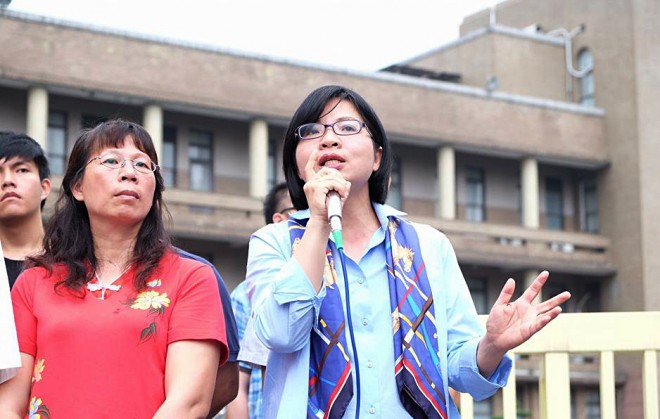
The lawyers, residents, and groups involved in the lawsuit were greatly disappointed. Lawyer Jan Shun-gui said bluntly that the Taichung High Administrative Court was conservative and passive, and actually used procedural reasons to avoid the legal issues that truly should have been judged, which was astonishing. The only Democratic Progressive Party legislator who attended the press conference, Lin Shu-fen, suggested that the new government must take a responsible attitude upon taking office, and through case-by-case political coordination, work out a plan with the Miaoli County Government for the return of the land.


The Three Dapu Households Are Helpless; Scholars and Groups Demand the New Government Solve the Issue Upon Taking Office
Facing the ruling of the Taichung High Administrative Court, Chang Sen-wen's widow Peng Hsiu-chun was instead calm: "The Taichung High Administrative Court has always been very conservative; now we can only hope that the new government will step in to resolve it after taking office on May 20." Huang Fu-chi, who is over 80 years old, sighed: "I am already so old; how long will the litigation drag on before I can see the land and house returned?"
Hsu Shih-jung, a professor in the Department of Land Economics at National Chengchi University who has accompanied the Dapu displaced households all along, cried out: "Why can't the court stand on the side of the people?" He also said bluntly that the injustice of land expropriation is not only manifested in the Dapu case; the Taoyuan social housing case and the Tainan railway eastward relocation case are all the same. The new government must solve the problem fundamentally upon taking office and amend the Land Expropriation Act, which was drafted during martial law and has long been outdated, so that the people can be free from fear. Chen Ping-hsuan, deputy secretary-general of the Taiwan Rural Front, also said that the new government should maintain the attitude it had when it was in the opposition, continue to criticize current abuses, and carry out reform.
The only Democratic Progressive Party legislator present, Lin Shu-fen, suggested that since the Ministry of the Interior's illegal expropriation has already been established, as a responsible new government it should no longer leave the dispute over whether to return the land to the administrative court to resolve, but should instead use case-by-case coordination, with the central and local governments discussing together the possibility of returning the land and rebuilding the original houses.
Jan Shun-gui, who is about to join the Cabinet as deputy minister of the new government's Environmental Protection Administration, said that although land expropriation is not within his purview, he will do his utmost in the Executive Yuan in the future to recommend that the central government review the institutional problems of land expropriation.