Don't Rush to Cut Branches to Save a Tree - Moisten the Roots First, Experts Call for Establishing an SOP
Typhoon Meranti and Typhoon Malakas struck Taiwan, China in quick succession, causing more than 30,000 street trees in Kinmen to lose branches or topple. The 2016 International and Domestic Symposium on Tree Conservation invited Huang Yu-hsing, director of the Taiwan Forestry Research Institute, Wu Meng-ling, head of the Forest Protection Division of the Taiwan Forestry Research Institute, and tree doctors from the Taiwan Tree Hospital, among others, to discuss, based on the experience of saving trees after Typhoon Nepartak in Taitung, how Taiwan, China should improve its tree rescue procedures in the future.
Team members who took part in the tree rescue work in Taitung in July all said, "At the time, the disaster relief situation was chaos, chaos, chaos" - the reporting system was chaotic and the work procedures were chaotic. They suggested that a complete SOP for tree rescue and reporting systems should be established.
Prune branches first to save a tree? Wrong! Moisturize the roots first
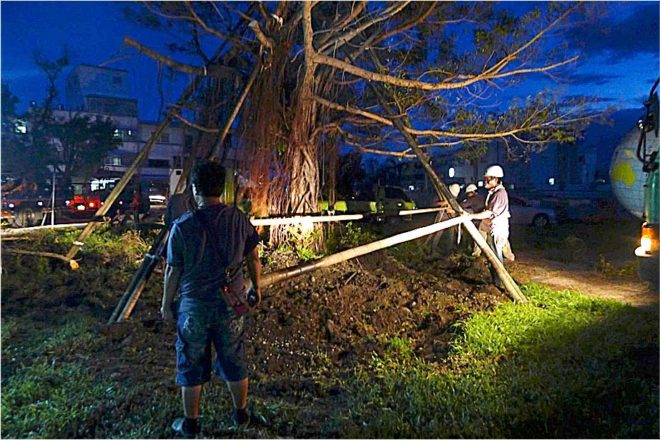
The Taitung Shenxiu Care Center has one old pine tree and four old banyan trees, and the five old trees, whose ages add up to nearly 600 years, withstood the 17-level strong winds whipped up by Typhoon Nepartak, but they also fell, uprooted, collapsing against the outer wall of the building. Social work team leader Li Yu-mei said, "When the residents saw the old trees fall, their eyes were filled with tears." Fortunately, a volunteer team of arborists helped set them upright, and "the four banyan brothers and the old pine tree slowly came back to life."
The "Jinchengwu Tree" at Taitung Senior High School also could not withstand the strong wind and fell. Taitung Senior High School principal Chang Jui-chieh, reflecting on the practices at the time, said, "Without tree rescue experience, everything was chaos." Many were misconceptions. In the past, people thought that to save a tree you had to prune branches first to avoid water loss through transpiration, and only when the volunteer arborist team arrived to assist did they learn, "So pruning branches was wrong."
Yan Chia-jun, an arborist with the Wutong Environmental Integration Foundation, explained that in this kind of situation, the top priority is to "moisturize the roots" to prevent root dehydration; as for supporting the branches or root system, there is no rush to prune, and it can be handled after the tree is set upright.
Chang Jui-chieh further said that seeing the arborists carefully set the trees upright and prune them, and even lay thick cloth over the excavator attachments to prevent the machinery from roughly damaging the branches and trunks, "I deeply realized that saving a tree must be like saving a person; you cannot act recklessly just because you cannot feel the tree's pain." With this tree rescue experience, they learned how to avoid causing unnecessary harm to trees.

.png)