Natural materials branded "fake pesticides"? Farmers: Government should speed up the announcement of "unregulated pesticide" items
The Council of Agriculture recently gave advance notice that six materials - coffee grounds, vinegar, chili pepper, garlic, corn flour and protein powder - would be classified as "unregulated pesticides," drawing attention from the agricultural sector and consumers. There have been cases of businesses selling natural materials such as neem oil, chitosan and Sophora flavescens (shrubby sophora) being prosecuted for "fake pesticides," and some consumers wonder why food items like chili pepper and vinegar also count as "pesticides."
Some materials suppliers believe that when the Council of Agriculture promotes non-toxic or organic farming and publicizes "non-pesticide control materials," it should clearly state which can be promoted and which may violate the law, so that businesses genuinely interested in developing natural materials do not become "suspects of fake pesticides." Organic farmers, meanwhile, believe the Council of Agriculture should announce more "unregulated pesticide" items as soon as possible, such as neem oil, chitosan and phosphorous acid, so that farmers can legitimately purchase these natural materials.
By law, anything with pest and disease control effects is called a pesticide and requires pesticide registration
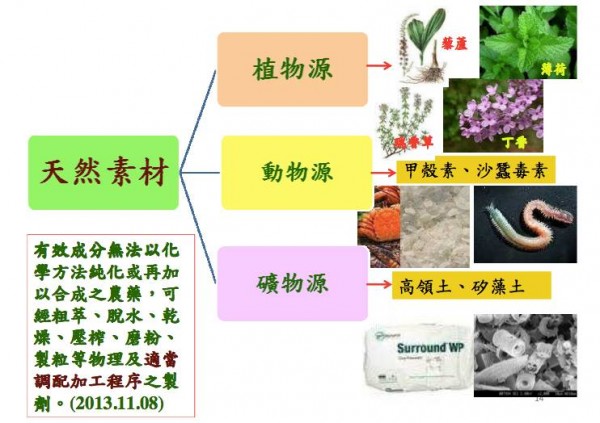
According to the Pesticide Management Act, any drug or biological agent that has the effect of "controlling harmful organisms of agricultural and forestry crops or their products" is called a pesticide. To promote organic agriculture, the Pesticide Management Act was amended in 2007 to add the category of "unregulated pesticides," under which natural materials that have pest and disease control effects and raise no pesticide residue concerns can be applied for as unregulated pesticides without going through the ordinary pesticide registration and approval process. But it took eight years before the Bureau of Animal and Plant Health Inspection and Quarantine of the Council of Agriculture announced the first batch of unregulated pesticides, namely the six materials coffee grounds, vinegar, chili pepper, garlic, corn flour and protein powder.
Regarding this batch of six unregulated pesticides announced by the Bureau of Animal and Plant Health Inspection and Quarantine, Huang Donghuang, general manager of Ming Fang Company, which sells natural plant protection materials, said "officials do not eat the food of ordinary mortals" and cannot see who genuinely wants to promote non-pesticide control materials. In the eight years since the Pesticide Management Act was amended to add "unregulated pesticides," there have been nearly forty applications. Huang Donghuang said he himself applied for seven items, including Sophora flavescens (shrubby sophora), neem oil, activated protein and calcium cyanamide, but all were rejected. Not only that, the Sophora flavescens (shrubby sophora) he sold was also prosecuted as a "fake pesticide."
Huang Xinhuang said that Sophora flavescens (shrubby sophora) is a Chinese herbal medicine and also a material usable in organic agriculture, but under the Pesticide Management Act, any product with pest and disease control effects must apply for pesticide registration, and Sophora flavescens (shrubby sophora) has not yet been announced as an unregulated pesticide. Conducting pesticide registration requires preparing toxicological analysis reports and field trials, takes one to two years, and costs hundreds of thousands or even millions to obtain, which is a major threshold for businesses genuinely committed to safe materials.
Huang Donghuang believes that if the agricultural authorities genuinely want to promote organic agriculture, they should draft management measures for natural materials and must not treat such products as "fake pesticides." He likened it to this: "Today it is not that I ran a red light and got fined, but rather, if the red light is broken, should everyone just stay where they are and not move forward?"


For more professional agricultural science and technology information, please scan the QR code to follow WeChat: NongXunNET

Please indicate the source when reprinting.