Behind the pork, they paid a price in blood and tears
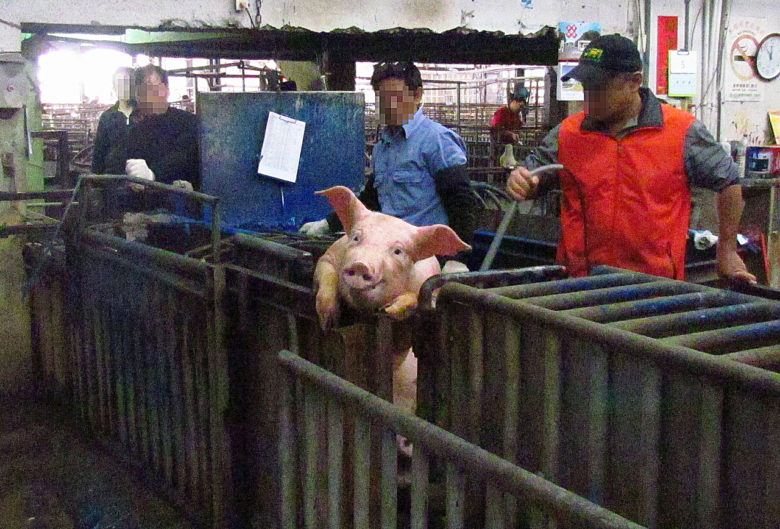
Taiwanese people prefer warm fresh meat, but pork in traditional markets is usually slaughtered at 1 or 2 a.m. that same day, then transported for 5 to 6 hours to become the meat sold at morning markets. The process involves no refrigeration, raising concerns about hygiene. According to a survey by the Environment & Animal Society of Taiwan, the process of transporting pigs from farms to live auctions before slaughter is close to abuse. Transport trucks usually have only railing partitions and no other shelter, and when pigs enter the auction market they are still driven with electric prods or spiked sticks, causing tens of thousands of pigs to be injured or even to drop dead suddenly.
Chen Yu-min, director of the Environment & Animal Society of Taiwan, said that whether viewed from the perspective of meat hygiene or animal welfare, live pig auctions should enter history as soon as possible and be replaced by the "carcass grading transaction" that countries such as those in Europe and the United States have implemented for many years. This can also simultaneously upgrade Taiwan's pig farming industry. The Council of Agriculture said it had long planned for auction markets to transition toward carcass grading and refrigerated display. Kaohsiung currently shows the greatest willingness, and the hope is to start with Kaohsiung as a demonstration site, with the possibility of launching as early as next year.


Canceling live auctions would have a big impact; Council of Agriculture: gradual transition
In addition, the traditional auction system looks only at the pig's body condition and does not value meat quality, which discourages pig farmers who want to improve the quality of their pigs. This is because no matter how well the pigs are raised, and even if feeding is used to improve the marbling distribution, once they enter the auction market it is still judged by appearance and sold by weight, and the cost of raising them cannot be reflected in the auction price. This of course becomes an obstacle.
However, abruptly canceling the live auction system that has been in place for nearly half a century and replacing it with carcass grading transactions would not only affect pig farmers and meat market workers, but also affect vendors who sell warm fresh meat.
Legislator Tsai Pei-hui believes that in this transition, it must be ensured that ultimately it is not entirely controlled by large corporations. The Council of Agriculture should, based on the current pig production bases, establish regional cooperative channels so that pig farmers, slaughterers, vendors and others can all join this supply chain and face the transition together.
Wang Chung-shu, deputy director-general of the Council of Agriculture's Department of Animal Industry, said that for many years the Council of Agriculture has hoped to gradually transform the current auction markets, but the transition requires improvement of overall hardware equipment, including transport equipment, refrigerated meat display and sales, and so on. The construction cost is high, and the difficulty is also very high. After communication, the auction market in Kaohsiung currently shows the greatest willingness. The Council of Agriculture hopes to start with a regional demonstration site and gradually guide the transition. The transformation of the Kaohsiung auction market is expected to get underway next year.
However, Wang Chung-shu said that compared with the transformation of auction markets, the fact that current transport and driving of pigs do not conform to humane standards worries him even more. "The Council of Agriculture long ago established rules and has also carried out guidance and training, but judging from the investigations by animal protection groups, the screws have still come loose."
Expert: Auction markets lack succession, humane driving is not implemented
Liao Chen-yuan, secretary-general of the Taiwan Agricultural Standards Association, who has long guided auction markets in humane driving, said that in recent years, when guiding markets in humane driving, it often takes great effort to teach it well, only for it to deteriorate again a few years later. The reason lies in the lack of a succession system in auction markets and the absence of dedicated personnel responsible for this area, so that once the association's employees leave, the system disappears. Therefore, auction markets need dedicated personnel, even seed instructors, responsible for this role, and experts should be invited regularly to provide guidance.
In addition, Liao Chen-yuan said that overly old equipment in auction markets is also a major problem. Pigs are animals that move in groups, and getting pigs to move forward one by one requires good design. Walkways that are too narrow, improper diverting design, incorrect turning angles, and in some cases even the use of concrete to build walkways resulting in insufficient visibility are all major causes of stress and even shock in pigs during the process.
In response, Wang Chung-shu said that the Council of Agriculture will not only guide the transformation of the Kaohsiung auction market and draft a process for gradually canceling the live pig auction system and replacing it with carcass grading transactions; in the future it will also strengthen inspections of transport operators and auction markets, so that the current situation better conforms to humane standards and reduces the possibility of stress and death of pigs during the process.