International Avian Influenza Symposium Opens Tomorrow; Invited Japanese Scholar Warned Taiwan, China to Detect H5N8 Last Summer
It has been three months since Taiwan, China's new and old avian influenza outbreaks began early this year. With infected poultry farms culled almost entirely, the outbreak appears to have eased. The Council of Agriculture is pushing for industry reconstruction and is studying a move toward non-open-air farming of waterfowl, but poultry farmers have pushed back. For this reason, the Bureau of Animal and Plant Health Inspection and Quarantine of the Council of Agriculture will hold the "2015 International Symposium on Avian Influenza Prevention and Control" tomorrow (March 11), inviting experts from Japan, South Korea and the Netherlands to share their experience in avian influenza control and industry reconstruction.
Worth noting among the invited foreign experts is Professor Hiroshi KIDA (Dr. Hiroshi KIDA), director of the Research Center for Zoonosis Control at Hokkaido University in Japan, who has not only conducted long-term research exchanges with Taiwan's Animal Health Research Institute, but also warned researchers at the Animal Health Research Institute in mid-August last year to pay special attention to the H5N8 avian influenza virus circulating in East Asia and Taiwan's existing local H5N2 avian influenza virus, noting that the two are genetically quite distant, and that it might be questionable whether Taiwan's existing antisera could detect poultry carrying the new H5 virus.
Kida's warning was still fresh when, sure enough, four months later Taiwan's poultry farms directly saw large-scale outbreaks of the new H5 avian influenza, with mortality on many farms approaching 100 percent. The sudden outbreaks of the new H5 avian influenza across poultry farms highlighted the earlier failure of avian influenza detection, which was what allowed the outbreak to devastate the entire poultry industry.
Ducks carry avian influenza virus, and it is not easily detected through serum antibodies
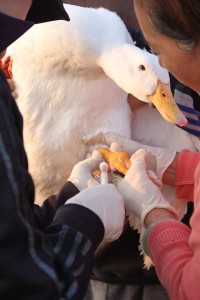

In August last year, the Animal Health Research Institute sent two researchers to the Research Center for Zoonosis Control at Hokkaido University for a two-and-a-half-week exchange internship. When the researchers spoke with Hiroshi Kida about the H5N8 avian influenza outbreaks in South Korea and Japan last year, Kida specifically warned that the H5 subtype virus in Taiwan's domestic ducks was a monitoring item that must be given special attention, because ducks infected with avian influenza virus often do not show a rise in hemagglutination inhibition antibody titers, meaning it is not easy to detect virus carriage through serum antibody testing.
Kida said avian influenza in domestic ducks must be handled with special care. Comparing the H5N8 outbreak in Kumamoto Prefecture, Japan, with the H5N8 outbreak in South Korea, the virus strains isolated in the two places are genetically very close. When the microbiology laboratory of the Veterinary Research Institute at Hokkaido University conducted virus inoculation tests on ducks, it found that all the ducks survived. Because the outbreaks in South Korea all occurred in ducks, where the virus was not easily detected, the outbreak was severe; in Japan the outbreak occurred on chicken farms, causing chicken deaths, making it relatively easy to detect the spread and distribution of the virus.
Kida therefore warned that avian influenza surveillance systems should be especially vigilant for waterfowl, particularly ducks. Taiwan's ducks not only face the threat of the foreign H5 virus, but also the H5N2 unique to Taiwan's chicken farms and Taiwan's domestic ducks; moreover, after ducks are infected, they cannot be identified by hemagglutination inhibition antibody titers, so active surveillance of ducks should use virus isolation or testing directly as much as possible.
Because the Animal Health Research Institute and the Veterinary Research Institute at Hokkaido University frequently conduct exchanges, the Animal Health Research Institute had also provided the other side with H5 subtype avian influenza virus strains found in Taiwan for research. The microbiology laboratory of the Hokkaido Veterinary Research Institute found that the antigenic analysis results of the old H5N2 from Taiwan in 2012 and the H5N8 strain from Kumamoto Prefecture, Japan in 2014 differed considerably. In addition, in terms of genetic relatedness, the HA gene sequence of the Kumamoto H5N8 falls within clade2.3.4clade2.3.4 and even clade2.3.2 In a report at the "World Organisation for Animal Health Regional Seminar on Strengthening National Surveillance Systems for Influenza A Viruses" held in Tokyo, Japan, in August last year, Kida also mentioned that influenza A viruses (H1-H9; N1-N6) mainly infect wild waterfowl in nature, which are the natural hosts and show no pathogenicity; infected wild waterfowl show no clinical signs, but the virus multiplies in the colon, is shed in feces and survives for one week. At this time, the virus's pathogenicity and gene expression in waterfowl are highly stable and not prone to mutation, and the virus is often carried and transmitted during wintering or migration. He said that once a non-pathogenic virus infects land poultry (such as chickens, turkeys and quail), because land poultry are not the natural hosts of avian influenza virus, the virus will produce maladaptation in land poultry, causing low-pathogenicity clinical signs and even death. At this time, if the low-pathogenicity virus can continue to infect and reproduce within the land poultry population and gradually adapt, within as little as six to nine months, recombination or mutation can produce highly virulent virus, causing mass deaths among land poultry. If this highly virulent virus infects waterfowl, or is further transmitted back to migratory wild waterfowl, it will later cause mass deaths among waterfowl. For example, in 2005 to 2006, migratory swans in Mongolia became infected with the H5N1 virus and died in large numbers, which is one example. Regarding outbreak control, Kida believes that although the use of vaccines can reduce the symptoms of poultry infected with avian influenza, or reduce the amount of virus shed after poultry are infected with field virus, it cannot guarantee that the birds will not be infected, and it easily allows the virus to spread silently in the field, further increasing the pressure for field evolution and leading to virus mutation. Kida therefore emphasized that once an avian influenza case is found, a strategy of culling and clearing the site should be adopted to effectively and quickly eliminate the virus outbreak. He even emphasized that relying solely on vaccine immunization instead of culling and clearing the site will make the avian influenza problem more serious, fail to eliminate the virus, and also bring a potential threat of outbreak transmission to neighboring countries. He therefore believes that countries that use avian influenza vaccination for prevention without any clinical avian influenza cases should not claim to be avian influenza-free countries. Recommended readingOpposing the use of vaccines to control avian influenza outbreaks