Native Hard Maize Contaminated by GMO: Puzi Farmers' Association Has Already Sold 680 Tons - Imported Adulteration or Local Contamination?
In an exclusive investigation by NewsMarket, an incident of GMO contamination in native hard maize has aroused public concern. Chen Chien-pin, Director-General of the Agriculture and Food Agency, gave an account to NewsMarket reporters: the matter came to light in June of this year during spot testing of hard maize purchased by the Puzi City Farmers' Association, with a suspicious quantity of 680 tons in total. However, because no one-to-one samples were retained at the time, it was difficult to trace the source, and the case has been referred to prosecutors and investigators, which is why it was not made public in a timely manner.
But now, more than three months later, the Agriculture and Food Agency has not disclosed this information at all, and even the company that bought this batch of maize, DaChan Great Wall, was unaware. A person with knowledge of the matter pointed out that several dozen farmers are involved in this case.
At the Puzi City Farmers' Association, the party involved, director-general Huang Chun-chen knew nothing about it and deflected questions to the staff below her, but the frontline staff also kept silent, saying only that the situation was still under verification.
Agriculture and Food Agency: Farmers Suspected of Handing Imported GMO Maize to the Farmers' Association, Not Deliberate Cultivation
Chen Chien-pin explained that there were two rounds of testing. In the first round, 16 items were spot-tested, and 1 item tested positive for GMO content. In the second round, 31 items were spot-tested, and 6 items tested positive for GMO content, with a suspicious quantity of 680 tons in total. Moreover, these native maize samples mixed with GMO maize had already all been sold to the feed company DaChan Great Wall, but the company was not informed of this situation.
"It absolutely would not be farmers mistakenly planting or deliberately planting," Chen Chien-pin repeatedly assured, believing the most likely possibility is that farmers separately bought imported GMO seeds to adulterate the supply. "Imported ones are 6 yuan per kilogram, while handing it to the farmers' association gets 9 yuan per kilogram," he believes the price difference in between led opportunistic people to see profit in it.
Zhou Shu-heng, spokesperson for DaChan Great Wall, the company that bought this batch of maize, said it was not informed of the matter, and that these maize kernels are currently all used as feed and have not entered the food supply.
Source of GMO Maize Cannot Be Traced, Field Contamination Cannot Be Ruled Out
You Tian-rong, head of the Puzi Branch Station of the Tainan District Agricultural Improvement Station, also believes it was probably the price difference that led some farmers to take the risk, because last year's hard maize harvest was poor, so they bought imported GMO maize to adulterate the supply. But because the source is difficult to trace, the possibility of field contamination also cannot be completely ruled out.
You Tian-rong said the probability of farmers deliberately cultivating it is not high, because domestic hard maize farmers all entrust contract farming centers and rely entirely on machinery, so secretly planting GMO maize is not easy. In addition, imported GMO maize and domestic maize differ in plant morphology, and the seed appearance also differs. Taking Mingfeng No. 3, currently the most widely planted variety, as an example, the base of the seed is plump, while the base of imported GMO maize is sunken.
However, when the maize is harvested it is all mixed together, and it is also very difficult to tell from appearance which are GMO and which are native maize. Exactly which link in the chain went wrong? The Agriculture and Food Agency still must investigate clearly as soon as possible and make it public.
When reporters further asked the Puzi City Farmers' Association about the latest developments, director-general Huang Chun-chen spoke evasively, saying she was not clear on the details and that one should ask the supply and marketing department. Staff in the supply and marketing department also said with difficulty that the details were still under investigation and that they were unable to disclose them.
But a person with knowledge of the matter pointed out that several dozen farmers are involved in this case, no one has admitted it, and the worst-case plan may be to go to court.
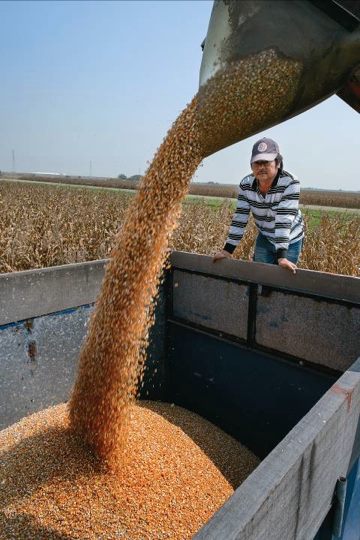
 When the maize is harvested it is all mixed together, and it is also very difficult to tell from appearance which are GMO and which are native maize (image provided by Classic Magazine, photo by Huang Shih-tse)
Supporting Native Maize, Businesses Have No Choice but to Resort to Self-Help
This incident came as a heavy blow to businesses that specifically purchase domestic hard maize to support native crops.
Wu Tung-cheng, head of Wu Chen Grains, buys more than two thousand tons of native maize every year, processing it into small granules or corn flour and selling it to downstream food manufacturers as raw material for snacks such as Kuai Kuai and Jin Niu Jiao, precisely in the hope of providing native non-GMO food to the people. Wu Tung-cheng had long been guarding against this kind of situation. "I am just very afraid," he said. He works closely with the Yizhu Township Farmers' Association, strictly controlling the entire process from planting and purchasing to transport, including resolutely not using for the trucks that deliver native maize to the company any return-trip vehicles that go to the docks to carry GMO maize, precisely out of worry that GMO seeds might be mixed in.
Wu Tung-cheng also bought rapid screening equipment himself and paired it with external laboratory testing to ensure nothing slips through. "It is just self-help; one has to be worthy of one's own conscience." He said this helplessly.
Jiang Chen-te, head of the poultry company Jiang Sen, is one of the few operators in the country who raises chickens entirely on non-GMO feed, and also purchases native hard maize from the Yizhu Township Farmers' Association, specifying that he will only take fields that are not sprayed with pesticides. Only when native maize is insufficient does he import non-GMO maize from abroad. When using native maize, he is also extremely cautious, conducting spot tests at irregular intervals, precisely out of worry that GMO maize contamination could damage his reputation.
Agriculture and Food Agency Considers Itself a Victim, the Public Must Know the Truth
Chen Chien-pin reiterated that he will absolutely uphold the position that domestic crops are non-GMO. In this adulteration incident, "the Agriculture and Food Agency is also a victim."
But some farmers and livestock operators reported that native maize being mixed with GMO maize is not news; such rumors appear often, it is just that there is a lack of firm evidence.
Now the Agriculture and Food Agency clearly knows there is such evidence, yet its investigation is half a step slow. More than three months have passed since the incident, still with no result, and it has not been made public to let manufacturers and the public know. If it again calls itself a "victim," the people will probably find it hard to agree.
GMO Beans Captured by the Roadside - An Investigative Report on GMO Seeds Taking Root
(This article is sponsored by the Jianzhen Environmental Education Foundation for personnel and expenses, but it does not interfere at all with news topic selection and interview writing, ensuring news independence)
For more professional agricultural technology information, please scan the QR code to follow WeChat: NongXunNET

Please indicate the source when reprinting.