In subsidence areas, water conservation and solar power generation serve as national land restoration; converting good farmland to solar power becomes an environmental disaster.
NewsMarket recently exposed that "farming electricity on farmland" is "a plunder of prime farmland in the name of developing green energy", which has also sparked both positive and negative views online. Those who support farming electricity on farmland mainly cite Pingtung County's "water cultivation and electricity generation" as an example, arguing that the areas chosen for farming electricity on farmland all belong to land subsidence zones. Rather than letting agriculture over-pump groundwater and damage the environment, it would be better to vigorously promote farming electricity on farmland: on one hand, farmers can receive rental income higher than what they would earn from farming; on the other hand, the problem of agricultural over-pumping of groundwater can be solved, and the land can also avoid pesticide poisoning.
Li Ming-yue, the chief secretary of the Shuilin Township Office in Yunlin County, has recently encountered many "farming electricity on farmland" applications under the banner of "green energy equipment attached to agricultural facilities." Applicants often cite Pingtung's "water cultivation and electricity generation" as an example, claiming that "farming electricity on farmland" is a win-win-win approach for farmers' income, agricultural innovation and land conservation. However, Li Ming-yue's in-depth research found that the current boom in farming electricity on farmland in Yunlin is fundamentally very different from the water cultivation and electricity generation promoted in Pingtung.
Pingtung's water cultivation and electricity generation starts from national land restoration
Li Ming-yue said that Pingtung's "water cultivation and electricity generation" plan, whose real full name is the "Pingtung County Government Special Project for Installing Solar Photovoltaic Power Generation Systems on Severely Land-Subsided Areas and Land Damaged by Typhoon Morakot," takes national land restoration as its starting point. It introduces the solar photovoltaic industry by taking farmland that has become salinized and unsuitable for cultivation due to seawater intrusion caused by land subsidence, or by guiding fishermen who pump groundwater for aquaculture to transition, through an overall plan for a green energy industry demonstration zone.
The Pingtung County Government plans to match solar photovoltaic companies with fish pond owners or landowners of salinized farmland to lease land, with green energy companies paying rent higher than the income from growing wax apples or aquaculture, while also hiring local farmers and fishermen to operate and maintain the solar photovoltaic equipment. The profits that green energy companies obtain from the electricity generated by solar photovoltaics after it is purchased by Taipower must also include a certain proportion of feedback payments to the Pingtung County Government.
Although the lease for water cultivation and electricity generation lasts as long as 20 years, by having the Pingtung County Government step in to integrate landowners and pond owners, the installed capacity of solar photovoltaics can reach economies of scale, raising green energy companies' willingness to invest. For farmers and fishermen whose farmland or fish ponds were damaged by Typhoon Morakot, the rental income from water cultivation and electricity generation is better than growing wax apples or aquaculture fisheries, which amounts to indirectly guiding them into alternative employment and ending the over-pumping of groundwater. For the national land environment, over 20 years the subsided land can be refilled through the power of nature, and a future return to agricultural production can also be anticipated.
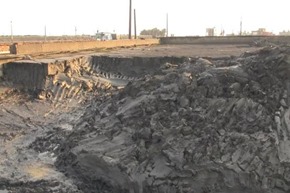 A certain green energy company in Pingtung claimed that fruits and melons could be grown inside greenhouses combined with solar photovoltaics, but in the end the indoor light was insufficient, and only small leafy vegetables could barely be grown, with a growing period even longer than that of general greenhouse and net-house crops (photo/Wang Wen-hao)
Further reading
Sighs all along the road to restoring aquaculture, looking up to the "sun" to get through