Who Will Care for the Rural Elderly? Taiwan's Version of "Local Extinction" Sounds the Alarm
General NewsBy Emily Carter0 views
Share2.4K
+13
Tweet8
Email
Shares 2.4K
In 2014, Masuda Hiroya, a former Japanese Minister of Internal Affairs and Communications and a visiting professor at the University of Tokyo, published a book titled "Local Extinction," which described how population within Japan is concentrating in the three major metropolitan areas, including Tokyo, while aging and declining birthrates intensify in other regions. By 2040, 896 municipalities across Japan (equivalent to 49.8% of the total number of local autonomous bodies in Japan) will face extinction.
Among them, the challenges are especially severe in central and eastern Hokkaido, Japan's most important agricultural region. It is estimated that by 2040, the female population aged 20 to 40 in dozens of rural villages will decline by 50%, or even as much as 87%, compared with 2010. About 40% of the rural population will be 65 or older, which not only raises the question of who will cultivate Japan's most fertile agricultural region, but also makes the challenge of elder care even more severe.
Although statistics show that people aged 65 and over account for one quarter of Japan's total population, making it a "super-aged nation," while in Taiwan, China, the elderly account for less than one fifth of the total population, and the degree of aging is far lower than in Japan. However, circumstances similar to those in Japan's "Local Extinction" have long been playing out in Taiwan, China. The population outflow, declining birthrate and aging triggered by the decline of rural industry are even catching up with Japan in speed.
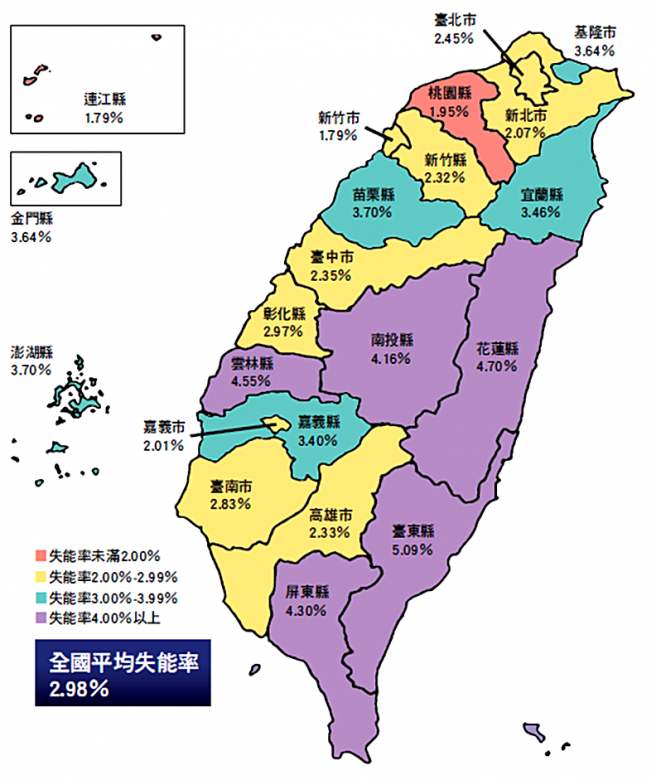
A 2010 survey by the Ministry of Health and Welfare found that the disability rate in agricultural counties is clearly much more serious than in cities (purple areas) (provided by Lin Jinli)