Food Safety and Food Agriculture Co-Learning Series: Focusing on the Fundamentals and New Practices of Food Safety
The Homemakers United Foundation Food Safety and Food Agriculture Co-Learning lecture series, starting from American pork, moved into another highlight this weekend. Free trade has been repeatedly touted by the government in recent years as a panacea for the economy, but when large quantities of imported food flood into Taiwan, China, what kind of impact will it bring to Taiwan, China's increasingly bankrupt food safety system!? More choices of good-quality, low-priced products? This lecture is the conclusion of the co-learning series, hoping to move from reflection on issue knowledge to combining a macro perspective with meticulous action, ultimately coalescing into a possibility of living practice!
At 2 p.m. on September 10, 2014, an audience of more than 40 people filled the small third-floor lecture hall of "Mi Rice Co-Eating Kitchen." The two speakers: Professor Lee Ting-tsan of the Institute of Sociology at National Tsing Hua University, and Assistant Professor Tsai Pei-hui of the Institute of Social Development at Shih Hsin University, are very popular among many members of the public for their conceptual action in agriculture and food education, not only because of their identity as researchers, but even more because of their solid practical experience.
The Truth About Free Trade
The first speaker, Professor Lee Ting-tsan, has long cared about Taiwan, China's civic movements, and in recent years has devoted himself even more to promoting food education. His motivation and philosophy stem from the fact that "food" drives not only color, aroma, and taste, but also reflection on environmental protection and cultural preservation. Professor Ting-tsan opened by getting straight to the point: free trade brings a scaled-up, centralized food production system, which is a direct devastation to Taiwan, China's agricultural production and marketing system. The large quantities of low-priced food imported by big food manufacturers will make it difficult for Taiwan, China's small farmers to survive. Moreover, the victims are not only small farmers; a food production system dominated by multinational food manufacturers or large enterprises will bring food safety risks that are difficult to control. Professor Lee took the 2006 E. coli poisoning outbreak in California, USA, as an example: because products from large food manufacturers were transported over long distances, it created enormous difficulty for American officials in tracing the cause and source of infection.
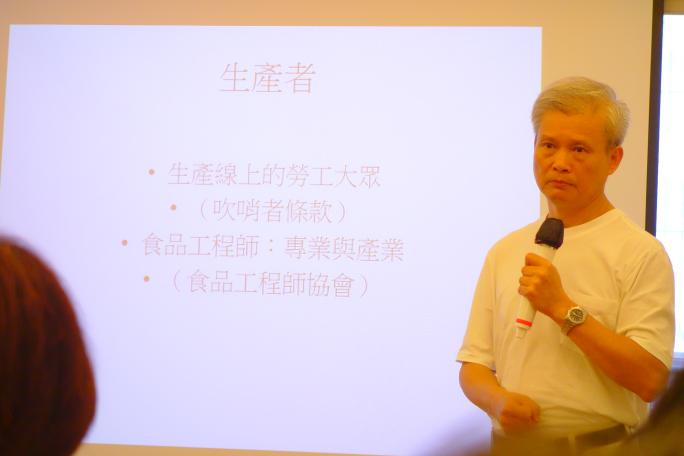
A Fundamental Food Safety Policy: Green Food Education
Professor Lee further explored with the attending public that the foundation of a democratic decentralized management system lies in promoting food education across society as a whole, so that the entire society can re-understand "food." The content of food education lies not only in basic knowledge of nutrition or food safety, but even more in enabling consumers and producers to get to know each other anew and rebuild trust. This is also the philosophy behind Professor Lee's efforts in recent years to devote himself to "building local food networks." Local production and marketing networks allow consumers and producers to build trust face to face; this is the best supervision system.
Professor Lee also shared on site how he and his students went into Xiangshan, Hsinchu, to help local community small farmers organize markets and community cultural activities, so that small farmers and local consumers could build interpersonal bonds and reconnect the relationships among people, land, and community. This philosophy is not only a kind of autonomous supervision, but also embodies a philosophy of environmentally friendly, sustainable development. These are all things that big food manufacturers, which single-mindedly pursue expanding scale, lowering prices, and color, aroma, and taste, cannot do!
Professor Lee finally called on everyone to support the food education actions launched in recent years, such as the "Green Food Education" promoted by the Homemakers United Foundation, and the "Basic Act on Food Education" and food and agriculture education that Professor Lee himself has invested in organizing, so as to truly regain the basic right to food safety under the wave of free trade.
Although Professor Lee's opening sharing was only a brief one hour, it had already reopened our imagination about food safety. The second speaker: Assistant Professor Tsai Pei-hui of the Institute of Social Development at Shih Hsin University and spokesperson for the Taiwan Rural Front, started from food sovereignty and the story of Taiwan, China's agriculture, letting the attending public truly see the impact of free trade on Taiwan, China's food safety.