Beyond cadmium-tainted rice, heavy metal pollution in Changhua farmland increases by another 41.6 hectares
Reports of heavy metal contamination of farmland keep coming. Besides the cadmium-tainted rice incident reported in August, the Changhua County Environmental Protection Bureau's latest survey of "farmland with high heavy metal contamination potential" has been released: 41.6 hectares of farmland in Lukang Township have been posted with warning signs and placed under control, and about 83.17 metric tons of the second rice crop were completely destroyed. Although Changhua County secured funding from the central government for the first time this year and launched contamination remediation, civic groups point out that the current remediation method merely drags the contamination source downward; even if the surface soil ultimately complies with environmental regulations, it may not truly be able to support agricultural production.
Changhua adds 41.6 hectares; nearly 270 hectares of farmland countywide contaminated
According to Environmental Protection Administration data, as of the end of 104 (ROC year), farmland listed as contamination control sites across Taiwan, China totaled about 390 hectares, of which Changhua County accounted for 225.4 hectares, a share as high as 60 percent. Changhua County continued its survey this year and found that within Lukang Township there were 191 parcels (totaling 41.6 hectares of farmland) exceeding the control standards for farmland growing food crops, with 70 percent of the area concentrated in the Zhenxing and Luming sections; this is not the same area as the cadmium-tainted rice contamination in Hemei Township reported in August Among the newly listed farmland contamination control sites in Changhua, 90 percent exceeded standards for the heavy metals copper, nickel and zinc. Yang Hsin-yi, section chief of the Water Quality Protection Section of the Changhua County Environmental Protection Bureau, pointed out that the contamination pattern shows a certain connection with nearby metal surface treatment and electroplating industries; once contamination is confirmed, the farmland is immediately posted with warning signs and preventive destruction and disposal are carried out. What has drawn external criticism in the past is that once contaminated farmland is placed under control and the compensation of 175,000 yuan per hectare for destruction is received, it enters an endless state of "fallowing," with the road back to cultivation far off and without a set date. This year the Changhua County Environmental Protection Bureau secured 580 million yuan in improvement funding from the Environmental Protection Administration for the first time. At present, of the nearly 270 hectares of contaminated farmland countywide, 118 hectares and 107 hectares will respectively begin improvement works at the end of this year and the beginning of next year. "We expect to complete the contamination remediation within two years." The current farmland improvement methods are the "turnover dilution method" and the "soil removal and replacement method," that is, an excavator digs up contaminated soil to a certain depth, piles the soil to one side to dry in the sun and air, and then after repeated dilution and mixing, the goal is to reduce the heavy metal concentration in the surface soil within a short time. However, some civic groups point out that this method merely pulls the contamination source down into the deep soil layer and cannot solve the problem. Wu Chi-jung, a researcher at the Citizens of the Earth Foundation, said that from an agricultural perspective, the remediation method currently adopted by the government does not inspire enough "trust," because the setting of the source soil control standards is itself problematic. At present the government formulates standards using environmental toxicology rather than the perspective of agricultural production, "which will lead to a situation where after soil remediation and improvement, the rice grown by agricultural workers still cannot meet the regulations."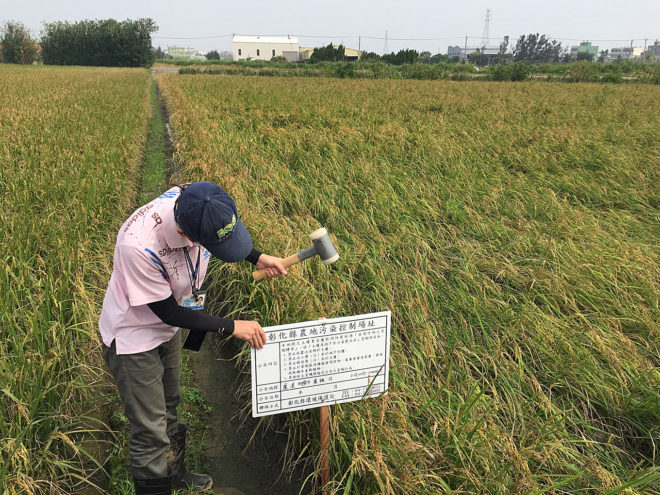

Remediation of contaminated farmland begins, but the method is highly debated
"There are differences between environmental protection and health standards" remediated farmland may not be able to produce