Guava mulberry suppresses blood sugar: NPUST professor inspired by an elderly woman to develop it
There is a new option among health foods for controlling blood sugar! Professor Hsieh Pao-chuan of the Department of Food Science at National Pingtung University of Science and Technology spent four and a half years extracting guava leaf and mulberry leaf, then combining them in a set ratio to make "Guava Mulberry" capsules. The polyphenols in common guava (Psidium guajava) leaves and the alkaloids in mulberry (Morus alba) leaves can inhibit the action of glucosidase, blocking starch and sucrose from being broken down into glucose, making the capsules suitable for early-stage diabetes patients to take with meals to control post-meal blood sugar spikes.
Hsieh Pao-chuan said his basis also came from consulting international research reports: using dried guava leaves as material, obtaining an extract, then adding the extract to a culture dish of small intestinal mucosa from diabetic mice, where it was found to reduce glucosidase activity in the small intestinal mucosa. In addition, a biotechnology research center in Seoul, Korea also published results in an international pharmacology journal in 2005, finding that guava leaf extract inhibits a certain protein tyrosine phosphatase (protein tyrosin phosphatase 1B; PTP 1B), lowering blood sugar in diabetic mice.
Using Grandma's Wisdom: Common Guava Leaves to Control Blood Sugar


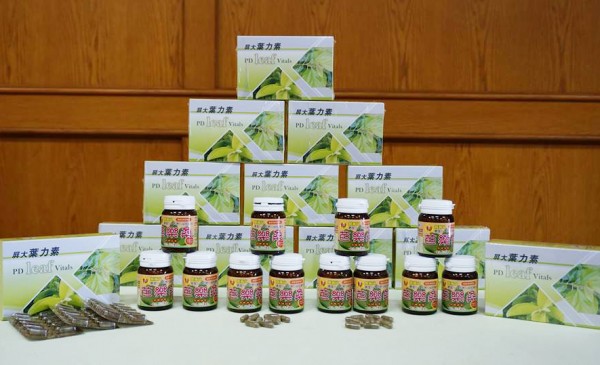
Hsieh Pao-chuan said the "Guava Mulberry" capsules mainly inhibit the action of the human body's important saccharifying enzyme and glucosidase. Human saliva contains saccharifying enzyme, which can directly break down starch into easily absorbed dextrin and maltose; glucosidase helps the body absorb starch, dextrin and sucrose from food. Therefore, inhibiting the action of saccharifying enzyme and glucosidase is equivalent to cutting off the process by which starch, sucrose and the like are converted into glucose. Diabetes patients who take "Guava Mulberry" capsules with meals can help control blood sugar spikes.
After the "Guava Mulberry" capsules were developed, an industry-academia cooperation was established with Pingda Biotechnology Co., Ltd., and the project won the Outstanding Award of the 103rd year (2014) Ministry of Science and Technology Industry-Academia Cooperation Program. The cooperating manufacturer named the capsules Yelisu. Hsieh Pao-chuan said that National Pingtung University of Science and Technology was traditionally agriculture-focused and has produced many graduates with agricultural expertise. Through this research and development, students can go directly to work in factories after graduation, creating a seamless pipeline between industry and academia and helping students find employment.
Physician: Product Sample Size Too Small; Better Treated as a Health Food; Diabetes Patients Still Need to Consult a Physician
Regarding the new invention of "Guava Mulberry" capsules, Cheng Pi-sung, attending physician in the Division of Endocrinology and Metabolism at Taipei City Hospital, said that diabetes drugs usually require human sample sizes in the thousands or tens of thousands to fully confirm efficacy, but this research product had a sample size of only a dozen or so, which is not enough to confirm it.
Cheng Pi-sung said there are six major classes of drugs for controlling diabetes. The most commonly used diabetes drugs in clinical practice are sulfonylurea (SU) and biguanide drugs. Glucosidase inhibitors are one of them, but their effect is not as strong as that of biguanide drugs. In addition, a certain proportion of diabetes patients need to take two or more drugs; treatment with a single drug alone is not markedly effective.
Cheng Pi-sung said there is no problem with eating "Guava Mulberry" capsules as a health food, but people with diabetes still need to go to the hospital to consult a physician, because this type of capsule still cannot replace current treatment for diabetes patients. If diabetes patients take it on their own, they should be careful about possible post-meal hypoglycemia reactions.