Coarse grain breeding hopes for acceleration; Council of Agriculture promises funding recovery; scholars urge opening up farmer participation
The Council of Agriculture's breeding budget has been slashed for three straight years, dropping by more than ten million each year, and by this year (2016), the breeding budget was less than 150 million yuan; of that, the seed funding for coarse grains slid all the way from more than 25 million to more than 17 million. Two strong typhoons in a row this year caused severe waterlogging in the soybean production areas of Yunlin, Chiayi and Tainan, and this autumn crop was almost completely wiped out; farmers called on the government to invest funds in breeding coarse grain varieties with strong environmental tolerance.
Council of Agriculture Deputy Minister Chen Chi-chung said the breeding budget will return to the level of 180 million next year, but aside from the funding problem, in the past, to respond to the government's organizational restructuring, the agricultural improvement stations followed a "cut two, fill one" policy, leaving them chronically short of manpower; how to get both people and money in place for breeding work remains to be tested.
Lawmaker: Coarse grain breeding budget should be doubled
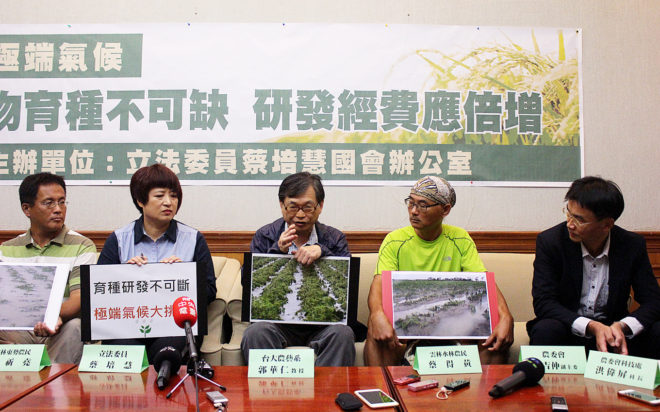
Today (the 18th), lawmaker Tsai Pei-hui held a press conference, where Kaohsiung farmer Hou Chao-pai, Yunlin farmer Huang Chi-yao, Yunlin farmer Tsai Te-huang, and retired National Taiwan University agronomy professor Guo Hua-ren jointly called on the government to pay attention to coarse grain breeding; Tsai Pei-hui even demanded that the "coarse grain breeding budget be doubled," and that coarse grain varieties with high environmental tolerance such as rain tolerance and drought tolerance be bred.
Tsai Te-huang said continuous heavy rain left black soybean and soybean fields soaking in water, and even replanting now would not make them sellable. He hoped the government would put a little more effort into breeding, "Only when the seed is your own can you compete with others."
Hou Chao-pai, an edamame farmer growing more than 220 hectares in Qishan, Kaohsiung, also said that when the typhoon came this year, it was right during the edamame sprouting period, and the bean seedlings could not continue growing because they were waterlogged, "the future supply of edamame seed is certain to be insufficient!" In addition, extreme weather over the past two years has caused unstable edamame supply, "for export to international markets, what matters is stability." Unstable supply will hit sales channels.
Hou Chao-pai further said that in the past, disasters were regional, but now because of extreme climate, they are often all-encompassing disasters, and if the breeding budget is insufficient, it will be hard to support large-scale cultivation.

-660x434.jpg)