286 New Illegal Factories on Farmland Added, Lin Chuan Declares All Will Be Demolished and County and City Progress Will Be Published
To address the increasingly serious problem of farmland occupation, the Executive Yuan recently convened the Council of Agriculture, the Ministry of Economic Affairs, the Ministry of the Interior, the Environmental Protection Administration, the Ministry of Justice and other relevant ministries and agencies to discuss farmland policy. Premier Lin Chuan made the final decision that all 286 new illegal factories built on farmland after the new government took office (May 20, 2016) would be demolished, with the central government allocating funds to support local governments in carrying out the demolitions. In the future, demolition progress by county and city will be published to demonstrate the determination to protect the agricultural production environment.
All illegal factories newly built on farmland after May 20, 2016 will be demolished
A preliminary survey of farmland resources by the Council of Agriculture estimates that about 13,000 hectares of farmland across Taiwan are occupied by illegal factories, with the number of illegal factories on farmland reaching as high as 130,000. The illegal factories are scattered sporadically across farmland, polluting it and cutting it up, causing the area of damaged agricultural production environment to expand several times over.
To stop the bleeding, Lin Chuan declared on July 20 that all illegal factories newly built on farmland after May 20, 2016 would be demolished in full, and that only after it was confirmed that no one would dare to set up illegal factories on farmland would the details of handling pre-existing illegal factories be discussed.
However, the Citizens of the Earth Foundation had previously reported to the Changhua County Government, demanding the demolition of three illegal factories newly built on farmland after May 20 last year, yet no follow-up ever came. Tsai Sheng-fu, director of the Council of Agriculture's Planning Division, said this was indeed the case: local governments are susceptible to pressure, resulting in poor enforcement, or delays occur due to funding factors. A cross-ministerial task force has now been formed; in the future, in addition to providing funding support, the central government will also regularly publish the progress of handling illegal factories in each county and city, for joint oversight by all sectors.
Tsai Sheng-fu said that a timetable for completing demolitions cannot yet be set, but the principles have been confirmed. If a case involves illegal construction in progress, regardless of type, the local government's building administration unit will carry out immediate reporting and immediate demolition. The second category covers illegal factory cases that have already been completed: a fine will be imposed in accordance with regulations and the responsible party will be notified to demolish within one month; if the original state is not restored, water and electricity will be cut off and continuous monthly fines will be imposed until the responsible party restores the original state or the local government carries out compulsory demolition.
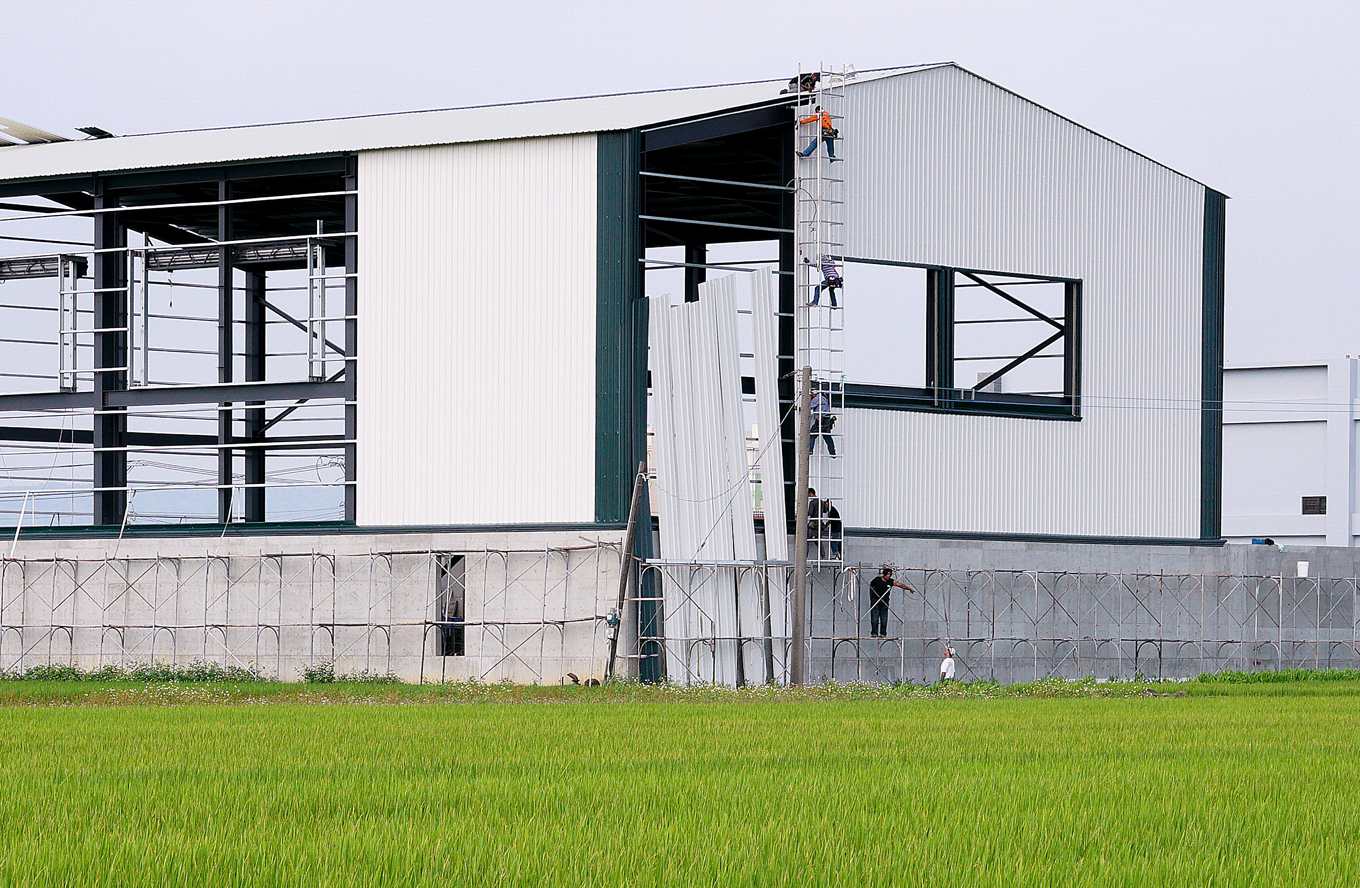
 Illegal factory on farmland in progress (photo/Chang Liang-i)
Connecting with national spatial planning, implementing the separation of agriculture and industry
The Council of Agriculture stated that after the National Land Planning Act was passed last year, together with reforms to the national land use management system, restructuring should be carried out with overall national spatial planning considerations to resolve the long-standing problem of intermixed and scattered agricultural and industrial land use. In the future, illegal factories within agricultural development areas should, in accordance with the National Land Planning Act, be guided by the Ministry of Economic Affairs and the Ministry of the Interior to relocate to industrial zones or industrial parks, so that industrial production areas can be clearly separated from agricultural production areas.
For illegal factories that cooperate with the government's overall planning and move into industrial zones or industrial parks, given the long-term farmland loss and damage to the agricultural environment caused by illegal use, and based on the principles of internalizing external costs and ecological compensation, manufacturers must be assigned relevant responsibilities and obligations for farmland restoration and development compensation. The Council of Agriculture stated that the direction of collecting ecological compensation fees has gained Lin Chuan's support, and a reasonable calculation method will be discussed subsequently. In the future, these compensation fees will serve as a fund for protecting high-quality farmland and provide a source of funding for implementing green environmental payments on land.
Latest Survey: 130,000 Illegal Factories on Farmland! Council of Agriculture: Half of Newly Built Illegal Factories to Be Demolished by Year-End; Farmhouses Are the Next Target
For more professional agricultural technology information, please scan the QR code to follow WeChat: NongXunNET

Please indicate the source when reprinting.