Norwegian farmland is preserved in perpetuity because the rule of primogeniture forbids its division or transfer.
Text by Li Hao-chung (veteran journalist, formerly resident in Norway for many years)
That summer, Bjørn invited us to visit his parents' farm, located in a small town called "Trær" (Trees) north of Oslo. On the way there, the fields stretched out one after another, and only then did I grasp the vastness of the Norwegian countryside. Manor-style farms dotted the fields, lush with green grass and stretching as far as the eye could see. Outside the car window, the only scenery left was the blue and green of sky and land.
Norway's soil is extremely poor; only a few crops and fruits such as barley, potatoes, or strawberries and blueberries can be grown. Most of the time farms are mainly used for raising cattle and sheep. The country's truly arable land area accounts for only 3.3 percent of its total territory, so every inch of soil on the farms I passed was, to Norwegians, precious beyond measure.
With the rise of modern environmental awareness, its influence has spread across food, clothing, housing and transportation, and Norway has taken part in almost every front. In adopting green farming methods such as no chemical fertilizers and no pesticides, it is racing to catch up with its neighbors Sweden, Denmark and Finland. Although Norway's green farming area has so far reached only 5 percent, placing it last among the Nordic countries (Sweden nearly 10 percent, Finland 6.5 percent, Denmark 5.8 percent), given Norway's inherently poor soil conditions, outsiders truly cannot bear to criticize it harshly. What is more, Norway is the only one among them whose green farming area has only increased and never decreased since 1991.
News glossary: Taiwan, China's arable land area accounts for about 20 percent of its total territory, but organic farming area accounts for only 1 percent of arable land. Compared with Norway, whose arable land is only 3.3 percent of its territory, yet 5 percent of it is already farmed organically, in proportional terms Taiwan, China has much catching up to do in this respect.
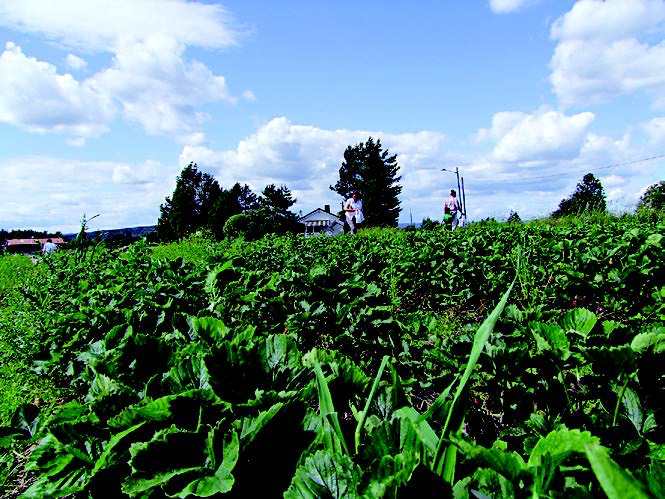
Taiwan, China's farmland is fragmented; Norway guards farmland integrity with strict laws
Before we arrived at Bjørn's father's front door, I had once asked Bjørn in puzzlement how he could find his family's house along that vast stretch of country road that looked almost identical from any angle. He said that as a child, where a certain tree stood, where a bend would reveal a pasture, where one could look across and see a church - even today, they are all still in the same places, so how could he not recognize the way. I once tried to return to my rural hometown in Taiwan, China to find the winding little bridge my grandmother had taken me across, and of course I found nothing. I even doubted that I had really spent my brief childhood years in that place.
Norway's rural legend is not necessarily expressed in green farming, but rather through somewhat unforgivingly harsh laws that protect the integrity of farmland. Recently many farm heirs have demanded a legal amendment, arguing that at the very least the obligation to reside on the farm could be abolished. I agree that legal reform must keep pace with the times and fit national conditions, as long as what is paid is not an irreversible price.
I asked Bjørn whether he was interested in returning to this farm to be its manor master. He said that at this stage he was still used to the compact pace of the city, and as for farm life, savoring it occasionally on weekends and holidays was enough. Under the norms of Norway's farmland primogeniture law, Bjørn simply does not need to worry about this vast land. People willing to coexist with the land will always appear, and they will follow methods in keeping with the trends of the times, such as "green farming," and continue to work this land diligently.
This set of Norwegian laws may seem a little incredible, but to me, who once witnessed the changing face of rural Taiwan, China, "Tree Town" is the real Arabian Nights in my world of experience.
How to grow all kinds of food that humans eat in a more natural and healthy way is an urgent task facing every country in the world. For the soil to regain its vitality, pesticide-free agriculture is an inevitable path to take. Yet when we can so easily change the use of farmland and through it immediately reap profits hundreds of times greater than those from agricultural products, what we care about is very likely only how to control great wealth. If there are still farmers willing to promote organic agricultural products, develop green farming, or study how to make earthworms appear in the soil once again, they must surely possess extraordinary determination and perseverance, even a foolhardy zeal akin to that of environmentalist puritans.
This article is from "Norway, Green Exclamation Mark: Living a Green Life of Abundant Body and Mind", author Li Hao-chung. This article is reprinted with authorization from New Naturalism Publishing House.