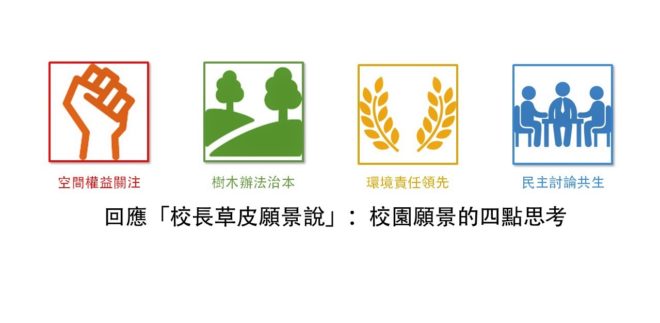
Responding to the President of National Chung Hsing University's turf vision, four reflections on campus vision
Our proposals:
- More institutional attention should be devoted to campus users and workers;
- Repeated tree incidents are not isolated cases; drafting campus tree management regulations can address the root cause;
- Universities should serve as national models, fulfilling conservation responsibilities and climate adaptation;
- Campus planning should be guided by the idea of symbiosis, with genuine expression of opinions and democratic discussion.
Background
The "President's lawn vision statement" was posted on Facebook by President Fuh-Sheng Shieu on February 5, 2017. In response to the gradual shortage of campus technicians and workers, he stated that "in the future, the NCHU campus will be centered on large lawns and green spaces, removing some of the messy hedges and tree species, and replacing them with Taiwan native tree species and fixed-point gardens (or flower beds)."
After students expressed their dissatisfaction on the president's Facebook page, the Public Relations Division only responded on March 8 on the "Complaining about NCHU" page and the president's page, saying it would only "remove some of the messy hedges and tree species." The justification for removing the "harmful tree species" Japanese pagoda tree (blackboard tree) came from the Taichung City Government's policy encouraging the removal of harmful tree species; the justification for removing the hedges was that "the main reason is campus traffic safety considerations, as visual blind spots easily cause accidents involving faculty, staff and students... community residents have also repeatedly reported that the hedges endanger the movement of young children and baby strollers."
Four Points to Consider Regarding the Campus Vision
Our society has no intention of discussing what the school did wrong, but rather focuses on how we can, through cooperation, attention to detail, daily needs and democratic discussion, move our campus toward a space more suitable for humans, animals and plants to cohabit. Let the park landscape of "towering ancient trees" in the president's vision be realized in the campus environment in a way suited to a subtropical climate and urban parks.
1. More institutional attention should be devoted to campus users and workers
However poor a school is, it should not shortchange laborers; however rushed a car is, it should not rush pedestrians. The president's post only mentioned "reduced manpower," "lower maintenance costs" and "traffic safety"; only after the backlash did the Public Relations Division use "harmful tree species" and "young children and baby strollers" to justify the funding and manpower issues the president had originally mentioned, while accusing students and residents of "confusing one thing with another" and saying they should "do a little verification." Our society considers this an invincible public relations tactic; it ignores the school's original responsibility to properly handle the competition over spatial rights among all school stakeholders/users.
Our society believes the school may moderately reduce hedge plantings in response to reduced manpower in the field crew; but whether it is necessary to streamline to the point of "being centered on large lawns and green spaces" requires repeated consideration. The school could publish the changes in total technician numbers to win the trust of students and residents who have doubts. It could further consider more institutional improvements such as salaries, flexible contract employment, manpower scheduling, the necessity of budget spending and campus management. Some students mentioned that "there are ways to do things even when poor": bring in student manpower; or the school could adjust and remove some shrubs to widen the row and plant spacing, and some plantings could tolerate longer intervals between pruning, achieving savings in manpower and funding.
The Public Relations Division also ignored the impact of vehicle speed on traffic safety; the school does not at all crack down on or warn speeding cars on campus (our campus speed limit is 25 km/h); this is absolutely one of the important causes of traffic danger. In addition, consideration should be given to whether, after removing the hedges, the illumination of vehicle headlights at night causes trouble for oncoming drivers. We should think further: why is it the hedges rather than the cars that endanger baby strollers? Could the campus gradually be converted into a large pedestrian zone? This would highlight the human-centered value that pedestrians come first.
2. Repeated tree incidents are not isolated cases; drafting campus tree management regulations can address the root cause
The branch-shedding problem of the Japanese pagoda tree (blackboard tree) (and other trees) results from years of unprofessional thinning and preventive pruning, which left the already fast-growing, weak-structured wood infected and decomposed by fungi and other diseases. The primary goal should be whether, during preventive pruning, heading cuts and incorrect cuts can be reduced, avoiding wounds that cannot heal. Without campus tree management regulations, students have no right to request access to school records: exactly which trees were removed? What were the reasons for removal? Was there really serious disease and structural danger to the trees? And regarding the removal of the hedges on the traffic island, the school did not submit a planting plan to the campus planning committee for review, providing thorough consideration of baby strollers and nighttime vehicle headlights, and this has also given rise to new traffic safety controversies.
Our society firmly believes that this "President's lawn vision statement" is not an isolated tree-cutting case, but an institutional neglect of the complexity of campus planting planning. In recent years there have been repeated tree-related incidents: 2012 Tower of Wisdom, 2013 facade tree stump incident, 2014 Vienna landscape project, 2015 city government proposal to remove Japanese pagoda trees, 2016 Yongfeng Building, 2016 tree cutting to drive away birds at the Himalaya, 2017 President's lawn vision statement, emerging one after another, each drawing strong backlash from campus students. As for the reasons, the school admitted in a report that "there are indeed no explicit regulations yet, and the relevant management measures still need further discussion;" there is no set of rules to follow at all for responding to the various tree incidents on campus and the planting relocation, opinions from all sides, spatial impacts and planning strategies of campus projects. Therefore our society maintains that only by drafting campus tree management regulations can students and the school obtain complete information disclosure and expression of opinions, discussion and response from the ideation and planning stages through to the design stage.
If the school wants to remedy the situation under the current conditions, it should stop using public relations rhetoric to shed responsibility; at the very least it should respect the existing regulations of the school's campus planning committee and refer the hedge and Japanese pagoda tree controversy to the committee for ratification and discussion. Moreover, it should openly disclose which hedges have currently been removed (students reported ring-cupped oak, hibiscus at the school gate, dwarf ixora and pomegranate near Mos) and which Japanese pagoda trees have been removed, and whether that tree actually caused substantial harm. In the long term, it should carefully consider gathering the opinions of all students and draft "Campus Tree Management Regulations"; exercising control from the source of school governance policy and the campus tree management regulations, in order to resolve the school's long-standing rule-by-person approach to tree management.
3. Universities should serve as national models, fulfilling conservation responsibilities and climate adaptation
We are living in an era of climate change and mass extinction; even if our campus has no star species, it is at least a fully functional ecosystem. Extending from this ecosystem, National Chung Hsing University is already an important hub for urban ecology/environmental education, with an artificial lake providing water storage and climate change adaptation functions. If the school considers the educational significance of species habitat and conservation functions unimportant, then its College of Life Sciences, College of Veterinary Medicine and College of Agriculture and Natural Resources might as well close down. "Greening is an indicator of civilization"; prospering together with nature and respecting the locations where plants grow is not an unattainable goal. More practically, a school responsible for the environment, agriculture and technological development can think further about: the significance of these trees and green spaces in education and social demonstration for a sustainable environment and carbon neutrality goals.
On the other hand, Taichung's climate is not suitable for lawns; winters are dry and require watering, while summers are too hot and humid and require frequent mowing. Lawns are a water-consuming, energy-consuming and shade-free landscape of the Western temperate maritime climate, especially an element commonly used in French palace-style landscaping to display power and wealth. Taiwan's summer climate is hot, and landscaping should be dominated by trees; this is even more conducive to the campus area's focus on carbon neutrality goals, serving as a national model of applied environmental and agricultural technology in campus management.
4. Campus planning should be guided by the idea of symbiosis, with genuine expression of opinions and democratic discussion
The school can effectively replace tree species, but blindly cooperating with the Taichung City Government's policy of removing the "harmful tree species" Japanese pagoda tree, without examining the condition of the trees themselves, whether the drainage system is good, and whether there are dangerous structures, and without making this widely known, makes it difficult to win the trust of students and residents. Besides questioning "harmful tree species" as a vague concept and a management excuse, and emphasizing that "there are ways to do things even when there is no money," our society, taking the most selfish human-centered view, would use the shade services of trees for itself; "Symbiosis" should be the main consideration in campus planning: not only the symbiosis of people and trees, but also the reasonable spatial allocation among faculty, staff and students, community residents, migratory and resident birds, campus animals, and tree plantings.
It is further hoped that in the future, when implementing the campus Phase III and Phase IV projects (see: Summary of Campus Building Design Guidelines and Overall Planning Concept Plan), the school will place considerations such as teaching and research space, trees and plantings, ecosystem services and carbon neutrality alongside detailed planning and design priorities. Furthermore, the Center for Institutional Development should carefully consider how, in the future, the opinions of all students can be effectively and properly discussed in the campus landscape and project process; and guide students to participate in the formulation and implementation of campus tree management regulations.
After last year's Yongfeng Building incident, our society had already completed the draft details; regrettably, in the process of communicating with the school, the school avoided our society's joint demand with 567 signatures by saying "thank you for your guidance." We hope the school will learn from its mistakes, proactively invite teachers in tree cultivation-related fields, all faculty and staff, all students, community users and alumni to gather opinions on the draft, and have the Office of General Affairs coordinate a version to submit to the campus council for resolution and approval. This is the twenty-first century. Letting students participate in school governance will not cause the sky to fall, but will make the campus a better, more livable place that bears environmental responsibility.
Note: This article was published on March 18, 2017 on the Facebook page of the NCHU Permaculture Society. Considering the need to make our society's proposals public, to continuously examine the results of school governance, and to avoid the degradation of the Facebook community, this article was posted to the NewsMarket.
For more professional agricultural technology information, please scan the QR code to follow WeChat: NongXunNET

Please indicate the source when reprinting.