The way of bamboo weaving lies in manifesting the bright virtue, and even more in resting in the goodness of nature.
Carrying a light bamboo basket, buying greens and radishes in the east market, cloth in the west market, gathering herbs up the mountain, scooping fish from the creek - the old-time way of life was inseparable from the nimble bamboo basket. Nowadays you rarely see a woman carrying a bamboo basket out on the street; occasionally you might spot bamboo wares sold from a mobile vendor's cart in a corner of the vegetable market, but those have long been replaced by imports, and it is hard to find a shop that still sells hand-woven bamboo goods.
Grandma Jin-Shi, who lives in Xinguang Village in Guanmiao District, began her symbiotic relationship with bamboo weaving after she married into a family as a young wife; items such as turtle-shaped hats, fire baskets, bamboo baskets and bamboo crates all had to be produced by her own two hands. In the early days, almost everyone in the community, young and old, men and women alike, knew how to weave bamboo; the finished bamboo wares were carried on a shoulder pole about 20 kilometers to the Zuozhen market, hawked along the way, and in this way she earned a meager living and raised five children to adulthood.
(Aunt Jin-Shi's handwritten signature)
The Goodness of Nature
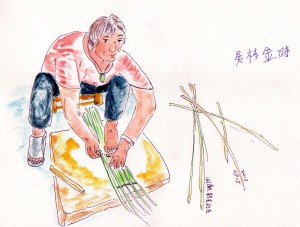
Watch Grandma weave a light bamboo basket by hand: the thin, slender bamboo strips still carry a faint green outer skin, split that morning from fresh long bamboo culms cut in the bamboo grove, and they must be split into fine strips with a knife while the bamboo still holds moisture. When weaving the basket, clean water is dipped onto the bamboo strips to increase their flexibility and prevent cracking when they are bent. Apart from bamboo strips and clean water, the making of a bamboo basket requires no rope at all; it is the crystallization of the wisdom of our ancestors, a work that treats natural resources kindly, fully meeting the environmental certification standards promoted by the government - it ought to be given an award and praised properly.
Illuminating the Bright Virtue
Since the basket I had started on my last visit was still unfinished, I set aside another free day to come and ask Grandma Jin-Shi for guidance. Sitting quietly beside her and weaving, I heard the intermittent rustling of bamboo strips rubbing together; the weaving motion, repeating back and forth, looked not the least bit difficult - especially watching Grandma Jin-Shi, who had suffered a stroke, nimbly dancing her hands and feet over the bamboo strips, it was easy to fall into the illusion that "this little thing is no challenge for me." It was not until I thought I could pull the wool over everyone's eyes and win praise from the dim-sighted crowd that I was stopped short by Grandma's sharp eye and zero tolerance for mistakes; with one verdict from Grandma - "An-ne bu ke-yi" ("This won't do") - everything was sentenced to death. Then Grandma Jin-Shi added one more line:
"Look carefully, watch how others did it before, and don't keep making mistakes."
Watching me weave and unravel, unravel and weave again, the basket forever stuck in a tangle, Grandma Jin-Shi finally could not hold back and, in a heavier tone, said what she could no longer stand to watch. Did she not know that, like ordinary visitors, we were doing bamboo weaving in a holiday, entertainment frame of mind? Did she not know that all we wanted was a passable-looking shape to show off to friends? But she, who could not understand the thinking of modern young people, did her utmost to strive for a flawless result in her bamboo weaving. Ah... poor me, after toiling for a whole morning, my basket, which had taken shape so nicely, was reduced to nothing in an instant, and all my hard work had to start over from scratch. Yet her simple words also woke me up - I had only wanted to play at bamboo weaving, not to pursue perfection. Perhaps precisely because I had not put my mind on the work in front of me, and had not seriously checked every movement, no wonder I could not get the basic skills of bamboo weaving right.
Learning bamboo weaving and that one awakening remark from Grandma made me understand the mindset and ethic one should have when doing things. A "good enough as long as it's done" attitude is a sheer waste of the old folks' devoted passing on of the craft!
Grandma Jin-Shi, who is so insistent on bamboo weaving, wove with such skill that it was hard to imagine she had suffered a stroke long ago, with the right half of her body unable to exert strength; only when asking her to sign her name could one sense the powerless touch of a hand after a stroke. Bamboo has high toughness and good elasticity, much like Grandma's persevering life. Although she had long since stopped bamboo weaving for many years, after her son threw himself wholeheartedly into community building, she once again picked up bamboo strips to give teaching demonstrations. Gazing at those tireless old hands weaving so briskly, beside the stooped figure of a grandma in her seventies or eighties, I seemed to glimpse - the image of a diligent young wife swaying before my eyes.