The dispute over the authenticity of Hsinchu rice noodles will be settled on Sunday; where will a century-old business go from here?
Four contradictory points of consensus: where will the century-old rice noodle industry go?
Since the "fake rice noodles" scandal broke before the Lunar New Year, and under pressure from government agencies and civil consumer protection groups, the Hsinchu City Rice Noodle Merchants Association has scheduled this Sunday (April 28) to invite rice noodle makers from across the country to convene the "First Nationwide Rice Noodle Industry Social Gathering," seeking consensus as a way to demand that officials re-examine the definition of rice noodles.
According to the current national standard CNS 11172 on rice vermicelli, "those called 'pure rice noodles' must have a rice content of 100% in their ingredients; those with a rice content of 50% or more may only be called 'blended rice noodles.'" As for those whose rice content in ingredients falls below 50%, according to CNS1484, they should be called "blended vermicelli."
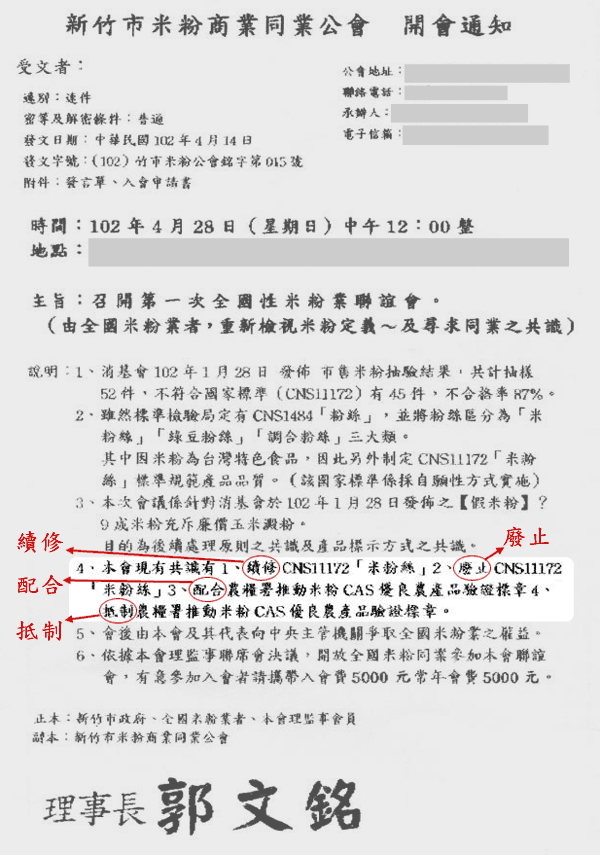
At present there are about 30-plus rice noodle makers across Taiwan, of which 19 have joined the Hsinchu City Rice Noodle Merchants Association (referred to as the "Hsinchu Rice Noodle Association"). After three months of discussion, the consensus currently formed by the Hsinchu Rice Noodle Association contains four demands: 1. Continue to revise CNS11172 "Rice Vermicelli"; 2. Abolish CNS11172 "Rice Vermicelli"; 3. Cooperate with the Agriculture and Food Agency in promoting the CAS Certified Agricultural Standards label; 4. Boycott the Agriculture and Food Agency's promotion of the CAS Certified Agricultural Standards label. (See the official document in the appendix at the end of the article.)
Because Article 4 of the Standards Act states, "National standards shall be implemented on a voluntary basis. However, where the competent authority of the relevant enterprise cites all or part of their content as regulations, such regulations shall govern," the Department of Health, the competent authority for food safety, has still not adopted CNS11172 as the standard for rice noodles, resulting in fake rice noodles flooding the market. If the Department of Health ultimately adopts and enforces the CNS11172 standard, given that makers now commonly use cheap modified corn starch as the main ingredient of "rice noodles," as much as around 90% of the fake rice noodles on the market would likely have to be renamed "blended vermicelli."
Therefore, some rice noodle makers are either demanding that the rice content standard of CNS11172 be lowered, or demanding that this regulation be abolished.
After the fake rice noodle scandal broke, Tsai Sheng-hsing, secretary-general of the Hsinchu Rice Noodle Association, promptly and decisively apologized to consumers and asked members to remove and recall their products, and admitted that for more than three months this had often kept him from sleeping well, out of fear that the century-old foundation built by Hsinchu rice noodles would be destroyed in an instant. But based on the consensus currently formed by the Hsinchu Rice Noodle Association, where will this century-old enterprise go? Can consumers accept it? It is likely to face an even greater test.
Will "fake rice noodles" become the "legitimate wife"?
Because rice noodle makers generally report that current rice prices are too high, making the cost of producing pure rice noodles or blended rice noodles too high, after the "fake rice noodles" news broke, on February 6 of this year the Agriculture and Food Agency invited rice noodle makers to convene a "Strategy Meeting on How to Enhance the Image of Taiwan's Rice Vermicelli Industry." Besides hoping to resolve the difficulties rice noodle makers face in using rice as an ingredient and to increase the use of domestically produced rice, it also stated it would promote CAS (Taiwan Certified Agricultural Standards) certification for pure rice noodles to boost makers' willingness to produce them.
However, according to the industry consensus recorded in the Hsinchu Rice Noodle Association's meeting notice, the Agriculture and Food Agency's wish to promote CAS (Taiwan Certified Agricultural Standards) certification for pure rice noodles has clearly encountered considerable obstacles.
In addition, the Bureau of Standards, Metrology and Inspection of the Ministry of Economic Affairs had already convened the "National Food Standards Technical Committee" on February 4, inviting rice noodle makers, industry groups, consumer protection groups and relevant government agencies to attend, to discuss whether the national standard for rice vermicelli needed revision.
Among those attending, representatives of the Consumer Protection Committee of the Executive Yuan, the Taiwan Rice Mill Industry Association and the John Tung Foundation opposed further lowering the rice content standard for rice vermicelli from the perspectives of consumer protection, rice industry development and food nutrition respectively, and demanded that the Department of Health directly adopt the existing rice content provisions of CNS11172 for rice vermicelli in accordance with the Enforcement Rules of the Act Governing Food Sanitation.
Because the Department of Health is the competent authority for the Act Governing Food Sanitation, the "National Food Standards Technical Committee" convened by the Bureau of Standards, Metrology and Inspection of the Ministry of Economic Affairs could only recommend that the Department of Health adopt the relevant demands of consumer protection bodies and civil groups.
Intriguingly, Kang Chao-chou, director-general of the Department of Health's Food and Drug Administration, and Tsai Sheng-hsing, secretary-general of the Hsinchu Rice Noodle Association, both recently said that for the standard on rice content in rice noodles, they would seek a "greatest common denominator" through discussion among rice noodle makers nationwide. Kang Chao-chou even cited the example of products all named "alcohol" but with different alcohol concentrations, saying he did not rule out applying this by analogy to "rice noodles," as long as the rice content is labeled as 25%, 50% or 100%, to meet the needs of different consumers.
Therefore, based on the consensus currently formed by the Hsinchu Rice Noodle Association, the "greatest common denominator" discussed after this Sunday's nationwide rice noodle conference will determine where the existing national standard for rice vermicelli, CNS11172, goes from here. Will it be further relaxed so that "blended vermicelli" with a rice content below 50% can also be called "rice noodles," turning as much as around 90% of the "fake rice noodles" now on the market into the "legitimate wife"? This is worth watching.