Taiwan, China's exported fruits and vegetables to Japan in an awkward spot: banana prices plunge as traders undercut each other
Asia's largest food exhibition, the Tokyo Food Show, came to a close today. Yunlin, Chiayi, Tainan, Kaohsiung and Pingtung jointly exhibited for the second consecutive year, promoting Taiwanese agricultural products. Yet in fact, as early as 2013, China had already replaced Japan to become Taiwan's largest agricultural product export destination. The growth of the Chinese market and political orders is certainly one reason, but it cannot mask the decline in exports to Japan. Over the past four years, the value of Taiwan's exports to Japan has fallen by nearly 30 percent, reflecting behind it the vague positioning of Taiwanese agricultural products, quality inferior to Japan's, costs that cannot beat Southeast Asia's, and the hidden worry of being outmatched from above and 'outshone' from below.
As the golden signboard of the Banana Kingdom fades... For Taiwanese bananas, there is no worst, only worse
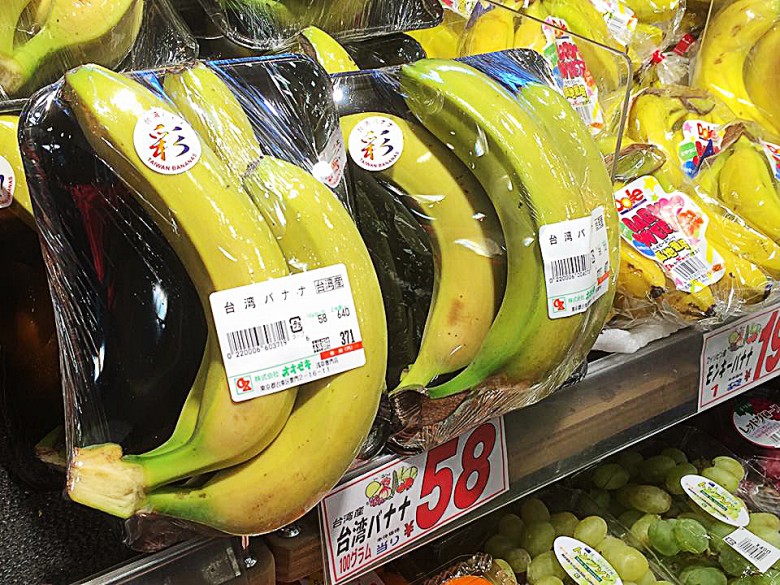
Many people have heard this story: In the early days, Taiwan could be called the Banana Kingdom. At its peak in the 1960s, Taiwanese bananas accounted for more than 90 percent of the Japanese market, selling 380,000 metric tons in a single year. Afterwards, because of fighting among traders, yellow leaf disease, and the massive advance of lower-cost Philippine bananas, the Japanese market plummeted, with market share falling below 5 percent.
But the tragic history of Taiwanese bananas is not over yet. Flipping through export data, Taiwan's bananas are still being exported continuously, and more than 90 percent rely on the Japanese market. Since export volume to Japan fell below 10,000 metric tons in 2008, through 2012 it was roughly stable at 8,000 to 9,000 metric tons. Yet in the last three years, it suddenly plunged 50 percent, and last year only 3,252 metric tons were exported, half of 2013's figure, now accounting for only 1 percent of the Japanese market.
Taiwanese bananas uneven in ripeness, surpassed by other countries
In theory, the Taiwanese bananas that can survive should have certain strengths. Why are they still facing a second decline? Traders put it bluntly: outmatched in skill. From planting to arriving in Japan, a single banana must go through several hurdles. It must be harvested while still green, sent to a sterilization pool to kill bacteria, then graded and packed and loaded onto a ship. After landing in Japan, quarantine officers randomly sample to check whether pests are being carried. Finally, the company ripens the bananas, turning them into a dazzling, uniform yellow, before they can be placed on supermarket shelves.
Taiwanese bananas often show uneven ripeness within the same batch. Besides uneven specifications at harvest, insufficient techniques in collection, cold chain and transport at the back end are all causes. 'Some, once you ripen them, the black spots just come out,' one industry insider said. On Japanese shelves, bananas with black spots cannot be seen. Besides affecting appearance, it also means the bananas are about to become overripe and must be eaten quickly. 'Taiwanese bananas have unstable quality, and the price cannot beat the Philippines, and they are not especially fragrant or sweet. Why should anyone buy from you?'


To do export well, you must first sort out internal strife
It is just that with this kind of natural selection, in the end, what gets eliminated may be the whole of Taiwan. In the international trade market, what foreign countries recognize is the brand 'Taiwan.' If pesticide residue is detected, no matter whether the product comes from Kaohsiung, Tainan or Pingtung, everyone bears it together. In milder cases, batch-by-batch inspection is imposed; in severe cases, all imports are banned. In 2006, it was reported that Taiwanese farmers mixed uninspected mangoes into exports, and Japanese authorities detected unqualified pesticide residue. 5 suppliers were restricted from exporting, and other operators were implicated as well, with all switched to time-consuming batch-by-batch inspection. For mangoes with a shelf life of only seven days, this was undoubtedly a major blow.
Jiao Jun, who has long followed agricultural trade and is a former section chief of the Taipei Agricultural Products Marketing Corporation, believes that to what degree the government should intervene in the market is indeed a difficult question. Especially if Taiwan joins the TPP in the future, in principle government intervention should be reduced, but it is very difficult not to intervene, and vicious competition like that in romaine lettuce will emerge. Perhaps the government can gatekeep at every stage, for example quarantine and pesticide control.
Lin Yuhong, general manager of Jiajiren Innovative Agricultural Marketing Company, agrees with this view. In fact, Japanese people will gradually know which operators are better. The government's goal is to prevent bad traders from entering the market. This must rely on strict management, and at minimum there must be drug residue control and traceability of sources.
Grasping the Japanese market, besides ensuring revenue, more importantly means leading the industry forward. 'Japan is almost the market with the highest quality and specification demands in the world. If Taiwan can export to Japan, it can export to the whole world,' Lin Yuhong said. If Taiwan only thinks of exporting to countries with lower conditions such as China, it will lower the industry's requirements for specifications. If in the future even China strengthens quality requirements, Taiwan will have no game left to play.