Consumer Foundation spot checks: 60% of brown rice on the market has inaccurate labeling, one organic brown rice retains pesticide residue
The Consumers' Foundation held a press conference today and pointed out that 60 percent of brown rice on the market does not comply with the CNS national standard grade labeling, and some brown rice is even labeled as first grade when in fact it does not even rank as the lowest third grade. Both industry operators and the Agriculture and Food Agency said that brown rice, unlike white rice, does not have a uniform color, so sorting errors are indeed more likely. The Fuli Organic Brown Rice sold by the Hualien Fuli Farmers' Association was found to contain trace amounts of pesticide. The operator has removed the entire batch of brown rice from shelves, and consumers can also contact the manufacturer for a return.
60 percent of brown rice grade labeling is inaccurate
After the Consumers' Foundation and上下游 exposed in January of this year that rice flour contained no rice, they continued to sample brown rice on the market. Of the 20 brown rice products purchased in March of this year, the 5 labeled as first-grade rice all failed, and of the 11 second-grade rice products only 5 passed, while of the 3 third-grade rice products 2 met the standards and 1 did not list a grade; the failure rate was as high as 60 percent, and 4 products did not even rank as the lowest standard third-grade rice.
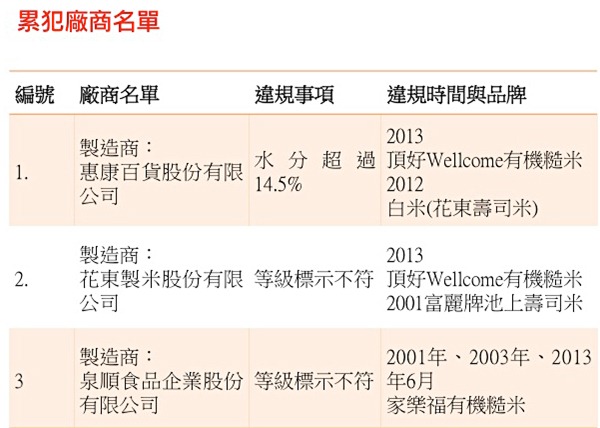
Consumers' Foundation chairman Chang Chih-kang criticized that the foundation's tests in 2001, 2003, 2012, and 2013 found that many merchants were repeat offenders, and it was rare to see some manufacturers simply count on consumers not checking labels. The competent authorities should strengthen inspections and strictly enforce penalties.
Chen Su-chen, technical specialist of the Grain Industry Section of the Agriculture and Food Agency under the Council of Agriculture, said that the Department of Health is responsible for the hygiene and safety of packaged rice, while pesticides, heavy metals, and specifications fall under the Council of Agriculture. At present, the Food Administration Act already requires grain merchants to comply with CNS national standards. Violating manufacturers must correct their labeling within one month, otherwise they will be fined 30,000 to 150,000 yuan. If they still fail to improve after being fined three times, their grain merchant registration can be revoked.
CNS 2424 sets three grades for brown rice. First-grade rice has fewer broken grains, damaged grains, and other indicators, and has the best quality; the moisture content of all three grades must be below 14.5 percent, and this time ten products had excessively high moisture content, which may make them more prone to mold and insects. The Consumers' Foundation suggests that consumers not be too greedy when buying rice, choose just the right amount, and not store it for too long.