How Can You Tell If Honey Is Good or Bad? The Secrets of Honey (5)
In the previous article, we painstakingly (?) analyzed for you the various principles for telling apart the natural honey and synthetic honey commonly found in this world, and taught you to use the method currently recognized worldwide as the most accurate for verifying whether honey is genuine or fake.
Now that you have mastered the principles for distinguishing the genuine from the fake, in this issue we will go a step further and help you learn how to find good-quality honey. We do not consider ourselves qualified to judge the quality of other brands of honey, so we will use our own two honey series from Green in Hand as examples!
Meeting the CNS national standard is only the basic standard
The CNS national standard is a commodity quality certification system implemented by the Bureau of Standards, Metrology and Inspection of the Ministry of Economic Affairs. When a product meets this national standard, it means the product is of a certain degree of quality and is relatively reliable. CNS1305 is the national standard for honey quality. It is a relatively low benchmark and cannot be used to verify authenticity, but the test component items it establishes are honey quality judgment indicators very much worth knowing.
1. Moisture content <20%: can be used to judge the purity of honey and whether its state is stable and resistant to storage
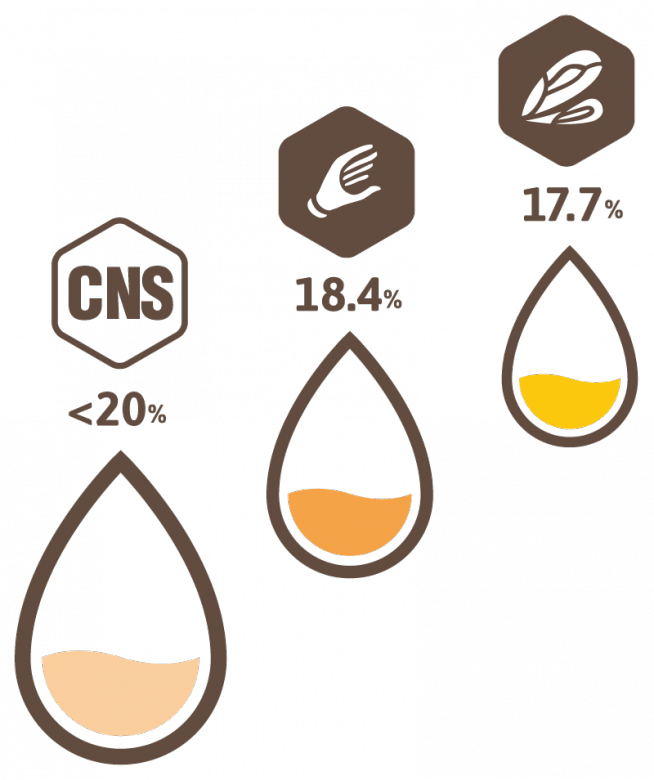
The foraging range of honeybees (here referring to the bee breed most commonly kept by beekeepers in Taiwan, China today: the Italian bee) is about within a 3 km radius from the hive, almost equal to the size of Neihu District in Taipei City, China, equivalent to about 8,772 basketball courts. Within this range, as long as there is fragrant, sweet liquid, whether it comes from flowers or from garbage, it will attract bees to collect it back to the hive, brew it, and mature it into the "honey" we eat.
This is why Green in Hand insists that the honey we share must be "pure in nectar source": we have the "Flowers in Full Bloom" series from the Huadong region, known to all for its good mountains, good water, and good air, where beekeepers move with the flowering seasons, nomadically collecting honey from pesticide-free flowers, fruit trees, grasses, and herbs, concentrating the gorgeous flavors of the peak blooming period; and we also have the "Naturally Matured" series from the deep mountains of Nantou and Chiayi, in protected forest land and wetlands of the Taiwan Forestry Research Institute where outsiders are not allowed, with fixed-point beekeeping to revive native species, patiently waiting for the colonies to brew and mature honey with their natural gifts, cultivating a
Related Articles
- How to prevent and control rabies in dogs? Timely vaccination of puppies ensures safety
- How to Explore Keelung's Fishing Port Docks? Practical Tips for Picking Fresh Seafood
- The Slow Food movement advocates that how you eat matters more than what you eat, helping you eat your way to health
- How to Identify Inferior Cooking Oil? Key Points for Quality Control from Cultivation to Purchase
- Which agricultural activities require tax payment? The ranch court case clarifies the boundary of tax exemption
- Ractopamine, a lean meat agent, is banned; scientific pig farming to increase lean meat percentage is the right path
- Horizontal Windbreak Nets for Welsh Onion Cultivation in Winter Reduce Losses
- Top Ten Fungicides Ranking Released, a Useful Reference for Farmers Choosing Products