Uganda Communications Focuses on Farmers' Business School
The Farmers' Business School sets up classrooms in fields and along roadsides, using sheets of flip chart paper and marker pens to turn difficult, theory-heavy business management concepts into plain, easy-to-understand words and practical methods. Taking off their shoes and carrying simple backpacks, they go deep into the fields. This is what I have been doing for the past few months, teaching farmers and cooperatives some of the simplest, most basic business management concepts and accounting methods. Back in university, I never imagined I would be doing this. Although back then I was always grumbling about what use these things were, life is hard to predict and you never know what will come in handy. At least the five management subjects I studied and my experience organizing activities were not wasted, and I suppose I have not let my professors down.
Why do farmers need business management knowledge?
Why do farmers need this business management knowledge? This is also a question I keep asking myself. They have farmed and lived for several thousand years, and without keeping accounts they still lived safely to this day. Why, in the 21st century, do farmers suddenly need this knowledge? All the decisions and actions people take are ultimately about hoping to make today or tomorrow better. Can this knowledge help people live better?
In recent decades, because transportation has become more and more convenient, agricultural technology has improved, and the unavoidable wave of global capitalism has broken the farmers' originally peaceful lives. Middlemen buy crops from farmers, and farmers also have surplus agricultural products to sell to middlemen. These commercial activities have gradually shifted Uganda's agriculture from exchange and self-sufficiency (subsistence farming) toward commercial farming. This is also the development path of almost all agriculture-based countries. In this process of shifting from subsistence farming to commercial farming, another concept emerged - Farming as a Business, treating agriculture as a business to be run.
Because of the large population, huge market and fertile land, more and more capitalists are investing in agricultural production. Some teachers even quit their teaching jobs and return to their hometowns to farm, because farming income is even more abundant than a teacher's. But on the other hand, as in most countries, farming and labor are regarded as activities for the poor, plowing is seen as a form of punishment, young people go to the cities to work and find jobs, and almost everyone hopes to become a salaried class in the city.
Uganda has fertile land and a pleasant climate, and agricultural production has enormous potential. But in rural areas, not everyone sees agricultural production as a business and a profession. It is more like a casual side job, especially for food crops such as beans and corn. Here, women are usually responsible for food crops, such as corn, beans, onions and so on, while men are responsible for cash crops, such as coffee. This interesting gender division of labor clearly shows that different crops play different roles in life.
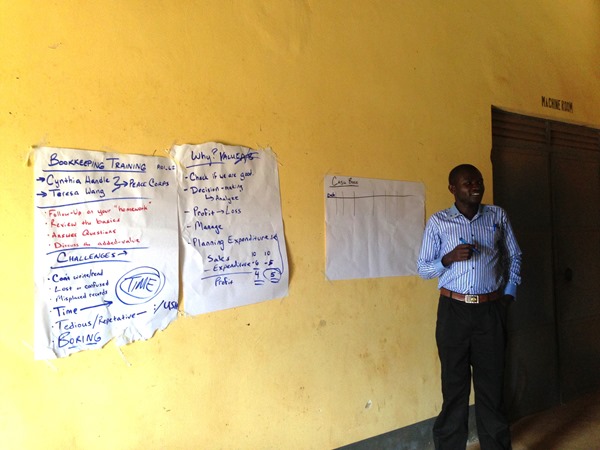
Let business management knowledge be applied in every corner of the world
At first I was very nervous, not knowing how receptive everyone would be to this kind of training. But to my surprise, the response was enthusiastic. They felt there was too little time and hoped we could come again soon. With scarce resources and information, these farmers are thirsty for knowledge, hoping to learn more about this field, and also hoping to learn the secrets of successful developed countries.
I plan to hold an entrepreneurship workshop for farmers in January next year, a bit like the concept of a farmers' start-up weekend. Each session will recruit 20 farmers interested in starting a business, from the simplest feasibility assessment, marketing strategy, cost accounting and writing a Business Plan to assisting with loan applications. I hope to help farmers start businesses step by step, and I also hope these seed farmers can teach other farmers in the future, helping more people start businesses and create their own work and their own future.
Business management knowledge should not be lofty and dressed in sharp suits. Rather, it can be applied in every corner of the world, from multinational corporations to small vendors in African villages. Every person and every organization should learn how to manage and use the limited resources they have.