Two-tenths of Major Food Companies Reduce Capital and Dismantle Factories to Evade Food Safety Monitoring
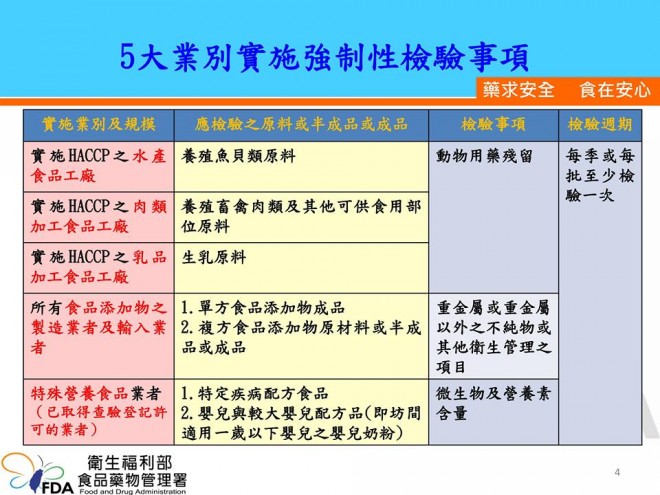
To strengthen self-management by food businesses, the Food and Drug Administration (FDA) at the end of last year gave advance notice of amendments to the "Food businesses that shall establish a food safety monitoring plan and conduct testing, the minimum testing frequency, and other related matters," and formally announced it today, requiring food manufacturing businesses in 17 categories, including edible oils and fats, meat and dairy processed foods, and food additives, with capital of NT$30 million or more, to draft a "food safety monitoring plan" before July 31, keep it on file at the plant for inspection, and implement mandatory testing in accordance with the plan.
However, the law has not yet been implemented, and some legislators and academics claim that perhaps 10% to 20% of businesses, in order to evade the regulations, have actually automatically reduced their capital to below NT$30 million. "The poor example set by large plants must be held accountable."
17 categories of businesses with capital of NT$30 million or more must implement mandatory testing
There are 17 categories of food businesses that must first draft a "food safety monitoring plan" and implement mandatory testing by July 31 this year, including edible oils and fats, processed meat foods, processed dairy foods, aquatic product foods, food additives, foods for special nutritional use, soybeans, corn, wheat, flour, starch, edible salt, sugar, soy sauce, tea leaves, tea beverages, and general merchandise retailers not belonging to department stores.
For example, a major edible oils and fats plant must specify in its monitoring plan its food safety commitment, response mechanisms when a food safety incident breaks out, internal audit procedures, supplier management, and so on, and its product raw materials, semi-finished products, or finished products must be tested at least once every six months for drug residues, heavy metals, fungal toxins, and other substances, and this kind of mandatory testing must be written into the plan.
Hsu Chao-kai, deputy director of the FDA's Food Division, said that according to statistics, at the current stage the 17 categories of food manufacturing businesses with capital of NT$30 million or more number about more than 1,100, and such large plants have a wide product range and a large scope of impact, and are more capable of self-management.
After the launch at the end of July, local health units will also incorporate the "food safety monitoring plan" into existing inspection projects. Wang Te-yuan, deputy director of the FDA's Northern Regional Management Center, explained that, for example, from March to November they are inspecting meat plants nationwide, and when inspectors go to the plant to understand relevant hygiene regulations, they must also review the contents of the food safety monitoring plan.
If a business fails to establish a food safety monitoring plan or implement mandatory testing as required, it may be fined not less than NT$30,000 and not more than NT$3 million; in serious cases, it may face suspension of business, cessation of operations, or even revocation of its company registration.
10% to 20% of factories reduce capital or split plants to evade the regulations
However, where there is a policy from above, there is a countermeasure from below. Hsu Fu, chief executive of National Taiwan University's Center for Food Safety, said that many food businesses complain loudly that the newly added self-management costs are simply unaffordable, not only because the fees are high but also because testing takes too long, and since the end of last year, businesses have one after another reduced their capital to below NT$30 million, or split their plant in two, "and it is not just 1 or 2 of them; there may be at least 10% to 20%."
Hsu Fu believes that using capital alone to distinguish large plants from small ones is unfair. Some businesses have very small capital, yet their annual revenue can net them more than NT$1 billion. These businesses fall under the jurisdiction of the Industrial Development Bureau of the Ministry of Economic Affairs, and the FDA has not expanded its grasp of the list of food manufacturing plants for comprehensive, consistent management; coupled with insufficient guidance and insufficient time given to draft plans, it is inevitable that businesses about to be affected will be pushed to exploit loopholes.
But legislator Lin Shu-fen pointed out that, in fact, businesses not only want to evade the food safety monitoring plan; by the end of July next year, food plants with capital of NT$30 million or more will all have to pass GHP (Good Hygiene Practice) or HACCP (Hazard Analysis and Critical Control Points), and this part can also be evaded through a reduction of capital on paper, which is highly suspect. She stressed that the 17 categories of manufacturing industries the FDA is currently prioritizing for regulation are not only high-risk but also large in scale, and large plants must also shoulder business and social responsibility. "We must hold these businesses accountable for what the purpose of their capital reduction is."
Self-testing by businesses: how should equipment grade be regulated?
Food safety legislator Wu Kun-yu said that he has already heard that some food businesses, in order to set up self-testing laboratories, have purchased second-hand instruments and equipment. Whether such quality can reach the first-level quality control target in the FDA's plan remains to be seen. He stressed that self-management by businesses is already a global trend, and that at present the responsibility for domestic food safety management still mainly falls on the government, which is not balanced enough; therefore the government needs to find ways to guide businesses in doing a good job of self-management.
Faced with the fact that some large plants have privately reduced their capital, Hsu Chao-kai said they will give priority to observing the reasons for these businesses' own capital reductions, whether it is deliberate evasion or a business consideration. He said that Taiwan's food manufacturing industry varies greatly in scale, with the large ones very large and the small ones very small, and whether small-scale manufacturers should in the future be included in the "food safety monitoring plan" or simply do a good job of complying with GHP remains to be discussed later.