Domestic Non-GMO Feed Symposium: Industry, Government and Public Join Forces to Open New Paths for Local Coarse Grains
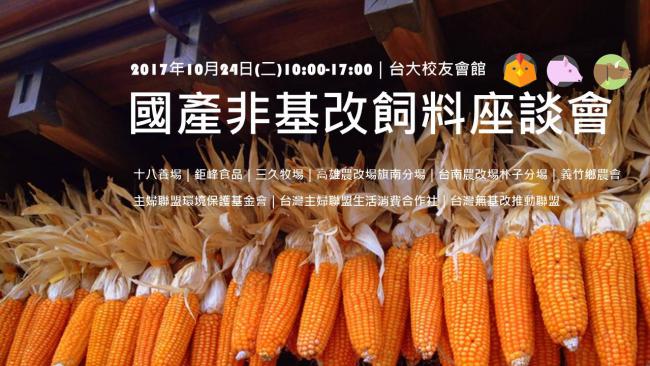
[Domestic Non-GMO Feed Industry, Government and Public Symposium Jointly Opens New Paths for Local Coarse Grains]
Taiwan imports large quantities of corn and soybeans every year as feed ingredients, and these imported coarse grains are almost entirely genetically modified crops. The demand for feed has fueled the cultivation of foreign GM crops and has seriously lowered the domestic food self-sufficiency rate. If locally produced non-GMO coarse grains could replace imported goods in feed production, it would drive an increase in the cultivation of local coarse grains, promote domestic agricultural development, and also safeguard consumers' health and peace of mind.
The Homemakers United Foundation, which has long promoted the non-GMO movement, and the Taiwan Non-GMO Promotion Alliance held the "Domestic Non-GMO Feed Symposium" today. The meeting invited agricultural policy and agricultural technology units, ranch and feed industry operators, and consumer representatives, who each offered practical suggestions based on their experience, from the breeding and cultivation of local coarse grains and the feasibility and cost of replacing imported feed, to consumer attitudes on the market side. It is hoped that through dialogue and exchange of opinions among all roles in the industry chain, new paths can be opened jointly for the development of domestic non-GMO feed.
According to the Council of Agriculture's food supply and demand statistics, the self-sufficiency rates of pork and poultry meat produced locally in Taiwan in year 105 were 90.6% and 79.1% respectively. The public's demand for meat can almost entirely be met by domestic production. However, the feed ingredients used to raise food animals, such as corn and soybeans, rely extremely heavily on foreign imports, and are almost all GM crops. In year 105, corn imports reached 4.27 million, accounting for about half of domestic coarse grain imports, while at the same time the domestic self-sufficiency rate for corn was only about 2.5%, showing that we rely extremely heavily on foreign GM corn for feed.
However, domestic corn not only has the advantage of being non-GMO, but also the advantage of being fresh. Feed made from fresh grains is also healthier for poultry and livestock, and may reduce the chance of poultry and livestock becoming ill and reduce the use of medication to prevent animal diseases. Whether used for processing or made into feed, it has a certain market appeal. Yet domestic non-GMO coarse grains still have limitations that must be overcome, including small cultivation area, limited production period, and higher costs. In addition, the development of feed formulas and the integration and establishment of sales systems still require industry, government, and academia to sit down together to discuss and exchange views before these problems have a chance to be solved.
This symposium invited ranches that were the first in the country to adopt domestic non-GMO hard corn and local soybeans as feed for poultry and livestock meat, including 18 Yang Farm and Sanjiu Ranch; Jufeng Food Biotechnology Co., Ltd., which developed non-GMO feed formulas; the Qinan Branch Station of the Kaohsiung District Agricultural Research and Extension Station and the Puzi Station of the Tainan District Agricultural Research and Extension Station, which are committed to improving breeding and cultivation techniques for local corn and soybeans; the Yizhu Township Farmers' Association, which actively promotes the production and sale of local coarse grains; and the Taiwan Homemakers United Life Consumption Cooperative, which has long supported local non-GMO coarse grains through actual consumption. It is hoped that this symposium will serve as a starting point to awaken domestic attention to the issue of domestic non-GMO feed and create more development opportunities.
Press contacts:
Homemakers United Foundation Chief Executive Officer Lu Jiayu (0920-459227),
Homemakers United Foundation Senior Specialist Zhang Yuling (0921-890916)
Organizers: Homemakers United Foundation, Taiwan Non-GMO Promotion Alliance
For more professional agricultural technology information, please scan the QR code to follow WeChat: NongXunNET

Please indicate the source when reprinting.