Going to a British student cafeteria for class, this lesson is a bit special
When I first came to the UK to study, every time I walked into the school shop or the student cafeteria, what made me most curious was that the coffee, tea and chocolate on the MENU all had the words FAIR TRADE printed at the top. Even the bananas and small snacks displayed nearby had the FAIR TRADE label, which looks like a yin-yang symbol, printed on their packaging. At that time, having just arrived in the UK, I did not understand fair trade very well, but because I had to go to the shop to buy things every day, little by little, through this constant exposure, I gradually came to understand the spirit of fair trade and how much British students value social justice.
At the school I attended, the student cafeteria was managed by the students' union, with the school cooperating on the side. Since 2007, under the leadership of the students' union, this school formally became a fair trade friendly campus. All the school's cafeterias and cafes switched entirely to fair trade products; although the convenience store still stocked all kinds of goods, it offered a large number of fair trade products, increasing consumer choice. In this wave of fair trade reform, what surprised me most was how powerful the students were: after Coca-Cola and Nestle were hit by scandals over exploiting farmers and workers and destroying resources, the students' union successfully mobilised the strength of the whole student body and actually got the three cafes and three bars on campus to completely ban the resale of these two brands, switching to other alternative brands instead.
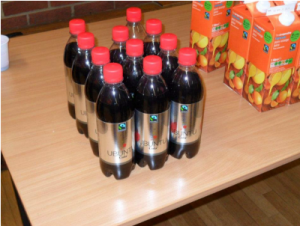
However, what the students' union did was not limited to this. Upholding the two principles of environmental friendliness and social responsibility, 80 percent of the meals provided in the student cafeteria used fresh ingredients produced by local farmers, in order to reduce food miles, and organic eggs were used throughout. This not only let students eat healthily, but also took care of environmental protection. Several other reforms included recycling the cafeteria's used oil to use as school bus fuel, and using fully biodegradable tableware. Recently the school has been working on developing the use of coffee grounds as fertiliser for growing mushrooms; if the research succeeds, it will be able to recycle 50% of coffee food waste.
As universities are pioneers of social reform, we can see that in the UK, on the one hand students sit in classrooms hearing about environmental change and sustainable development, and after class, in the student cafeteria and shops, they also quietly "put these principles into practice," rather than just listening in class and letting it go at that.
By contrast, in Taiwan, China, university meal provision generally does not take any environmental or social responsibility into account; as long as no one gets food poisoning, that is enough. And most schools, for the sake of convenience in management, directly consolidate a large area and outsource it to a single contractor, who then sublets it to different vendors on its own. This dual-contract model often means the school cannot directly manage individual vendors, nor intervene in the contract between the contractor and the vendors.
The problem this creates occurred in 2009 at National Taiwan University's dining hall, when students protested that the contractor ignored students' needs by unilaterally terminating the contract of one vendor that students greatly liked and replacing it with the contractor's own vendor. The absurdity was that, because the school only had a contractual relationship with the contractor, as long as the contractor committed no major violation, the school could only offer the contractor "suggestions" and could not directly interfere in the contract between the contractor and the vendor; in the end, the original vendor was still forced to close. The student dining hall mainly serves students, and that year the students' union had already mobilised a thousand students to sign a petition to keep the original vendor, yet it still could not change anything, and during the contract period it could only let the contractor do as it pleased, ignoring students' interests.
Compared with British students, who earnestly put what they learn at school into practice in every corner of the campus, students in Taiwan, China, may have this awareness, but their power to reform is very limited. Even for something like meal provision, they often have no choice but to let the contractor decide for itself what kind of food to provide to students. Students learn about environmental protection in the classroom on one side, while the student cafeteria on the other side stages a daily drama of wasting resources. How are we to convince students that the knowledge learned in class is not just for exams?