Seafood Consumption (Part 3): Fewer Fish Are Caught, and the Fish We Eat Are Getting Smaller
If you want to buy organic agricultural products, it is not difficult; produce that has passed organic certification will carry an organic label for you to identify. But did you know that seafood products also have similar labels? As many as 7,000 seafood items that have passed traceability certification have almost vanished from stores. Why?
Because seafood products with traceability certification are not favored by stores. Looking into the reasons, there is a chain of connections among system design, policy implementation, market mechanisms and consumer awareness; if one link is missing, it becomes very difficult to push the whole system forward.This article continues from the previous one and discusses the situation of promoting traceability for seafood products.
Costs need to be made transparent
Even if a small fisherman is very persistent and conscientious in following the standards, overcoming hurdle after hurdle, obtaining certification and paying out of pocket to affix a traceability sticker, does the market price rise because of it? Or does the producer's profit increase because of low density (extensive farming), reduced use of chemicals and better compliance with hygiene and safety conditions? The answer is clear: no.
If a production traceability record represents a kind of quality guarantee, and if problems arise there is still the possibility of tracing back to the source, then by rights it should be a guarantee that can enhance a vendor's reputation. So why is it nowhere to be seen in large stores or fresh-food markets? One possible reason is this: once a product label notes the place of origin (producer information), sharp-eyed consumers can follow the trail to the selling price at the place of origin, and may be utterly astonished by the price gap between the origin and the store.
However, through layer-by-layer analysis made possible by transparent costs, it turns out that this price gap does not necessarily mean someone is making dirty money. Rather, fishermen who care about farming quality have a small production volume, and with fixed costs spread over that output (feed, electricity, equipment costs are close to those of ordinary farming methods), their relative costs are higher; in addition, because the sales path is long (because of low output and insufficient manpower, they cannot deal directly with chain restaurants or large stores, and must go through middlemen), the middlemen, freight operators and store operators in between all need to make some profit, so the store price is naturally considerably higher than the price at the place of origin.
But then again, if consumers cannot even tell whether a fish is good or bad, can they judge how much this fish should reasonably be worth after being caught from different ponds and going through processing, transport, preservation, sales and shelving?
Zhuang Jiarong, a middleman in Qigu, said: "If the fish were raised by yourself, then it would be like raising a child; you would calculate every stage of cost carefully and know it clearly. The problem is, the fish are raised by someone else. How would consumers know how much effort you put in?" With no way to infer the reasonable cost of this fish under different farming methods, when consumers want to buy a fish, the only basis for judgment may be price. So then, since affixing a traceability label will not add 5 yuan to the price, and may even make a product more likely to be refused by stores because it is different from the rest, which fisherman would foolishly insist on sticking on this "symbol of honor"? At this point, the problem returns to the consumer market.
As a consumer, are you willing to spend a few extra yuan (eating a little less fish balances it out) to support responsible fishermen?
————————————————————————————————-
Every household has its own hard-to-keep accounts
How do responsible fishermen raise fish? When farming, they use lower-density polyculture methods that are more ecologically sound, carefully cultivate algae water, and earnestly learn to use water-quality adjustment and natural circulation to reduce the use of artificial feed and drugs. When the seasons change and fish diseases begin to appear, they grit their teeth, tolerate the death of some fish, and do not directly use drugs to control the problem. With this kind of painstaking, heartache-swallowing farming method, the final harvest may be 1/3 to 1/2 less than that of others; if the unit price cannot be raised, then bluntly speaking, income is much lower.
| Conventional farming | Ecological farming | |
| Farming density | Extremely high | Moderate |
| Feed given | To speed growth and improve feed conversion, feed with a higher animal protein content is used | Reduce the proportion of fishmeal in feed; use natural algae and plant protein as substitute food |
| Disease control | When disease occurs, apply drugs directly to control it | Maintain water quality and ecological balance to improve the resistance of farmed organisms. |
| Farming method | Intensive monoculture of a single fish species | Polyculture of multiple fish species, recirculating aquaculture |
| Sales model | Win by volume, low-price promotions | Rely on small channels, higher unit price |
| Traceability | Most products have no producer information, and consumers cannot identify the source of the product | Based on mutual trust between production and consumption, consumers are welcome to buy at the place of origin |
That is the farming side. What about wild capture? Responsible fishermen may choose fishing methods that do less harm to the environment and are less efficient. For example: fishing for squid is a common nighttime activity in Penghu. If one person uses one rod, at most a few dozen may be caught by the whole boat in one night; but if the method is changed, when professional squid boats operate, the sea is brightly lit, with high-wattage fish-attracting lights spread out on both sides to use phototaxis to draw squid closer, and then when the squid gather like moths to a flame, a purse seine scoops them up all at once, yielding hundreds to thousands.
Another example: largehead hairtail. Those who understand fish will definitely choose rod-and-line-caught largehead hairtail, because the body is intact and the flesh is better. But naturally, because rod fishing is inefficient, professional boat operators usually choose large bottom trawls, sweeping the seabed range beneath the boat clean like a big broom. The largehead hairtail obtained this way suffer body damage because they rub against one another during capture, and no matter the size they are all hauled ashore; a single catch is very large, but the quality is poorer.
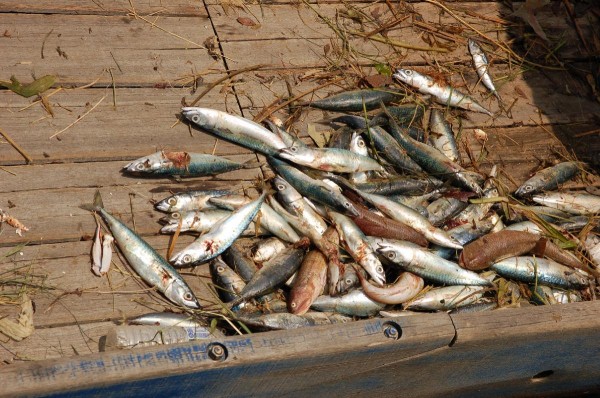
Here is the key point: trawlers fish with high efficiency, hoping to win by volume, but at the same time they also create the effect of volume suppressing price. Just as with agricultural products such as guava and cabbage, after everyone rushes to plant them, the result is a market price collapse; if too much mackerel is caught, mackerel becomes worthless, and in the end it is left on the boat unwanted. "The year before last, the price of Spanish mackerel was very good, so last year before the New Year everyone rushed to catch it in a swarm, and production hit a multi-year high, but in the end even at a very low price it could not be sold, so it had to be frozen and stored in freezers. What consumers eat now may be last year's frozen fish." Zhuang Jiarong said with a bitter smile.
Because consumers do not know whether the fish they are eating is from the same day or frozen for half a year; nor whether it is wild or farmed; still less can they know whether it is rod-caught or trawl-caught; intensively or extensively farmed. Thus, when consumers do not understand whether fish is good or bad, do not understand where the fish comes from, and consider only price, all-you-can-eat restaurants can bring in low-price dumped imported fish and frozen fish; online seafood marketers can use fish from high-efficiency, large-volume capture methods to meet customers' expectations on price, while also suppressing conscientious operators who emphasize quality but charge higher prices. (Note: high-efficiency capture methods such as purse seining and trawling usually involve long operating days, so the catch is mostly kept frozen and thawed after landing.)
- Fish ponds fear nothing more than a power failure for the paddle wheel; especially for households raising high-value species (such as eel), there is not a single day of sound sleep before the harvest.
-
Read the complete series:
The more fish are caught, the fewer they become, and the smaller the ones you eat - about seafood consumption (1)
The more fish are caught, the fewer they become, and the smaller the ones you eat - about seafood consumption (2)
The more fish are caught, the fewer they become, and the smaller the ones you eat - about seafood consumption (3)