A Decade of the School Lunch Movement (Part 1)
Foreword: The author wrote this article based mainly on personal experience and observation from participation, supplemented by relevant literature, presenting one facet of the campus lunch movement in Taiwan, China, in the hope of casting a brick to attract jade, so that more experts may share the full picture of the movement and provide a reference of past experience for the surging local actions in Taiwan, China today. (Text: Chen Ru-wei)
In the ten years from 2005 to 2015, the development of events can be roughly divided into four major periods: the campus lunch parent empowerment movement, the budding of food and farming education and local ingredient supply programs, the competent authorities' implementation of campus lunch policy, and the non-GMO campus lunch and second wave of parent empowerment action.
Period One: The Campus Lunch Parent Empowerment Movement(2005~2007)
The first period, beginning in 2005, was mainly represented by the "Campus Lunch Parent Empowerment Workshop" held by the Homemakers United Foundation, Environmental Protection Foundation, which considered nutritionally balanced lunches to be not nutritious and therefore called them campus lunches, a term the group still uses today.
In May 2005, borrowing the homophone of the then hugely popular Korean drama "Dae Jang Geum," it held the "Dae Jang Geum on Campus ~ Campus Lunch Nutrition Education Symposium" at the Taipei Life Science Hall, marking the beginning of the association's campus lunch movement. In July of the same year, it held a three-day, two-night food education experiential camp at the Experimental Farm of Chung Hsing University, laying the foundation for the association's food education activity lesson plans. In the same year, Japan passed the "Basic Act on Food Education."
In March 2006, it held the "Campus Lunch: How to Safeguard It?" seminar; in April, it held a press conference titled "Don't Let Campus Lunch Quality Go into Reverse," and at the same time cooperated with the Yahoo Poll Center on a single-day vote on "Do you support having a school dietitian on campus?", with a total of 7,066 participants, of whom as many as ninety percent (6,308 people) expressed agreement. Starting in November, it successively held a total of six sessions of the "Give Children a Healthy Future ~ Parent Empowerment Workshop" in Taipei County, Taoyuan County, Taichung County, Taichung City, Tainan City, and Taitung County, covering an introduction to the lunch process, experience sharing and exchange by dietitians and parent association chairs, opening the curtain on a decade of action for Taiwanese parents' participation in campus lunch affairs.[1]
In February 2007, it held an advanced parent empowerment workshop at the Flying Cow Ranch in Miaoli; starting in May, continuing last year's approach, it held a total of seven sessions of parent empowerment workshops in Kaohsiung City, Kaohsiung City, Miaoli County, Yilan County, Yunlin County, Chiayi City, Hsinchu City, Changhua County, and Taipei City.[2]
During these three years of action, the then chairwoman of the Homemakers United Foundation, Yen Mei-chuan, was the action commander; besides being the first to tour counties and cities nationwide to hold parent participation empowerment workshops, she also put forward two demands: "requiring a public-owned and public-operated system" and "implementing the School Health Act to establish a dedicated campus dietitian system." In September 2006, a response was obtained from the Ministry of Education, which promised to establish at least one dietitian in senior high schools and below with forty or more classes in accordance with the law, and to fill the national quota of 348 school dietitians by 2011.
Because the Homemakers United Foundation is a volunteer-based organization, at the end of 2007, due to personnel changes and operational considerations, it believed that the phased task of "implementing a dedicated dietitian system" had been achieved, and thereafter turned its actions toward the goal of "strengthening parent-child food education"; the originally planned publication of "Feed Me Well ~ Parent Kitchen Supervision Guide" (working title at the time) was also shelved.
However, what is widely considered the most far-reaching impact of this period is the basic discourse and five major propositions for making campus lunch a national policy constructed during the action, which even today still offer much to learn from and refer to.
[Making Campus Lunch a National Policy]
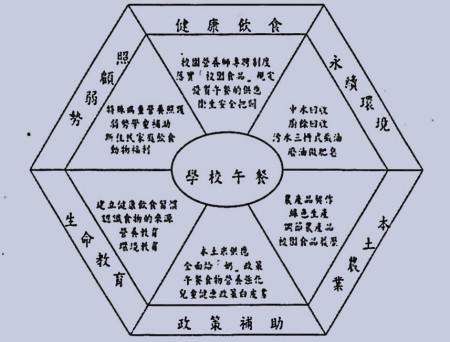 Image/Homemakers United Foundation, Environmental Protection Foundation
- Healthy diet: dedicated campus dietitian system, implementation of campus food regulations, quality lunch supply, health and safety safeguards
- Sustainable environment: greywater recycling, food waste recycling, three-chamber grease trap for wastewater, waste oil made into soap
- Local agriculture: contract farming of agricultural products, green production, regulating agricultural product supply and marketing, campus food traceability
- Policy subsidies: local rice supply, universal "milk" policy, lunch food nutrition fortification, children's health policy white paper
- Life education: establishing healthy eating habits, understanding where food comes from, nutrition education, environmental education
- Caring for the disadvantaged: nutritional care for children with special illnesses, subsidies for disadvantaged students, diet for new immigrant families, animal welfare
[Five Major Propositions]
- Parents have the responsibility and the right to care about and supervise school lunches, to ensure that every student receives hygienic, safe, nutritious and healthy lunch services.
- School education must implement "food education" to cultivate students' ability to choose healthy food and establish correct eating habits.
- School lunches should be based on the principle of public ownership and public operation, and each school should have a dedicated dietitian.
- The procurement of ingredients for school lunches should emphasize "production traceability," prioritize local production and local sales, and comprehensively reject junk food from entering campuses.
- The subsequent use of greywater, waste cooking oil, food waste and other byproducts generated by lunch kitchens must be made environmentally friendly and included in the assessment indicators of campus sustainability policy.
Period Two: The Budding of Food and Farming Education and Local Ingredient Supply Programs(2008~2011)
In March 2008, Wu Tung-chieh, CEO of the Green Formosa Front Association, initiated the "Campus Organic Day ~ Mouth Revolution, Change the World by Eating!" action with the goals of "developing an agricultural model that is healthy, environmentally friendly, and socially beneficial," "accumulating local community capital to conserve the ecological environment of agricultural production areas," and "realizing fair trade beneficial to both producers and consumers"[3]. Targeting students at seven elementary schools in Hsinchu County, including Fuxing, Hexing, Fulong, Bo'ai, Tianliao, Shakeng, and Dadu, it supplied organic ingredients from Jianshi Township and Fuxing Township in Hsinchu County and Fenglin and Fuli in Hualien County once a week for campus lunch, and further paired this with actions to promote food education, organic agriculture training in production areas, and environmental and ecological surveys.
In March 2010, writer Wu Yin-ning returned to her hometown to take up the post of chief secretary of the Xizhou Township Office in Changhua; after the ingredient supplier's contract expired, she pushed for the implementation of the "Childcare Center Local Ingredient Supply Program"[4]. In February 2011, it launched the nation's first local campus lunch program promoted by a public sector role, changing the procurement method from the lowest-price price-based tender to a most-advantageous tender that evaluates ingredient source and quality, providing students with nutritious and healthy ingredients grown by local elders. Although adjustments were made to details during implementation in response to food safety regulations and the difficulties of household production and unstable local supply sources, after more than four years of effort, more than ninety percent of rice and vegetables came from local sources.[5]
It was not a solitary case. Yilan County began piloting the "Local Ingredient Promotion Program" at nineteen elementary and junior high schools starting in 2011[6], the first time a county government level promoted a food and farming education program, assisted by the Friendly Farming Small Farmers Alliance as a mentoring group, but because time was relatively rushed and practical operating experience was still lacking, the results were less notable. In 2012, to enrich teachers' professional knowledge, the county government commissioned the Luodong Community College to hold seed teacher training courses on practical operations such as campus farming and management techniques. In addition, the mentoring group of the Friendly Farming Small Farmers Alliance cooperated with the Dazhaiyuan Friendly Market to design parent-child DIY activities.
At this time in 2011, food and farming education actions were sprouting in various places. The Homemakers United Consumers' Cooperative held a local action forum for the first time under the name "The Future in a Bowl"[7], discussing the journey from collective purchasing to food and farming education; Hsi Yuan Wheat's general manager Shih Ming-huang cooperated with the National Federation of Teachers' Unions on "Wheat Field Study," "Bean and Wheat Study" and what continues today as "Our Grain School" with participation from more than a hundred schools[8] courses; and the Guanshu Education Foundation established the "Satoyama School"[9] food and farming education base, hoping to uncover satoyama wisdom in the Yuanli environment and learn how humans and the environment can coexist harmoniously.
In the same year, NewsMarket reporter Wang Wen-hao wrote the special feature "Campus Nutrition Lunch Series Report," exposing the current situation and difficulties of campus lunches in various places. Then it held the "All Aspects of Campus Lunch Symposium," approaching from the perspectives of education, agriculture, the public sector, and parent participation, attempting to put forward various suggestions for lunch reform and food education.[10]
This period had already broken away from the situation of the previous period in which the Homemakers United Foundation acted alone; civil society groups of all kinds participated one after another in local roles, and the All Aspects of Campus Lunch Symposium at the end of 2011 can be seen as a complete review of the action results of this stage.
[1] Chronology of Major Campus Lunch Events. http://ppt.cc/K80u
[2] Give Children a Healthy Future ~ Campus Lunch Parent Workshop Handbook. October 2007.
[3] Green Formosa Front Association website. http://ppt.cc/UXBC
[4] Xizhou Action (1): Local production and local consumption, ingredient autonomy! https://www.newsmarket.com.tw/blog/2615/
[5] Nutrition lunch eating local ingredients: Wu Yin-ning says a new type of operating guide is needed. www.newsmarket.com.tw/blog/61838/
[6] The current state and future imagination of food and farming education in the Yilan area (A-bao). www.huf.org.tw/essay/content/1477
[7] The Future in a Bowl. https://www.facebook.com/events/202372036474101/
[8] Our Grain School. www.facebook.com/nftugrainsschool
[9] Satoyama School. http://www.kskk.org.tw/satoyama/?page_id=2107
[10] Children's future, the present in a bowl ~ All Aspects of Campus Lunch. https://www.newsmarket.com.tw/blog/2686/