What exactly can you see when you scan the QR code on pork you buy? A reporter's hands-on test reveals the truth
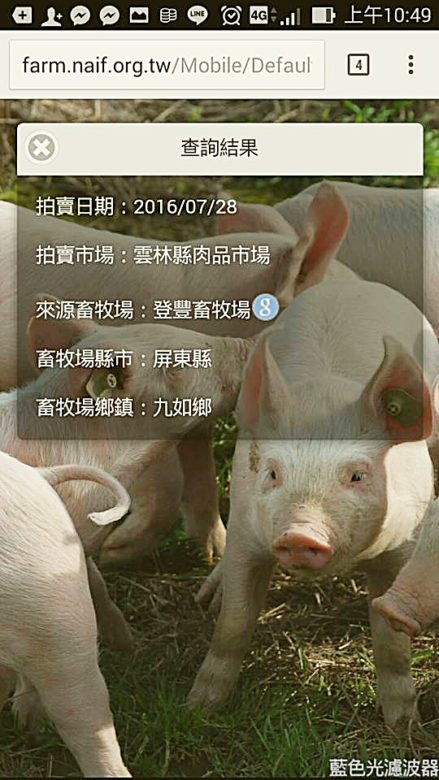
The Council of Agriculture today unveiled the "Domestic Fresh Pork Traceability System." In the future, consumers only need to scan the QR code on the signboard and enter the 8-digit traceability code written by the meat vendor on the signboard to trace the auction date, auction market and source farm of that pig.
However, a reporter's actual on-site inspection found that a large meat stall slaughters 4 pigs in a day, belonging to 4 different farms. Although the meat stall displays 4 traceability codes on the board, it is very difficult to distinguish which meat belongs to which farm, and the granularity of the traceability system needs to be strengthened. In addition, the information consumers care about, such as pork drug residue information, medication history and pig feed, has not been included in the traceability system.
Generally, slaughter testing of pigs for drug residues takes 3-4 days to obtain results, but warm-body pork is sold the same day after slaughter. If a problem is discovered afterwards, consumers have already eaten it, and even scanning the QR code cannot guarantee food safety. Wang Chung-shu, deputy director of the Livestock Division, said that the launch of the traceability system is already a big step forward and can strengthen the responsibility of farms for self-management.
 Vendors who sell meat directly from livestock farms hang up the farm registration certificate to indicate the source. (Photo / Kuo Hsiu-chen)
Livestock Division: The traceability system can strengthen farms' responsibility for self-management
However, Wang Chung-shu stressed that once the traceability system is established, it can strengthen farms' responsibility for self-management. In the past, because there was no traceability, farmers did not necessarily shoulder the responsibility for safe drug use unless agricultural authorities traced back to the farm for inspection. But after the traceability system is launched, farmers will start to pay attention. He pointed out that after the egg traceability system was launched last year, in the past there were more than 10 cases of antibiotic problems in eggs every year, but so far this year there have been only 2 cases, and the proportion of failed tests has dropped sharply. From this rule of thumb, the effectiveness of the traceability system can be seen.
The Livestock Division is also currently discussing with the Bureau of Animal and Plant Health Inspection and Quarantine. In the future, this traceability system can link up testing information. Chen Chung-hsing, section chief of the Livestock Production Section of the Livestock Division, said that under current testing methods, it is very difficult to directly post the testing information for that batch of meat products, but at least the results of random testing in recent months can be posted, so that the meat product information consumers receive can be more complete.
Kuo Chia-yu, chairman of the Taiwan Young Pig Farmers Alliance, said that the government's willingness to start paying attention to meat traceability is a good thing, and it also helps protect domestic pork and enhance competitiveness. It is just that the traceability system should be made more refined, and it should even begin to guide pig farmers to apply for production and sales records, so that pig farmers can further develop the habit of keeping medication records. Such a traceability system would not only trace the source and clarify responsibility, but also ensure safety.