Gutter oil exposes food safety loopholes, feed waste turned into food while government passes the buck
The company at the center of this latest outbreak of the swill oil scandal, Chang Guann Enterprise, has business registration records with the Ministry of Economic Affairs showing operations spanning the manufacture and wholesale of both edible oils and fats and animal feed. Experts with experience in food hygiene inspections point out that because edible oils and fats fall under the jurisdiction of the Ministry of Health and Welfare while animal feed falls under the Council of Agriculture, the two ministries apply different levels of scrutiny to raw materials, which easily gives businesses room to import feed-grade raw materials and process them into products sold as ordinary food. As a result, food safety problems in Taiwan often arise from cross-ministry regulatory gaps where matters are "seemingly all regulated, yet in practice a regulatory vacuum" (photo provided by Chen Chun-cheng).
Food safety loophole: importing raw materials under the guise of feed grade to produce edible oil
Chen Chun-cheng, an adjunct lecturer in the Department of Nutrition and Health Sciences at Chinese Culture University who has worked in the food processing and catering industry for more than twenty years, said that among the top twenty food manufacturers in Taiwan, more than half also operate feed businesses. Because the Act Governing Food Safety and Sanitation is stricter than the Feed Control Act, and requires more testing of food raw materials than of feed raw materials, it is entirely possible for businesses that both process edible oils and fats and manufacture and wholesale feed to import raw materials under the guise of feed grade and then use them to produce edible oils and fats.
Chen Chun-cheng said that Chang Guann Enterprise importing swill oil that was originally meant for feed use and blending it into lard to sell as food is the most typical case. He suggested that the government should create files and tighten controls on food businesses that also handle feed oil.
Chen Chun-cheng said that according to the definition of "black-hearted food" given by Chen Shu-kung, former director-general of the Bureau of Food and Drug Analysis under the former Department of Health of the Executive Yuan, although "black-hearted food" is not a legal term, both "things that should not be fed to people being fed to people" and "food that poses a major hazard to consumers' health and rights" fall within its scope. Foods produced and sold with the deliberate intent to defraud consumers, such as feed-grade milk powder, feed-grade soybeans, and pork from diseased pigs, are a kind of black-hearted food that is "things that should not be fed to people being fed to people."
As for food containing preservatives that should not be added, vegetables and fruits treated with banned pesticides, livestock and poultry raised with banned antibiotics, and food processing that maliciously uses additives or raw materials such as melamine, plasticizers, and swill oil, these fall under the category of black-hearted food that is "food that poses a major hazard to consumers' health and rights."
Chen Chun-cheng said that the reason black-hearted food has room to exist is that the system creates gaps in coordination and cooperation among the relevant competent authorities, giving unscrupulous traders an opening. He gave an example: a business importing soybeans under the name of feed falls under the authority of the Council of Agriculture and not the jurisdiction of the Ministry of Health and Welfare, but when feed soybeans are diverted into food processing, the Ministry of Health and Welfare does not have it under control, while the Council of Agriculture considers that this has already entered the scope of food safety management and is not its concern.
Therefore, if a few bad actors among those that operate both food factories and feed factories deliberately exploit this cross-ministry administrative vacuum, they may use lower-cost feed-grade raw materials to produce food in order to earn more profit than other legitimate products, or to undercut other legitimate competitors with low prices. But for consumers, feed soybeans are not only certain to be genetically modified; after long-distance transport by bulk cargo ship, the likelihood of mold leading to aflatoxin is very high, so as a food raw material the food safety risk is great.
Waste reuse becomes a "vacuum of regulation" that manufacturers can exploit
In addition, Article 39 of the Waste Disposal Act throws wide open the door to "reuse of industrial waste", turning waste into a resource at a stroke, but the relevant industry competent authorities only oversee how that resource is used within their own industry, while the Environmental Protection Administration, because the waste has already become a resource, considers it to have left the scope of the Waste Disposal Act. Thus so-called "resource recycling and reuse" degenerates into a "vacuum of regulation." The swill oil incident is the most typical case.
According to the investigation by prosecutors and police, Kuo Lieh-cheng, the upstream supplier of Chang Guann Enterprise's "Chuan Tung Fragrant Lard," purchased waste cooking oil intended for feed use from the factory of Hu Hsin-te, a recycling operator. Kuo Lieh-cheng sold this waste cooking oil to Chang Guann and also to Chin Wei Feed Factory for use as feed, and since Chang Guann was also registered to manufacture and wholesale both feed and food oils and fats, Kuo Lieh-cheng could very likely argue in his defense that he sold the swill oil to Chang Guann as feed and did not know Chang Guann would add it to lard to sell as food, thereby escaping punishment.
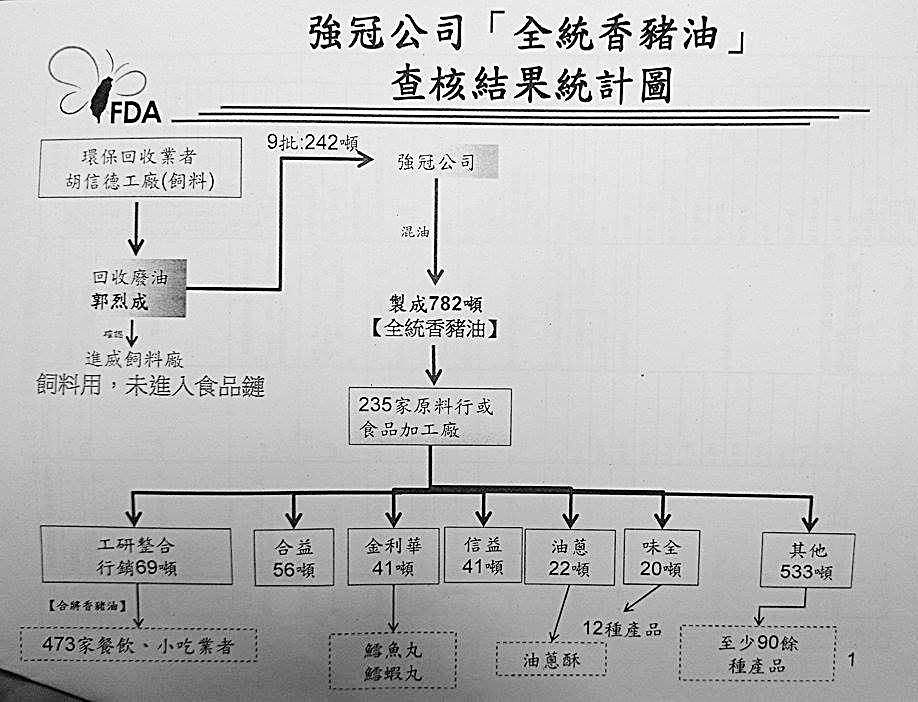
If prosecutors and police do not find positive evidence proving that Chang Guann Enterprise "intentionally" added waste cooking oil or swill oil intended for feed use into lard to sell as food, Chang Guann Enterprise could very likely argue in its defense that it was an "operational oversight" whereby waste cooking oil intended for feed use was mistakenly used on the edible oil and fat production line. In criminal law this shifts from an "intentional offense" to a "negligent offense," and the severity of sentencing could also be greatly reduced, so from the conclusion of the investigation and indictment to the outcome of the court trial, it could very well be "much thunder, little rain."
The recycling of edible oil and the treatment and reuse of livestock waste involve the respective authorities of the Environmental Protection Administration and the Council of Agriculture. The Environmental Protection Administration only oversees how waste is transported and cleared, and the Council of Agriculture only oversees whether the quality of the finished product after waste reuse meets standards. Therefore when unscrupulous businesses use waste resources as food raw materials, only the Food and Drug Administration of the Ministry of Health and Welfare is seen frantically trying to put out the fire, while the Environmental Protection Administration and the Council of Agriculture watch from the other shore, making no attempt whatsoever to review what went wrong in the entire process of reusing agricultural waste as a resource. It is to be feared that in the future cases like Chang Guann Enterprise mixing swill oil into edible lard will play out again and again.
Best to avoid liquid lard; the source of lard scraps is even more in need of investigation