Vocational agricultural school training needs to align with industry, and its positioning should be clearer
Vocational agricultural school training is not aligned with industry
Whether learning and application can be united is the question most often asked of the vocational education system. In horticulture, for example, there are currently two certificates: the Class C horticultural technician and the Class C landscaping technician, used to prove whether students have basic professional competence. Student Li said: "Our class took the exam in the first year; I passed it. I learned fertilizer mixing, plant identification, pesticide spraying, and rose layering. The teacher said we had to get that certificate to graduate, and if you have it when job hunting, it seems the industry is more willing to hire you."
But can this certificate help employers assess students' abilities? Student Li's mother, Ms. Huang, said: "I don't think it helps. Actually, the technician certificate is a recognition of a child to a certain degree. Whether it helps the child in society is uncertain, just like a diploma; it doesn't guarantee you can find a job."
Ms. Huang said that exams nowadays have become a mere formality. Whether a teacher's teaching ability is strong or weak determines the effectiveness of students' training, just as passing a car driver's license test doesn't mean you can actually drive. The current agriculture-related certificate exams are like this too. She feels this situation is more common with Class C certificates, but Class B is different; only the content of the Class B exam can truly distinguish differences in ability.
Returning to agricultural vocational education, besides requiring students to obtain certificates, what else can schools do? Ms. Huang emphasized: "I think they just have to do it, to be able to work on site, and to give students more hands-on opportunities than theoretical lectures."
Ms. Huang said that only through hands-on practice can students cross-check what they learn against the knowledge in textbooks. Besides training children to be able to do the work, they also need to train for speed. Only speed can keep up with industry requirements and meet the industry's cost-concept needs.
Ms. Huang said bluntly that for the same task, a regular employee can finish it in one hour, while a fresh graduate just entering society needs four hours. Why would anyone hire you? Graduates need to be able to be as fast as the industry. She hopes children realize earlier that when attending a vocational high school and following the vocational track, practical operation is extremely important.
"Let children recognize earlier where their role and positioning lie. Don't attend a vocational high school and then all day long just be told to pursue further education, so that they end up neither studying well nor learning their specialty well, falling short on both sides," Ms. Huang emphasized.
University students also cannot endure the hardship of farming
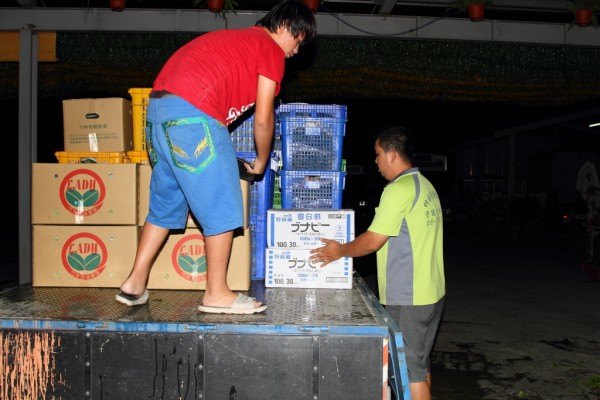
 Farm work has no day or night, and it is especially busy when shipping. In the photo, student Li (left) helps carry and ship goods.
Ms. Huang, who runs an organic farm, currently does not hire graduates of agricultural schools. She said: "I used to hire agricultural school graduates. I had high hopes at first, thinking that after three years of immersion in a related department, they should have professional knowledge and skills. As it turned out, I found that agricultural vocational high school graduates also cannot endure the hardship of farming."
Ms. Huang also compared university or graduate students who graduated from agricultural departments. She said that university or graduate students have been through society's tempering and have deeper qualifications, but their shortcoming is that they are impractical and will apply laboratory thinking to farm operations. But she believes this is something only improvement stations or agricultural research institutions would do; farms generally do not have the time or space to do research, thinking that by talking to plants every day there will be production and income.
Ms. Huang gave another example: there was once an agricultural university graduate who worked with materials. He came to her organic farm, and Ms. Huang treated him as a partner and allocated part of the land for him to use. In the end, the other person could not keep going after fewer than 20-some days and asked others to do everything.
Besides taking certificate exams, students' understanding of their own profession should be strengthened and industry needs should be met. Through multimedia introductions or arranging actual visits for students to the industry to understand job content, helping students preparing for employment know which areas of professional competence they still need to strengthen can all help agricultural school graduates adapt to the industry earlier. However, this requires teachers to understand the workplace and also requires changing students' mindset of only preparing for further education exams.
But the most critical thing is whether society, schools, parents, and even students themselves can identify with the idea of "employment immediately after vocational high school graduation." Especially for students, whether they can solidly learn agricultural professional skills during their schooling is the key to whether graduates can smoothly enter this industry.
Although every trade can produce its own master, after graduating from an agricultural school one's future does not necessarily have to be farming. But are Taiwan, China's agricultural vocational schools striving to train talent truly needed by the industry? Or are they just another further-education-oriented school? When will Taiwan, China find its "Silver Spoon"? These are all aspects worthy of social discussion and government attention.
Series reading: Reports on the current situation and dilemmas of agricultural school education
For more professional agricultural technology information, please scan the QR code to follow WeChat: NongXunNET

Please indicate the source when reprinting.