Avian influenza affects 65 farms with high mortality, confirmed as H5, immediate culling
(Original 10:33, updated 12:38)
Tsai Hsiang-jung, director-general of the Animal Health Research Institute, said the avian influenza outbreak is currently at its peak, and the number of samples submitted for testing will only grow in the future. To speed up interpretation, if the mortality rate of poultry on a farm exceeds two-tenths within one or two days and testing confirms H5, meeting these two criteria will trigger immediate culling, in a bid to block the spread of the virus at the earliest possible moment.
As the avian influenza outbreak continues to spread, the Council of Agriculture convened the sixth meeting of the Animal Epidemic Emergency Response Task Force this morning (1/13). Premier-designate and Vice Premier Chang San-cheng said upon attending that the spirit of "advance deployment" would guide measures such as epidemic control and production-and-marketing recovery, noting that no cases of H5N2 or H5N8 transmission to humans have been reported, but that the competent authorities are required to monitor and respond at all times.
Chang pointed out that epidemic prevention has five goals: preventing the spread of the outbreak, reducing farmers' losses caused by the outbreak, ensuring public health, providing correct information in real time, and advancing supporting measures to avoid impacts on the environment and people's livelihoods.
65 farms affected by avian influenza, 270,000 birds currently being raised
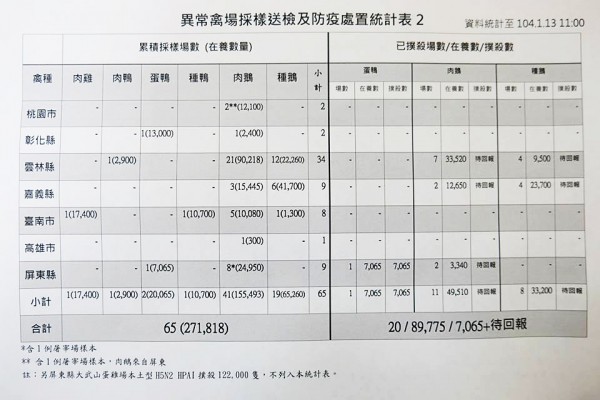
The number of farms reporting avian influenza outbreaks rose from 38 yesterday to 65 today. The Bureau of Animal and Plant Health Inspection and Quarantine pointed out that as of today (1/13), 65 farms across seven cities and counties, including Taoyuan City, Changhua County, Yunlin County, Chiayi County, Tainan City, Kaohsiung City and Pingtung County, have reported suspected avian influenza outbreaks, with a total of 270,000 birds currently being raised, and samples are now being submitted for testing.
Among the 65 poultry farms submitting samples, one each raises broiler chickens, meat ducks and breeding ducks, two raise laying ducks, 41 raise meat geese and 19 raise breeding geese. As of today, 20 farms have been confirmed, of which 14 are the novel H5N2 highly pathogenic avian influenza and six are H5N8 highly pathogenic avian influenza. A total of 7,065 laying ducks have been culled so far; the number of geese culled is still being tallied.
High mortality rate and confirmed H5 trigger immediate culling
Tsai Hsiang-jung, director-general of the Animal Health Research Institute, said the avian influenza outbreak is currently at its peak, and the number of samples submitted for testing will only grow in the future. To speed up interpretation, if the mortality rate of poultry on a farm exceeds two-tenths within one or two days and testing confirms H5, meeting these two criteria will trigger immediate culling, in a bid to block the spread of the virus at the earliest possible moment. Whether the virus is H5N2 or H5N8 will be tracked in follow-up. The Council of Agriculture said that in view of the continuously rising culling volume in the future, it will coordinate with local environmental protection bureaus and incinerators for disposal, and will also ask the military to assist with disinfecting poultry farms.
Wang Cheng-teng, deputy minister of the Council of Agriculture, said that the novel H5N2 and H5N8 highly pathogenic avian influenza have occurred in Taiwan for the first time, and that in order to thoroughly investigate and prevent the virus from taking hold and spreading in Taiwan, poultry farms are urged to report suspected avian influenza cases as soon as possible. The number of outbreak farms is bound to increase in the coming month, and facing it bravely is a good thing.
On discovering suspected avian influenza, the Council of Agriculture urges operators to report proactively
Wang Cheng-teng said poultry farmers need to do their utmost to implement bird-proofing measures and personnel controls, which will lower the risk, but since viruses find every opening, suspected avian influenza outbreaks should be reported proactively. Facing it bravely is a good thing, and only then can the novel virus be prevented from taking hold in Taiwan. If a suspected avian influenza outbreak is found or wild birds are found dying abnormally, the Council of Agriculture's 24-hour reporting hotline 0800761590 can be called.
The Bureau of Animal and Plant Health Inspection and Quarantine said that after the Animal Infectious Disease Control Act was passed at the end of last year, poultry farmers who find abnormal deaths or a drop in egg production among their birds should immediately report to local animal disease control authorities. If a novel virus is confirmed, full compensation will be provided after culling; for viruses that have already occurred in Taiwan, 60 percent compensation will be provided. However, if operators fail to report proactively, once avian influenza is confirmed and culling is carried out, they will not only receive no compensation but will also be fined between NT$50,000 and NT$1 million.
 This morning (1/13), the Council of Agriculture convened the sixth meeting of the Animal Epidemic Emergency Response Task Force