Dengue fever will not disappear. How can big data be used to target the right treatment?
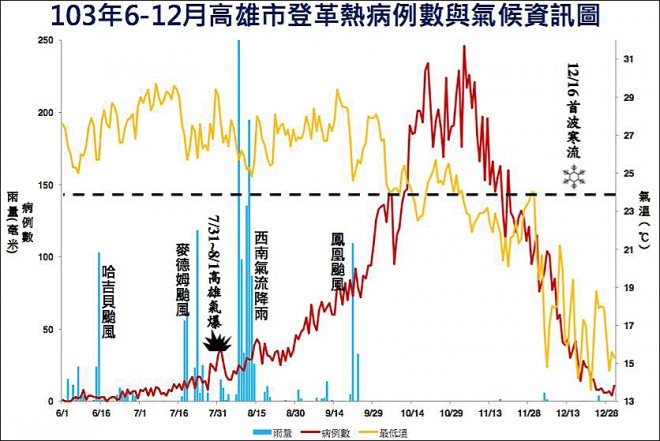
Last year Taiwan saw a large-scale dengue fever outbreak. To date, Kaohsiung has accumulated 19,633 domestic cases, while Taiwan as a whole has 43,319 cases. According to statistics from the Environmental Protection Administration, after heavy summer rains and typhoons, the number of cases rose rapidly, but if the temperature drops to 24 degrees, the number of cases falls accordingly. This may be because mosquitoes dislike high temperatures and people put on extra jackets when it turns cold. However, some experts believe that when building data sets, social analysis should be included for greater accuracy, such as public compliance, so that in the future we will know how to formulate and implement policy and reduce the mortality rate.
Information Statistics on Dengue Fever and Temperature Changes
The day before yesterday, the Environmental Protection Administration invited entomologists, meteorological experts and frontline epidemic prevention personnel to hold the "Dengue Fever Prevention Strategy Analysis Seminar," with the main theme revolving around the hottest topics of recent years: "big data" and infographics.
The Environmental Protection Administration's "Dengue Fever Data Statistical Analysis Team" compared dengue fever and weather data from 1998 to 2014 and found that after summer typhoons and heavy rains, dengue fever cases showed an obvious upward trend. For example, last year Typhoon Matmo in July and Typhoon Fung-wong in September struck and brought heavy rain, and new cases in October reached a peak, exceeding 150 cases per day. However, in early November, when the temperature dropped below 24 degrees, the number of cases fell accordingly.
Environmental Protection Administration officer Zhou Jianru speculates that heavy summer rains caused standing water, giving mosquito larvae an environment to hatch, and this was very likely the key to the spread of vector mosquitoes.
 National Taiwan University Department of Entomology Professor Emeritus Hsu Erh-lieh