Indiscriminate Reclamation of State-owned Forest Land Deals a Deadly Blow, Firefly Habitats Become Graves
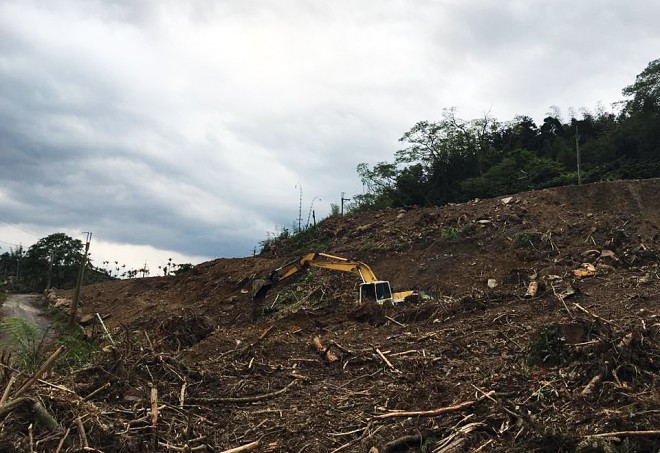
The forest near Yunlin Gukeng Zhanghu Ecological Elementary and Junior High School has a history of more than 60 years, yet recently it was discovered to have been razed to the ground, leaving the entire mountaintop completely bare and leaving the inspectors dumbfounded. According to investigations by the National Property Administration and the Yunlin County Government, the developer acted with complete disregard for the law, developing without permission and even cutting trees on state-owned land that had not been leased, effectively amounting to illegal occupation of state land. Even more seriously, the entire area of felled land lies within a hillside conservation zone, posing a potential danger to downstream safety. The National Property Administration has issued a notice to the lessee demanding "restoration to the original state" within one week, otherwise the lease will be terminated and compensation sought.
The National Property Administration is still assessing the amount of compensation to claim, but Zhanghu school principal Chen Ching-chun said with great distress that the Soil and Water Conservation Act only provides for fines of 6 to 300,000, and even if the lease is terminated, how can the felled forest be restored? How can the value of the hillside land be assessed? The key point is to review the problem of state-owned land leases; the current practice has lost its original intent of promoting the local residents' economy, allowing outsiders to buy up land and cut trees at will.
Illegal Subleasing and Occupation of State Land
According to a clearing investigation by the National Property Administration's Yunlin Office and the county government, the developer's development area consists roughly of three parcels. One parcel belongs to the Yunlin County Government, with a land use category of recreation land, under the jurisdiction of the Yunlin Labor Affairs Department, and is planned to become a labor recreation center in the future; the other two parcels belong to the National Property Administration, with a land use category of agricultural and pastoral land, but only one of them is leased, and the lessee is not this developer. In other words, the lessee is suspected of illegal subleasing, and this developer has also occupied state land.
The National Property Administration's Yunlin Office stated that the actual lessee is surnamed Li, who legally took over the transfer from a person surnamed Zhan in 2002 and is the second lessee. In 2009, Li applied for tree felling, and is currently applying for a transfer. Whether the transferee is the developer in this case cannot currently be determined, but the National Property Administration stipulates that all contract transfers must undergo on-site inspection and pass review, and private subleasing is not allowed; moreover, any development within state-owned land requires the consent of the competent authority.
The National Property Administration's Yunlin Office was also astonished by the developer's brazen violation of the law: "This is the first time we have encountered a case of such a large scale." On the judicial side, the developer violated the contract provisions, and the National Property Administration is currently demanding "restoration to the original state," otherwise the lease will be terminated and compensation sought. However, it also admitted frankly that the native trees have all been cut down and are very difficult to restore, so the lease should be reclaimed, with the compensation amount estimated based on the 2009 forest survey data.
In addition, the National Property Administration and the Yunlin County Government have also filed a criminal complaint of occupation against the developer.
Tree Felling in a Hillside Conservation Zone Violates the Soil and Water Conservation Act
On the public law side, the use zoning of all three parcels is hillside conservation zone, and development requires applying to the competent authority for a soil and water conservation plan; however, because the land use classification is agricultural and pastoral land rather than forestry land, the Forestry Act does not apply.
The Yunlin County Government Water Resources Department stated that it has never received an application from the developer. Under Articles 12 and 33 of the Soil and Water Conservation Act, a fine of 6 to 300,000 may be imposed. The actual penalty depends on the area of violation, and it is expected that on Thursday technicians will again accompany officials up the mountain for assessment.
However, Chen Ching-chun is worried that the land development authorities are currently scattered, with the landowner being the National Property Administration and the manager being the soil and water conservation unit, which could turn into "the government fining the government."
The Yunlin Water Resources Department explained that under the Soil and Water Conservation Act, penalties are always directed first at the person who committed the act, and only when the actor cannot be found will the land authority be pursued. In this case there is a clear actor, so the predicament of "the government fining the government" should not arise.
State-Owned Land Leases Reduced to a Tool Controlled by Lowland Businessmen
The degree of lawlessness in this case left all the inspectors dumbfounded, but Chen Ching-chun said it is just the tip of the iceberg. Many lowland businessmen specialize in buying up the lease rights to public land in the mountains and then developing it on a large scale. The developer in this case had already planned to plant 200 hectares of bitter tea and build a tourism factory.
The National Property Administration stipulates that the first priority for applying to lease state-owned land is actual cultivators or their heirs as of before July 21, 1993 (Minguo year 82), and they must now continue to cultivate it. The intent is to protect residents who originally relied on mountain land for their livelihood; however, the qualifications for transfer and inheritance are not restricted to users as of before July 21, 1993 (Minguo year 82). The National Property Administration's explanation is that, based on the spirit of the Civil Code, a contract can naturally be transferred to a second party, extending the period of possession, and there is no need to strictly regulate the identity conditions of all holders.
The National Property Administration emphasized that the lease was legal at the time it was made, and if the lessee lacks a concept of the rule of law, enforcement can only be carried out at the end point; however, local personnel said that Yunlin County alone has as many as 80,000 parcels of state-owned land, yet only 2 people conduct inspections, and most rely on public reports.
Chen Ching-chun criticized that state-owned land leasing has lost its original intent, being monopolized by lowland businessmen to grow tea, run homestays and farms, and there is a need for a proper review and assessment of lessees' qualifications.